
Abraham Newman of Georgetown University Speaks on “Weaponized Global Networks” as Economic Security Global Forum Weeks Head Toward Conclusion
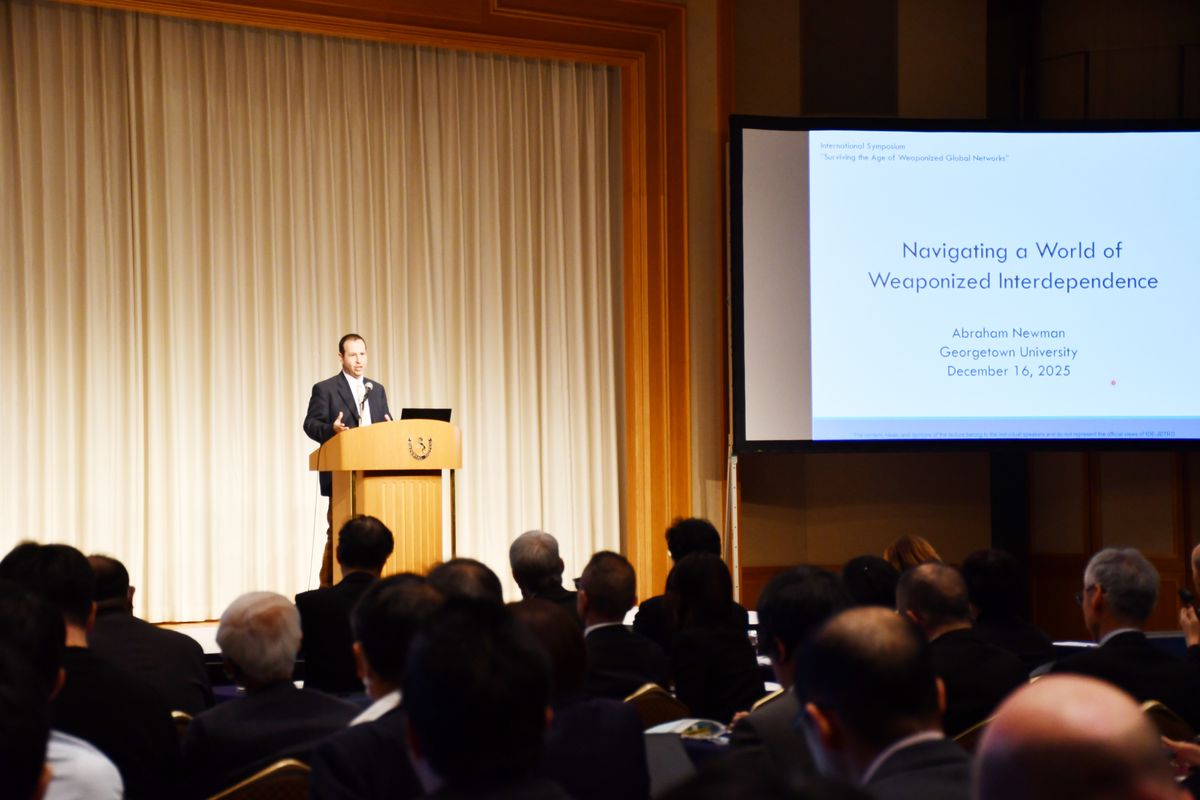
Prof. Abraham Newman of Georgetown University speaks at an international symposium on “weaponized global networks” in Tokyo on Tuesday.
2:00 JST, December 17, 2025
A symposium on “Surviving the Age of Weaponized Global Networks” was held in Tokyo on Tuesday as the Economic Security Global Forum Weeks moves toward its close this week.
During the weeks, with the Tokyo Economic Security Forum on Monday as a central event, government officials, scholars and businesspeople from around the world discussed a wide range of themes including artificial intelligence, supply chains and cyber security.
A total of nearly 30 events will have been held during the Global Forum Weeks, which began in September.
‘Weaponized global networks’
The symposium on “Surviving the Age of Weaponized Global Networks,” organized by the Japan External Trade Organization’s Institute of Developing Economies, consisted of speeches by three renowned researchers from Japan and abroad, followed by a panel discussion.
Prof. Abraham Newman of Georgetown University in Washington gave a speech titled “Navigating a World of Weaponized Interdependence.”
He posited that a large number of global networks in the realms of communications, production and finance, among other areas, can be said to run the global economy and are often highly concentrated or centralized. He further stated this web of centralizing power has been built for the advantage of global powers such as the United States, China and the European Union.
Newman said that U.S. President Donald Trump is using networks as tools “for a very different set of objectives,” namely domestic political goals and deconstructing the liberal rules-based order. He said that unlike in the past, the “tools are increasingly used for bargaining leverage,” and as a result, “economic coercion is being used … to get companies and countries to barter for exemptions from this pressure.”
However, he also said that a significant challenge for which the United States “is not prepared” has emerged, as a “proliferation of players” are also using global networks for power.
For midsized countries, which are “caught between the U.S., China [and] the European Union,” Newman emphasized the need for “international cooperative efforts to protect the world from the bad consequences.” They can “diversify their exports and imports” to “neutralize the threat of coercion.”
The two other speakers, Mireya Solis, director of the Center for Asia policy studies at the Brookings Institution, and Satoshi Inomata, senior research fellow at the Institute of Developing Economies, also gave lectures, after which a panel discussion was held.





Most Read
Popular articles in the past 24 hours
-

Japanese Shipping Giants Halt Strait of Hormuz Transit as Iran Co...
-

U.S. Launches Attacks on Iran: Avoid Escalation of Conflict by An...
-

Sawtooth Roof Factory Stands as Monument to Ashikaga Textile Hist...
-

Parents of Japanese Teen Shot in U.S. Strive for Gun Control
-

Disinformation Spreads About Team Mirai, Ballot Readers; Online P...
-

Asahi Breweries to Stage Comeback with New Product in April; Comp...
-
Bank of Japan Deputy Governor Says Rate Hikes Likely to Continue
-
Japanese Government Bonds Rally, Yields Tumble as Iran Strikes Sp...
Popular articles in the past week
-

Nepal Bus Crash Kills 19 People, Injures 25 Including One Japanes...
-
Milano Cortina 2026: Japanese Gold Medalist Figure Skater Miura S...
-

Tokyo Spends Big on Children, Wins Over Parents
-

McDonald's Japan Raises Prices; Big Mac to Cost ¥500, Double Chee...
-
Japan’s Miura, Kihara Announce Withdrawal from Figure Skating Wor...
-

Exhibition Featuring Yoshiharu Tsuge’s Manga World Underway in Ch...
-

Yokohama to Test Out Renewable-Powered Offshore Floating Data Cen...
-

BOJ Keeping Eye on Economy and Takaichi's ‘Proactive Fiscal Polic...
Popular articles in the past month
-

Producer Behind Pop Group XG Arrested for Cocaine Possession
-

Japan PM Takaichi’s Cabinet Resigns en Masse
-

Man Infected with Measles Reportedly Dined at Restaurant in Tokyo...
-

Israeli Ambassador to Japan Speaks about Japan’s Role in the Reco...
-

Videos Plagiarized, Reposted with False Subtitles Claiming ‘Ryuky...
-

Man Infected with Measles May Have Come in Contact with Many Peop...
-

Prudential Life Insurance Plans to Fully Compensate for Damages C...
-

Woman with Measles Visited Hospital in Tokyo Multiple Times Befor...
Top Articles in Society
-
Producer Behind Pop Group XG Arrested for Cocaine Possession
-
Man Infected with Measles Reportedly Dined at Restaurant in Tokyo Station
-
Man Infected with Measles May Have Come in Contact with Many People in Tokyo, Went to Store, Restaurant Around When Symptoms Emerged
-
Woman with Measles Visited Hospital in Tokyo Multiple Times Before Being Diagnosed with Disease
-

Bus Carrying 40 Passengers Catches Fire on Chuo Expressway; All Evacuate Safely
JN ACCESS RANKING
-
Producer Behind Pop Group XG Arrested for Cocaine Possession
-
Japan PM Takaichi’s Cabinet Resigns en Masse
-
Man Infected with Measles Reportedly Dined at Restaurant in Tokyo Station
-
Israeli Ambassador to Japan Speaks about Japan’s Role in the Reconstruction of Gaza
-
Videos Plagiarized, Reposted with False Subtitles Claiming ‘Ryukyu Belongs to China’; Anti-China False Information Also Posted in Japan