
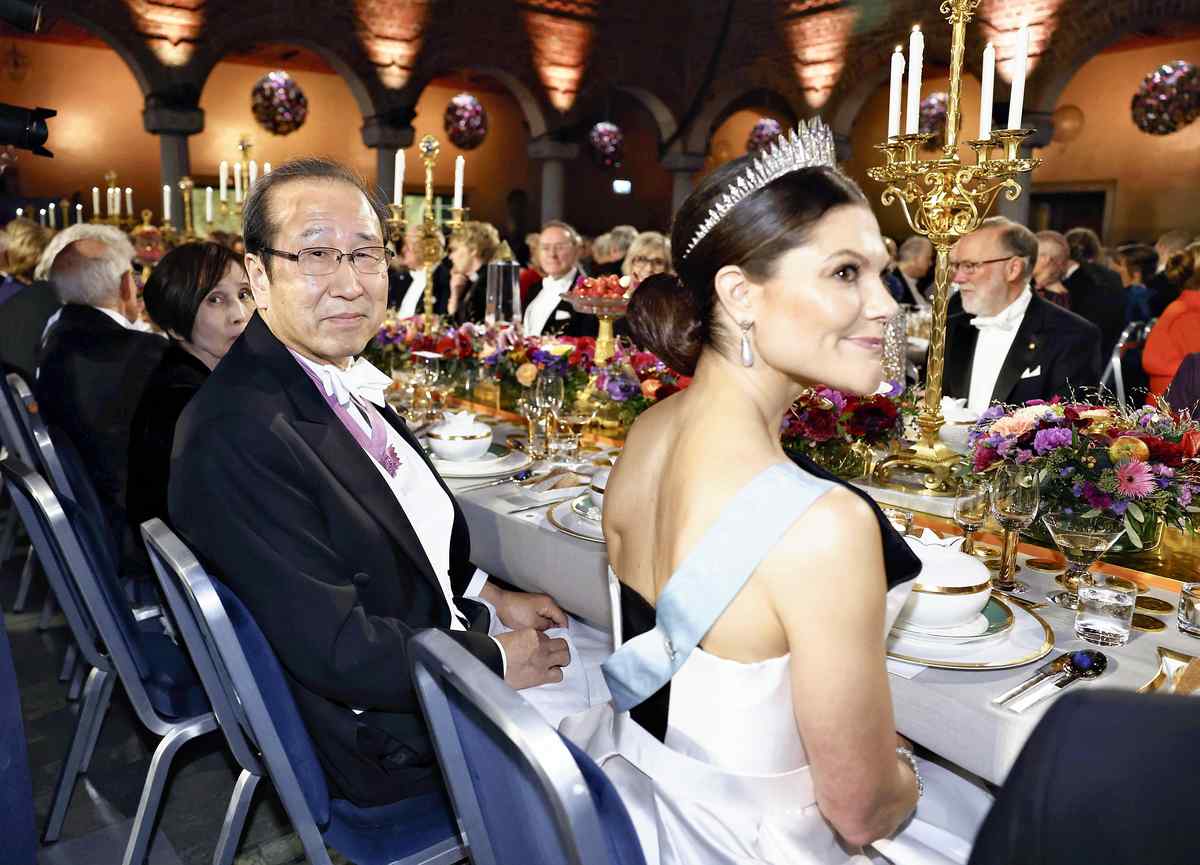
Susumu Kitagawa sits at a table next to Crown Princess Victoria at a banquet after the Nobel Prize award ceremony in Stockholm on Wednesday.
7:00 JST, December 12, 2025
STOCKHOLM — This year’s two Japanese Nobel laureates expressed joy at winning the prize at a banquet held after the award ceremony on Wednesday.
Shimon Sakaguchi, 74, a special honorary professor at Osaka University, and Susumu Kitagawa, 74, a distinguished professor at Kyoto University, attended the banquet alongside other Nobel laureates and members of the Swedish royal family.
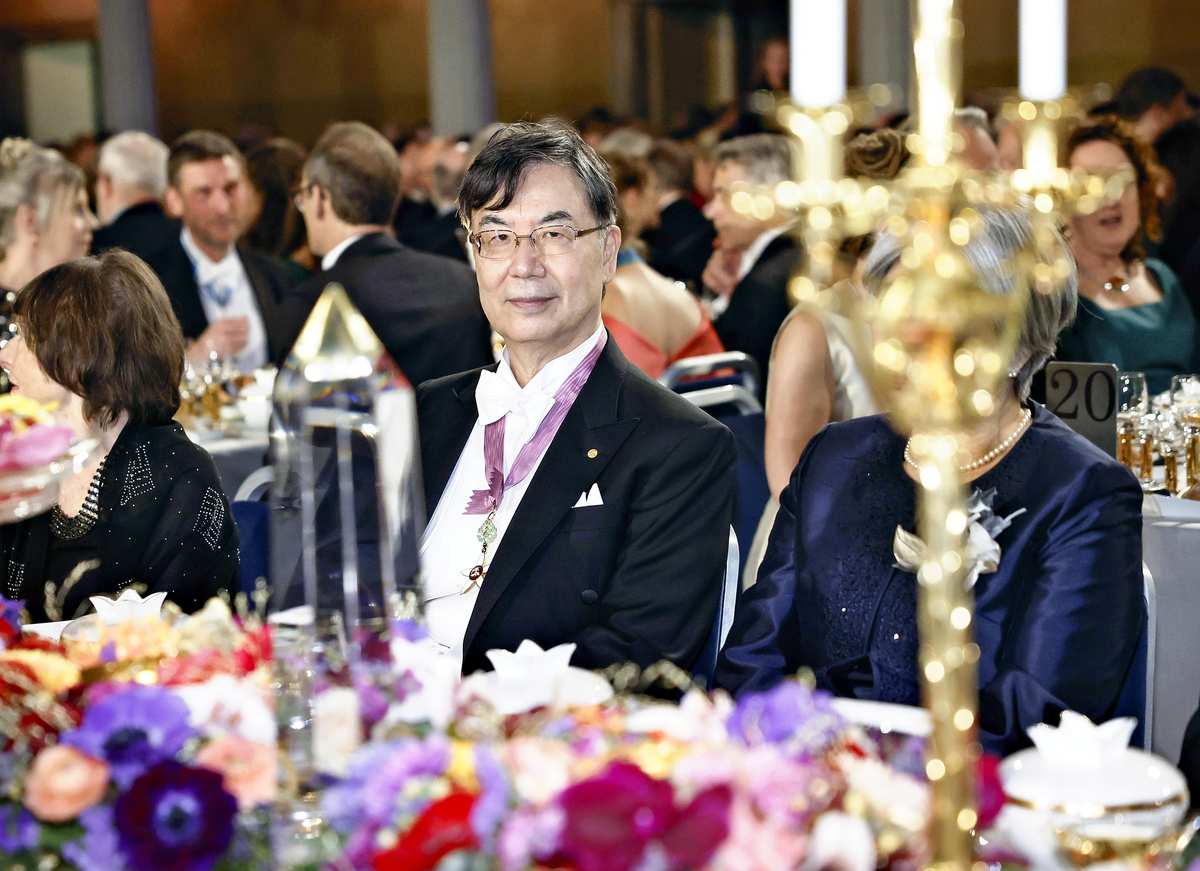
Shimon Sakaguchi sits at a table at a banquet after the Nobel Prize award ceremony in Stockholm on Wednesday.
After the ceremony, Sakaguchi held his medal and said, “It’s quite heavy, isn’t it?” He then posed for photos with his wife Noriko, 72, a doctor who has supported his research for many years.
The banquet began at 7 p.m. at Stockholm City Hall and was attended by about 1,300 people. Sakaguchi and Kitagawa were seated at the central table in the Blue Hall, which was adorned with colorful flowers. Kitagawa enjoyed dishes featuring local ingredients while conversing with Crown Princess Victoria, who was seated next to him.
“Our story is typical, on the one hand, as one whose success depended on and expanded upon basic research advances over many decades,” said Mary Brunkow of the U.S. Institute for Systems Biology, representing the three winners of the Physiology or Medicine prize, in her speech at the banquet.
“MOF [metal-organic framework] science is now practiced in more than 100 countries, inspiring young people everywhere, especially in the developing world,” said Prof. Omar Yaghi of the University of California, Berkeley, one of the three laureates for the Chemistry Prize, also speaking at the banquet.
Stubborn like his dad
Sakaguchi and Kitagawa persevered through long periods of obscurity, staying true to their convictions, and ultimately reached the world’s most prestigious scientific honor.
“For many years, I have been doing something that I was in doubt about. Gradually, it became clearer, and my work was recognized. My stubbornness led to today,” Sakaguchi said at a press conference after it was announced in October that he would receive the award.
His determination may have been inherited from his father. His older brother Isaku, 76, attributes his younger brother’s Nobel win to “our father’s persistence.”
Their father, Shoshi, studied Western philosophy at Kyoto Imperial University, now Kyoto University, and aspired to be an academic. However, he was drafted during the Second Sino-Japanese War, which erupted in 1937, and had to abandon his academic path. He urged his sons, born after the war, to pursue science.
“He probably advised us thinking that science majors were less likely to be drafted into war compared to humanities majors. Having a practical skill would also be advantageous for employment,” Sakaguchi said.
According to Isaku, Shoshi was transferred from the Chinese front to Southeast Asia as the war expanded. Because Shoshi spoke French, he was assigned to diplomatic negotiations.
After the war, he negotiated for the repatriation of Japanese soldiers and returned to Japan around 1947. He served as a high school teacher, principal and library director in his home prefecture of Shiga and died from illness in 1977 at age 65.
“Our father intended to pursue research but became a teacher to support our family. He must feel that his son avenged him by winning the Nobel Prize,” Isaku said.
Sakaguchi chose medicine from among the many scientific fields largely due to the doctors in his mother’s family.
After his father’s death, his mother would cut out newspaper articles about Sakaguchi and keep them. When people started talking about him as a candidate for the Nobel Prize, she would jokingly ask, “Think you’ll get it soon?”
She died last year at the age of 104.
Sakaguchi’s dedication and research led to the discovery of “regulatory T cells” that suppress excessive immune responses.
“My mother lived a long life, but she just missed seeing me win the Nobel Prize,” he said in an interview in November. “My parents made me who I am today. I can only feel gratitude.”
He plans to visit his parents’ graves and report on his win upon returning from Scandinavia.
‘Un-don-kon’
Shuhei Furukawa, 47, of Kyoto University, remembers a present Kitagawa gave him when his mentor visited his lab two years ago, three years after Furukawa became a professor. “I’d forgotten about it,” Kitagawa said as he handed over the object.
It was a figurine of an owl, a symbol of wisdom. Engraved on its base were the words “un-don-kon” (luck, stubbornness, perseverance). The phrase suggests that to be successful, one needs to be lucky enough to be given opportunities, as well as stubborn and persistent.
Kitagawa was painstaking in his research on copper, a material most chemists ignored, and finally developed a new material called MOFs, which can adsorb and store gases in countless pores. His journey was the embodiment of “un-don-kon.”
After completing his doctoral studies at Kyoto University in 1979, he moved to Kindai University and immersed himself in researching copper. He was invited by Megumu Munakata, 84, then an associate professor and now a professor emeritus at the university. Munakata had met Kitagawa at a conference and was impressed by his “sharp questions.” Learning Kitagawa was not employed, he hired him as a research assistant and had him research copper to “create a new academic direction.”
At Kyoto University, Kitagawa studied theory under Kenichi Fukui (1918–98), who would later become the first Japanese Nobel laureate in Chemistry. At Kindai, his focus shifted entirely to experimentation. He spent days shaking beakers and flasks.
Even so, it took ten years to discover the material bearing countless holes. After eight more years of research, he announced that gas could be absorbed into the holes, but he was harshly criticized.
His work only gained recognition after his corecipient of the Nobel Prize made a similar announcement, prompting other researchers to follow in their footsteps. He did not receive any major award until he was over 50.
Kitagawa, who acknowledges being a “late bloomer,” has given his former students owl figurines inscribed with the phrase “un-don-kon” when they become professors. As funding for scientific research is lackluster at the moment, he has placed his hope in the next generation.
“There is a mountain of work to be done. I want young people to become even more engrossed in their research,” he said.


Related Tags

Most Read
Popular articles in the past 24 hours
-

Japanese Shipping Giants Halt Strait of Hormuz Transit as Iran Co...
-

U.S. Launches Attacks on Iran: Avoid Escalation of Conflict by An...
-
Sawtooth Roof Factory Stands as Monument to Ashikaga Textile Hist...
-
Parents of Japanese Teen Shot in U.S. Strive for Gun Control
-
Disinformation Spreads About Team Mirai, Ballot Readers; Online P...
-
Asahi Breweries to Stage Comeback with New Product in April; Comp...
-
Bank of Japan Deputy Governor Says Rate Hikes Likely to Continue
-

Japanese Government Bonds Rally, Yields Tumble as Iran Strikes Sp...
Popular articles in the past week
-

Nepal Bus Crash Kills 19 People, Injures 25 Including One Japanes...
-
Milano Cortina 2026: Japanese Gold Medalist Figure Skater Miura S...
-
Tokyo Spends Big on Children, Wins Over Parents
-

McDonald's Japan Raises Prices; Big Mac to Cost ¥500, Double Chee...
-
Japan’s Miura, Kihara Announce Withdrawal from Figure Skating Wor...
-
Exhibition Featuring Yoshiharu Tsuge’s Manga World Underway in Ch...
-

Yokohama to Test Out Renewable-Powered Offshore Floating Data Cen...
-
BOJ Keeping Eye on Economy and Takaichi's ‘Proactive Fiscal Polic...
Popular articles in the past month
-

Producer Behind Pop Group XG Arrested for Cocaine Possession
-

Japan PM Takaichi’s Cabinet Resigns en Masse
-

Man Infected with Measles Reportedly Dined at Restaurant in Tokyo...
-

Israeli Ambassador to Japan Speaks about Japan’s Role in the Reco...
-

Videos Plagiarized, Reposted with False Subtitles Claiming ‘Ryuky...
-

Man Infected with Measles May Have Come in Contact with Many Peop...
-

Prudential Life Insurance Plans to Fully Compensate for Damages C...
-

Woman with Measles Visited Hospital in Tokyo Multiple Times Befor...
Top Articles in Society
-
Producer Behind Pop Group XG Arrested for Cocaine Possession
-
Man Infected with Measles Reportedly Dined at Restaurant in Tokyo Station
-
Man Infected with Measles May Have Come in Contact with Many People in Tokyo, Went to Store, Restaurant Around When Symptoms Emerged
-
Woman with Measles Visited Hospital in Tokyo Multiple Times Before Being Diagnosed with Disease
-

Bus Carrying 40 Passengers Catches Fire on Chuo Expressway; All Evacuate Safely
JN ACCESS RANKING
-
Producer Behind Pop Group XG Arrested for Cocaine Possession
-
Japan PM Takaichi’s Cabinet Resigns en Masse
-
Man Infected with Measles Reportedly Dined at Restaurant in Tokyo Station
-
Israeli Ambassador to Japan Speaks about Japan’s Role in the Reconstruction of Gaza
-
Videos Plagiarized, Reposted with False Subtitles Claiming ‘Ryukyu Belongs to China’; Anti-China False Information Also Posted in Japan