
Workshop Held on Coexistence with Endangered Asian Black Bears in Shikoku Region; Animals Remain on Brink of Local Extinction Due to Hunting, Habitat Loss
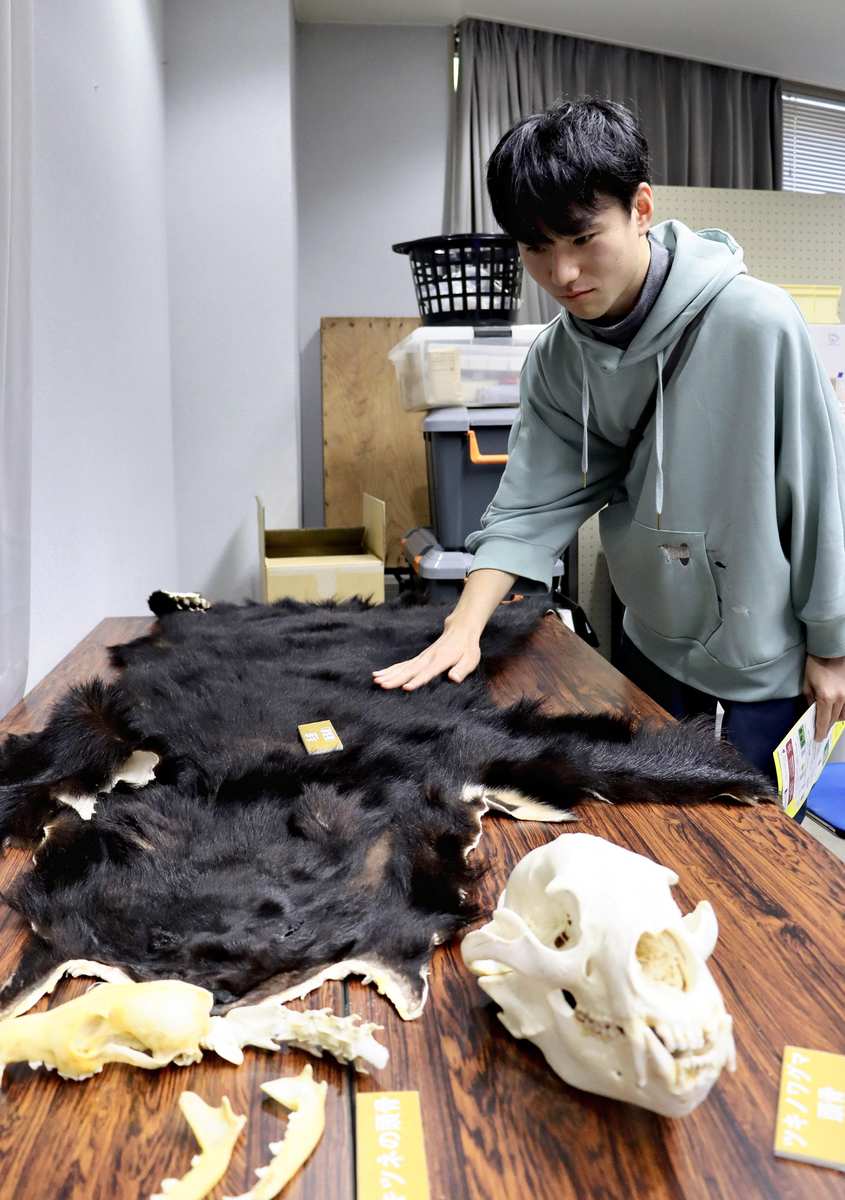
A workshop participant looks at an Asian Black bear skin and skull at the Omogo-sangaku Museum in Kumakogen, Ehime Prefecture.
2:00 JST, November 11, 2025
KUMAKOGEN, Ehime — Amid growing bear attacks in the Tohoku region, a workshop in Kumakogen, Ehime Prefecture, taught participants about the Asian black bears in the Shikoku area and discussed whether coexistence was possible.
Tohoku residents are on increasingly high alert, but the population of Asian black bears in the Shikoku region consists of only about 20 animals that live in Tokushima and Kochi prefectures.
The workshop, which was held at the town’s Omogo-sangaku Museum, sought to teach people about the conditions faced by this nearly extinct species.
Kyohei Ando is a researcher with the Shikoku Institute of Natural History, which conducts ecological studies on Asian black bears. Ando lectured at the event, where about 15 participants observed and touched items such as an Asian black bear skin and skull to learn about how these animals live.
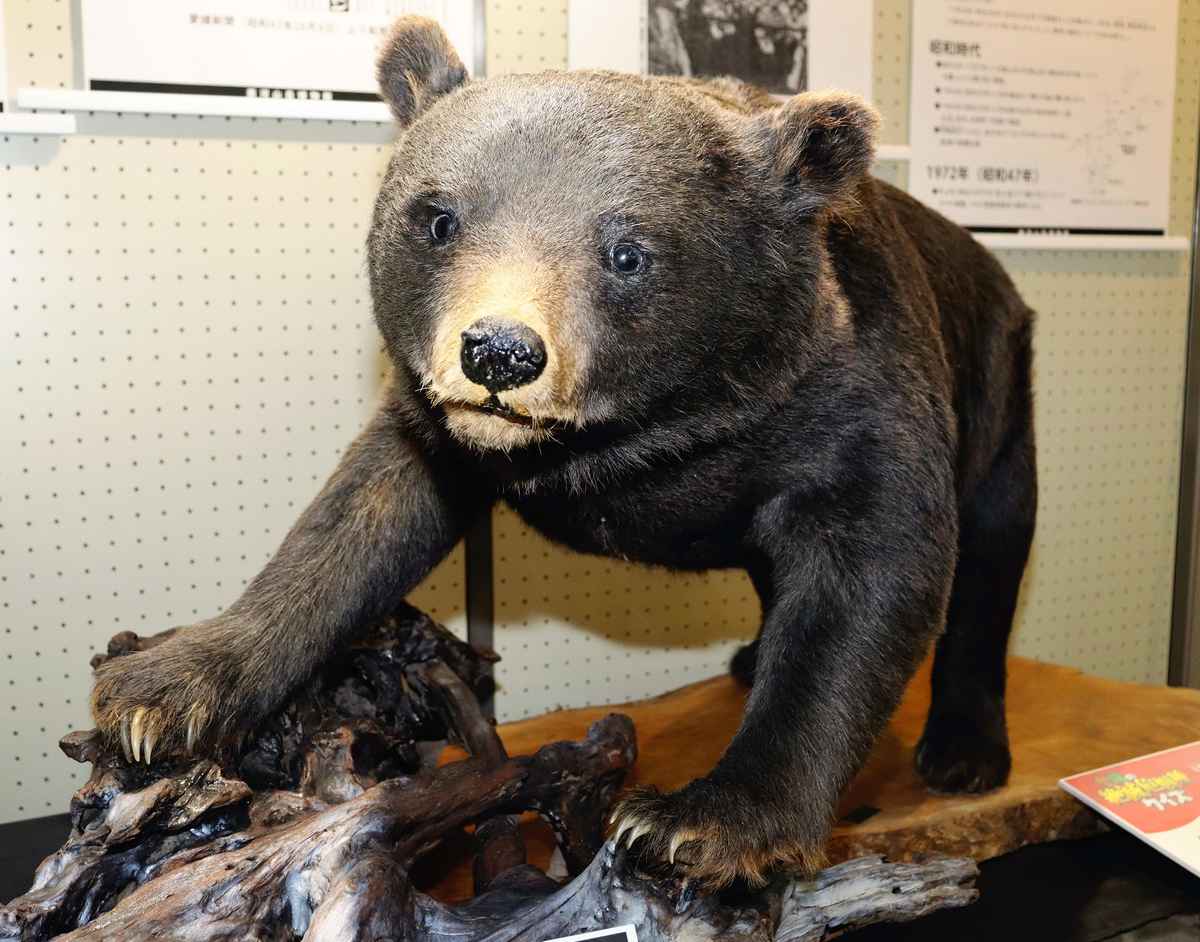
The stuffed body of an Asian black bear captured in 1972 in Nakayama Town, now part of Iyo City, is on display in Kumakogen, Ehime Prefecture.
At one time, Asian black bears resided across a wide area of Shikoku, but now they live only on and around Mt. Tsurugi, which straddles Tokushima and Kochi prefectures.
As of 2017, the population of Asian black bears in the region was estimated to be between 16 and 24. Last year, 26 bears, including two cubs, were confirmed to be living in the area.
Analyses using GPS showed that bears in the Shikoku region tend to avoid humans and do not approach forestry roads and mountain climbing trails.
In Ehime Prefecture, the last recorded capture of an Asian black bear was in 1972, when a male bear was taken in Nakayama Town, now part of Iyo City.
That bear, now stuffed, is on display at the museum as part of a special exhibition until Nov. 24.
According to research by the Environment Ministry, Shikoku is the only region of Japan where the range of land inhabited by bears shrank between 2003 and 2018.
Ando explained: “When population and inhabited areas shrink, genetic diversity declines and survival rates fall. If those factors strongly affect the animals, there is a roughly 60% probability of extinction by 2040 [for Asian black bears in the Shikoku region].”
The reasons for the decline in Shikoku’s bear population are thought to include the fact that the area they can inhabit is shrinking due to development on forest land. Also, the bears themselves are being killed as pests because they strip the bark off trees.
Ordinances were enacted in Tokushima and Kochi prefectures about 40 years ago to prohibit the hunting of Asian black bears, but the species’ population has shown no signs of recovery since then.
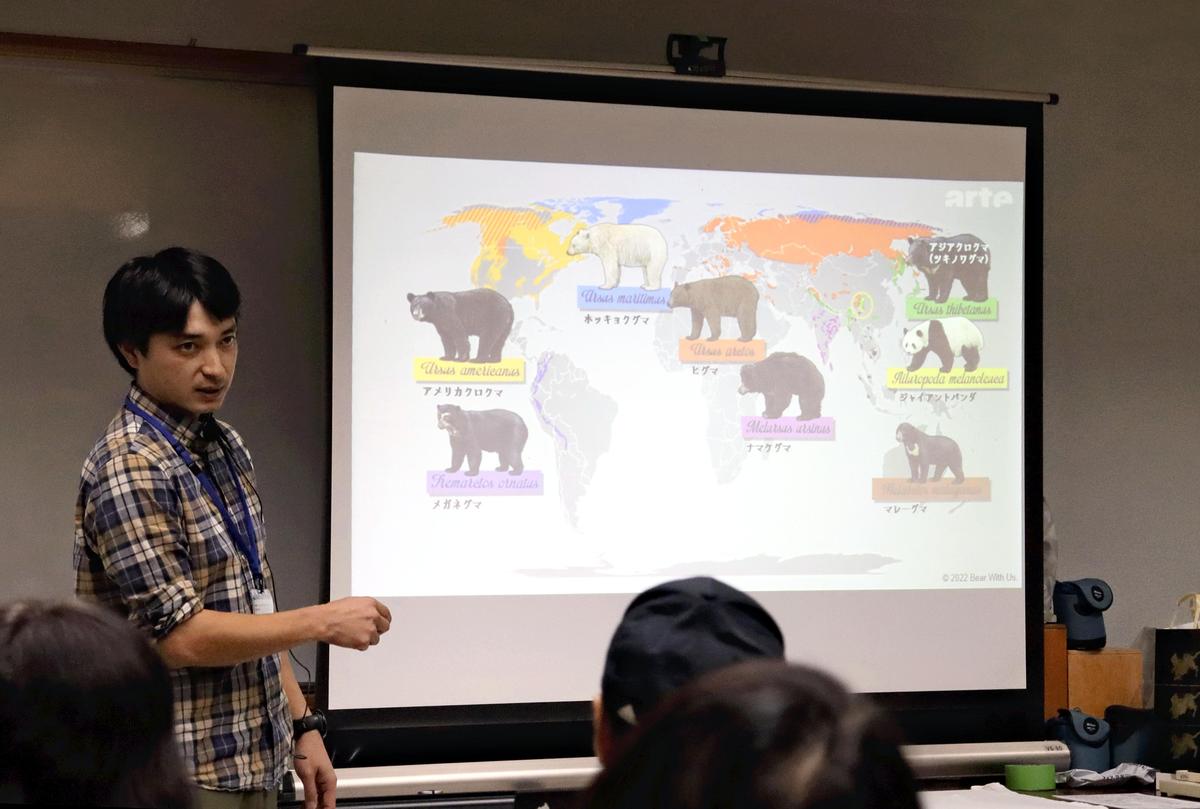
Kyohei Ando explains how bears fit into the environment
“Many people feel vaguely scared just because there are bears in Shikoku. I want them to learn the truth about the situation,” Ando said.
After the lecture, participants in the workshop held a discussion about whether people should accept bears living in Ehime Prefecture.
They voiced various opinions. One of them said, “It is alright if humans can arrange things so that they are able to accept [the presence of bears],” and another said, “It is difficult because the Shikoku region does not have a culture of coexistence with bears.”
A 59-year-old company employee from Kumakogen Town who participated in the workshop said: “I felt we should protect the bears that live in the Shikoku region. On the other hand, there are many human-planted forests in Ehime Prefecture, which means there are less of the tree nuts that they eat. Even if we accept bears living here, they don’t have enough food. So I think it will be difficult to find a happy medium that will allow us to coexist with them.”


Related Tags







Most Read
Popular articles in the past 24 hours
-

Japan Figure Skating Legend Yuzuru Hanyu Is Proud Disaster Surviv...
-

Massive Sewer Pipe Found Jutting Out of Highway in Osaka
-

Japan-U.S. Summit Likely to Focus on Middle East; Takaichi to Fac...
-

Hawaii Museum on Tsunami Including Japan's 2011 Disaster at Risk ...
-

15 Years since Great East Japan Earthquake: How Can Affected Area...
-
Japan Holds Memorial Events to Mark 15th Anniversary of 2011 Eart...
-

Japan Train Company to Increase Fares, Including in Tokyo Metropo...
-

Parents in Japan to Get Instagram Notifications When Teens Repeat...
Popular articles in the past week
-

Ibaraki Pref.'s 1st Foreign Bus Driver Hired in Tsukuba
-

Nippon Life Insurance's U.S. Arm Sues OpenAI Over Legal Assistanc...
-
Japan Figure Skating Legend Yuzuru Hanyu Is Proud Disaster Surviv...
-
Govt to Utilize ODA for Ensuring Economic Security; Securing Ener...
-
Massive Sewer Pipe Found Jutting Out of Highway in Osaka
-

Amid Strait of Hormuz Blockade, Shipping Companies Scramble to Ge...
-

Beckoning Cats Get Makeover to Fit Modern Lifestyles with Sleek D...
-
Japan Govt Survey Finds Just 10% of Workers Want Working Hours to...
Popular articles in the past month
-

Producer Behind Pop Group XG Arrested for Cocaine Possession
-

Japan PM Takaichi’s Cabinet Resigns en Masse
-

Man Infected with Measles Reportedly Dined at Restaurant in Tokyo...
-

Videos Plagiarized, Reposted with False Subtitles Claiming ‘Ryuky...
-

iPS Treatments Pass Key Milestone, but Broader Applications Far f...
-

Sanae Takaichi Elected Prime Minister of Japan; Keeps All Cabinet...
-

Nepal Bus Crash Kills 19 People, Injures 25 Including One Japanes...
-

South Korea Tightens Rules on Foreigners Buying Homes in Seoul Me...
Top Articles in Society
-
Producer Behind Pop Group XG Arrested for Cocaine Possession
-
Man Infected with Measles Reportedly Dined at Restaurant in Tokyo Station
-

Bus Carrying 40 Passengers Catches Fire on Chuo Expressway; All Evacuate Safely
-
Ibaraki Pref.’s 1st Foreign Bus Driver Hired in Tsukuba
-

Tokyo Skytree’s Elevator Stops, Trapping 20 People; All Rescued (Update 1)
JN ACCESS RANKING
-
Producer Behind Pop Group XG Arrested for Cocaine Possession
-
Japan PM Takaichi’s Cabinet Resigns en Masse
-
Man Infected with Measles Reportedly Dined at Restaurant in Tokyo Station
-
Videos Plagiarized, Reposted with False Subtitles Claiming ‘Ryukyu Belongs to China’; Anti-China False Information Also Posted in Japan
-
iPS Treatments Pass Key Milestone, but Broader Applications Far from Guaranteed