
Tokyo Metropolitan Govt Plans to Extend Oedo Line Subway with 3 New Stations in Nerima Ward; Expected to Open around 2040
A sign of Toei Subway
1:00 JST, October 16, 2025
The Tokyo metropolitan government has begun coordinating a plan to extend the Toei Oedo Line subway, which is run by the metropolitan government and connects central Tokyo with Nerima Ward, according to sources.
The line is currently 40.7 kilometers long and has 38 stations. The plan would extend the line by 4 kilometers northwest from Hikarigaoka Station, adding three new stations within Nerima Ward, according to the sources.
The total project is estimated to cost about ¥160 billion, and the extension is expected to open around 2040.
The government is expected to announce the results of profitability studies for the project soon and proceed with discussions with the central government and the ward office.
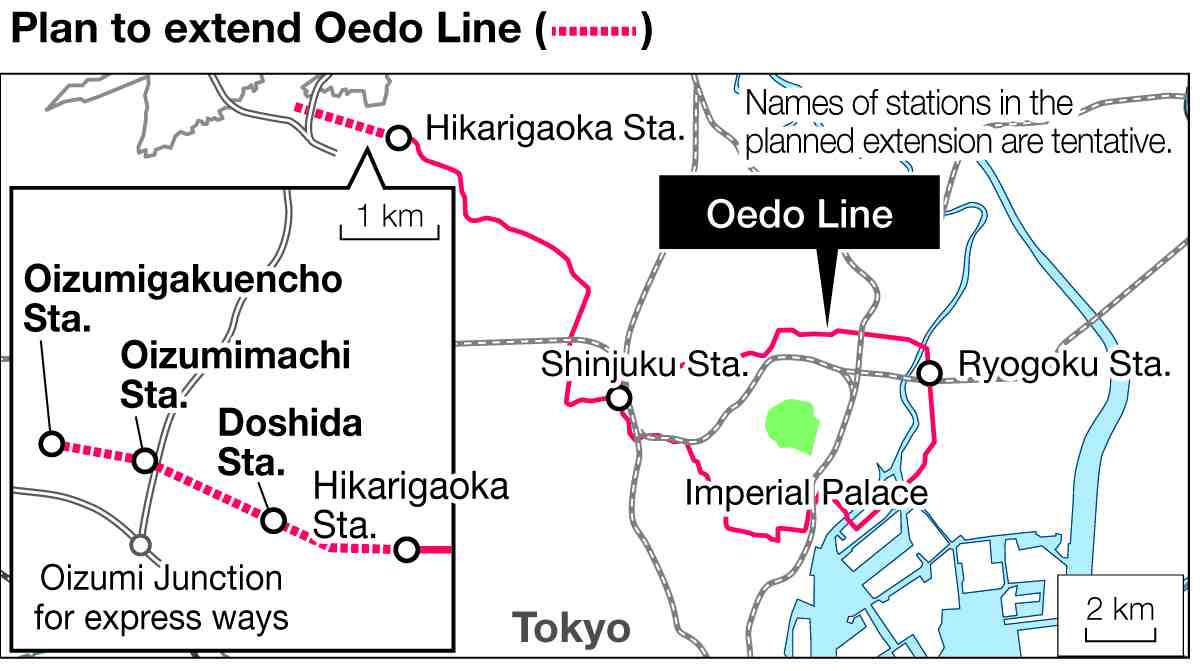
The area northwest of Hikarigaoka Station is mostly residential, and many areas are more than a kilometer from the nearest station, so it has been long referred to as a “railway deserted zone.” The ward has been requesting the metropolitan and central governments to extend the subway system for years.
In 2016, the Transportation Policy Council, an advisory panel to the Land, Infrastructure, Transport and Tourism minister, said the extension “would contribute to the improvement of the railway network along with the growth of local communities.”
The metropolitan government began profitability studies for the extension in 2023.
The studies were conducted with the assumption that three stations would be built in the Doshida, Oizumimachi and Oizumigakuencho districts and that the subway would run below metropolitan roads.
According to sources, while the project is estimated to cost about ¥160 billion, the results of the studies suggest that if the ward can create enough passenger demand through redevelopment around the new stations, the Oedo Line would see an increase of 60,000 passengers per day.
The studies suggest this could lead to profits within 40 years of opening the new section.
The benefit-cost ratio, which is used to evaluate the profitability of public works projects, exceeded 1, the benchmark for project viability.
To cover the cost of construction, the metropolitan government is considering using a subway construction subsidy program in which the central and local governments will shoulder a part of the cost.
The ward office plans to put more money into its reserve fund it has saved in preparation for the project and ultimately pay ¥20 billion. The metropolitan government and ward office will try to further improve the project’s profitability and begin drafting a specific plan.





Most Read
Popular articles in the past 24 hours
-
Power Outage Forces About 980 Passengers in Yokohama to Walk to T...
-

Masako Ikeda, Voice of Maetel in ‘Galaxy Express 999,' Dies at 87
-

Japan Defense Agency to Develop AI Intelligence Analysis System f...
-
Japan's TEPCO Releases Footage from Fukushima N-Plant Reactor
-

Japan's Sanyo Shinkansen Suspended Again; Between Okayama, Aioi S...
-

Japan Considering Taking Part in U.S. ‘Golden Dome’ Defense Syste...
-

Oil Reserve Releases: G7 Members Unite against Growing Threat
-
Government to Establish ‘Command Center’ for Developing Nuclear P...
Popular articles in the past week
-

Japan Figure Skating Legend Yuzuru Hanyu Is Proud Disaster Surviv...
-

Nippon Life Insurance's U.S. Arm Sues OpenAI Over Legal Assistanc...
-
Govt to Utilize ODA for Ensuring Economic Security; Securing Ener...
-
15 Measles Patients Confirmed in Tokyo in Past 6 Days; 1 May Have...
-
Massive Sewer Pipe Found Jutting Out of Highway in Osaka
-
Japan Govt to Tighten Requirements to Receive Permanent Residency...
-

Beckoning Cats Get Makeover to Fit Modern Lifestyles with Sleek D...
-
JR Tokai Breaks Ground on Yamanashi Maglev Station; Will Be Part ...
Popular articles in the past month
-

Producer Behind Pop Group XG Arrested for Cocaine Possession
-

Japan PM Takaichi’s Cabinet Resigns en Masse
-

Man Infected with Measles Reportedly Dined at Restaurant in Tokyo...
-

Videos Plagiarized, Reposted with False Subtitles Claiming ‘Ryuky...
-
Japan Figure Skating Legend Yuzuru Hanyu Is Proud Disaster Surviv...
-

iPS Treatments Pass Key Milestone, but Broader Applications Far f...
-

Sanae Takaichi Elected Prime Minister of Japan; Keeps All Cabinet...
-

Nepal Bus Crash Kills 19 People, Injures 25 Including One Japanes...
Top Articles in Society
-
Producer Behind Pop Group XG Arrested for Cocaine Possession
-
Man Infected with Measles Reportedly Dined at Restaurant in Tokyo Station
-
15 Measles Patients Confirmed in Tokyo in Past 6 Days; 1 May Have Come into Contact with Many in Shibuya
-

Bus Carrying 40 Passengers Catches Fire on Chuo Expressway; All Evacuate Safely
-

Ibaraki Pref.’s 1st Foreign Bus Driver Hired in Tsukuba
JN ACCESS RANKING
-
Producer Behind Pop Group XG Arrested for Cocaine Possession
-
Japan PM Takaichi’s Cabinet Resigns en Masse
-
Man Infected with Measles Reportedly Dined at Restaurant in Tokyo Station
-
Videos Plagiarized, Reposted with False Subtitles Claiming ‘Ryukyu Belongs to China’; Anti-China False Information Also Posted in Japan
-
Japan Figure Skating Legend Yuzuru Hanyu Is Proud Disaster Survivor and Gold Medalist, Vows to Continue Support Efforts