
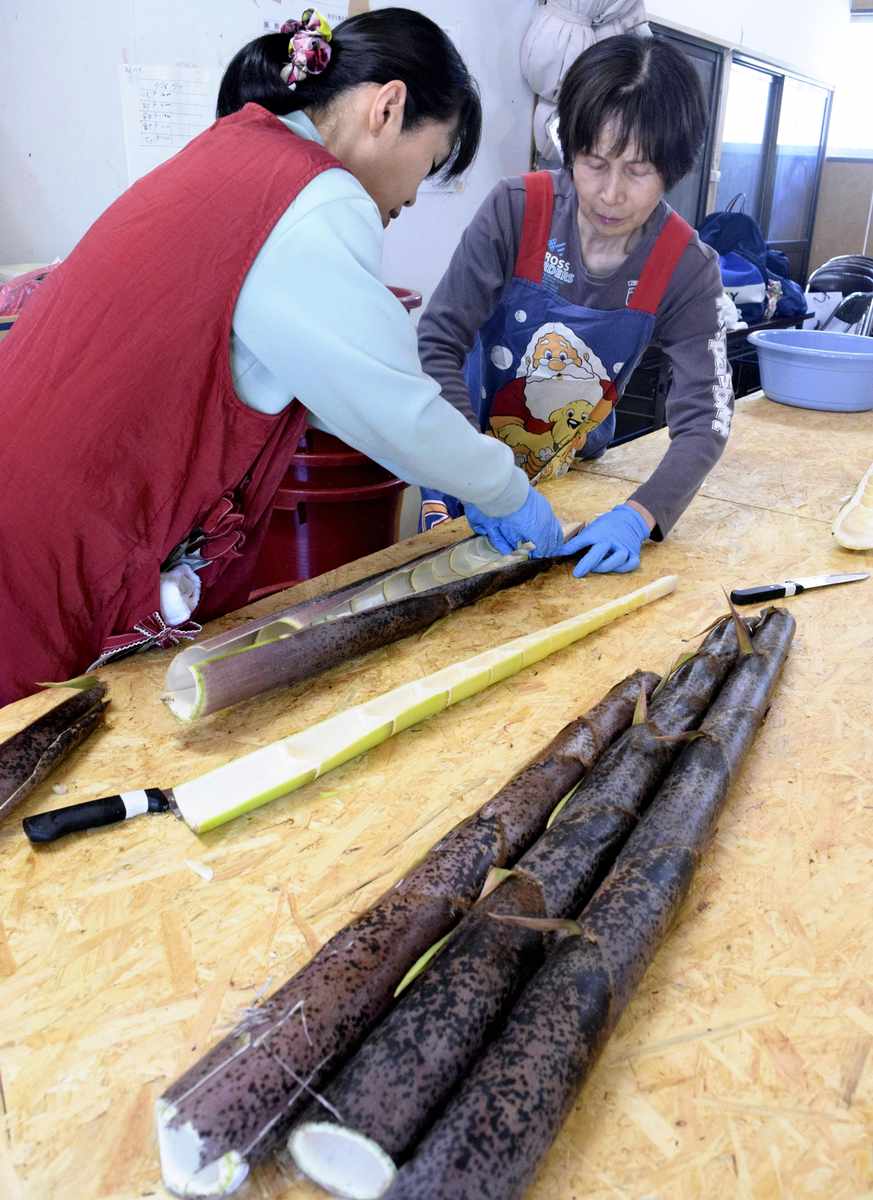
Locals process young bamboo shoots into menma in Himi, Toyama Prefecture.
15:13 JST, September 8, 2025
TOYAMA — With many bamboo forests across the country having been abandoned and grown unruly, some groups are attempting to manage them by harvesting the young bamboo shoots. These shoots are then being fermented and made into menma, a common topping for ramen.
As menma is easy to make, locals are able to start their own the initiatives, and they are creating new local specialties to help revitalize their communities.
In Himi, Toyama Prefecture, about 10 residents began making menma this spring. They cut down and shredded shoots of moso bamboo that were over a meter long. They then boiled the shoots and pickled them in salt for about three months.
“This project will help us well maintain the bamboo forest and make our community cleaner,” said Tadahiko Mae, 67, one of the project’s participants.
According to the Himi municipal government, bamboo forests in the city cover about 340 hectares, accounting for more than 60% of all the area in the prefecture, and many of the town’s forests are not well managed.
The project was thought up by Kei Mikami, 31, who moved to Himi by taking advantage of the government’s Local Vitalization Cooperator program. “This project provides locals with the chance to get together and enjoy working on the problem of abandoned bamboo forests,” he said.
There are also projects to make and sell distinctive menma with unique flavors. The Yokohama Chikurin Kenkyujo, an institute researching bamboo forests that is based in Yokohama, began making the condiment last year, and this year it has pickled about one ton of bamboo shoots.
Its product is sweet and spicy, with an accent of black pepper, and the institute sells it online under the name “hama no menma.” The institute is talking with tempura and Italian restaurants about using the condiment.
In another case, a group of locals in Kobe is selling two types of menma at local supermarkets.
Meanwhile, in the wake of the 2024 Noto Peninsula Earthquake, Tea Tree Communications, a company based in the town of Kamiichi, Toyama Prefecture, has developed menma that remains edible for one year.
“It can provide dietary fiber, something that meals at evacuation centers often lack,” said Masaru Chaki, 58, president of the company.
Local Bamboo Inc., a company based in Nobeoka, Miyazaki Prefecture, develops its own products and also listens to residents who are plagued by abandoned bamboo forests.
“We want to come up with sustainable solutions to the issue of abandoned bamboo forests by making people experience something delicious,” said company President Taro Ebara, 35.
Eight years ago, the “100%-made-in-Japan menma project” was launched by locals in Fukuoka and Nagano prefectures who were managing bamboo forests. Now, the project has 196 individual members and member organizations, and they produced about 90 tons of menma across Japan last year.
They have held annual meetings, calling for members to share success stories in different areas. “By approaching this from the food angle, we can get many people interested in the issue of abandoned bamboo forests,” said Yoshinori Fukasawa, 52, one of the project’s leaders.
Owners aging
Bamboo forests are pushing their boundaries outward. In 1986, they covered 147,000 hectares, but by 2022 this had grown to 175,000 hectares, nearly the size of Kagawa Prefecture, according to a Forestry Agency survey.
Bamboo grown in Japan has seen less use as more shoots have been imported from overseas and more products have been made from plastic, according to Kenichi Sato, a professor of geotechnical and pavement engineering at Fukuoka University who is familiar with the issue of bamboo use. Bamboo forests have been abandoned as many of those who own them are aging and unable to thin them.
Since bamboo roots are shallow, only going down about 30 centimeters below the ground’s surface, the land in which they grow can collapse in heavy rain. Bamboo is so prolific that it encroaches on other kinds of forests and harms the growth of other plants. Wild boars and deer also take to bamboo forests as they love the shoots, which has some concerned the animals could damage crops.
“The expansion of bamboo forests is a serious problem, and making menma from bamboo will give people the chance to take an interest in the issue,” Sato said. “It’s important to make these menma-producing projects sustainable and to maintain bamboo forests outside of spring, when the young bamboo shoots are harvested.”


Related Tags




Most Read
Popular articles in the past 24 hours
-

Japan Train Company to Increase Fares, Including in Tokyo Metropo...
-

Hawaii Museum on Tsunami Including Japan's 2011 Disaster at Risk ...
-

Japan Govt to Tighten Requirements to Receive Permanent Residency...
-

Tail of ANA Plane Struck Runway During Landing in Houston; No Inj...
-

Samurai Japan Holds First Practice in Miami; Team Will Play again...
-

Medical Care at Home and Disasters: Ensure Systems to Provide Con...
-

Iran Targets Busiest International Airport as Top UN Body Demands...
-

Japan to Face Venezuela in World Baseball Classic Quarterfinals
Popular articles in the past week
-

Japan Figure Skating Legend Yuzuru Hanyu Is Proud Disaster Surviv...
-

Nippon Life Insurance's U.S. Arm Sues OpenAI Over Legal Assistanc...
-

Ibaraki Pref.'s 1st Foreign Bus Driver Hired in Tsukuba
-
Govt to Utilize ODA for Ensuring Economic Security; Securing Ener...
-
Massive Sewer Pipe Found Jutting Out of Highway in Osaka
-

Amid Strait of Hormuz Blockade, Shipping Companies Scramble to Ge...
-

Beckoning Cats Get Makeover to Fit Modern Lifestyles with Sleek D...
-
Japan Govt Survey Finds Just 10% of Workers Want Working Hours to...
Popular articles in the past month
-

Producer Behind Pop Group XG Arrested for Cocaine Possession
-

Japan PM Takaichi’s Cabinet Resigns en Masse
-

Man Infected with Measles Reportedly Dined at Restaurant in Tokyo...
-

Videos Plagiarized, Reposted with False Subtitles Claiming ‘Ryuky...
-

iPS Treatments Pass Key Milestone, but Broader Applications Far f...
-
Japan Figure Skating Legend Yuzuru Hanyu Is Proud Disaster Surviv...
-

Sanae Takaichi Elected Prime Minister of Japan; Keeps All Cabinet...
-

Nepal Bus Crash Kills 19 People, Injures 25 Including One Japanes...
Top Articles in Society
-
Producer Behind Pop Group XG Arrested for Cocaine Possession
-
Man Infected with Measles Reportedly Dined at Restaurant in Tokyo Station
-

Bus Carrying 40 Passengers Catches Fire on Chuo Expressway; All Evacuate Safely
-
Ibaraki Pref.’s 1st Foreign Bus Driver Hired in Tsukuba
-

Tokyo Skytree’s Elevator Stops, Trapping 20 People; All Rescued (Update 1)
JN ACCESS RANKING
-
Producer Behind Pop Group XG Arrested for Cocaine Possession
-
Japan PM Takaichi’s Cabinet Resigns en Masse
-
Man Infected with Measles Reportedly Dined at Restaurant in Tokyo Station
-
Videos Plagiarized, Reposted with False Subtitles Claiming ‘Ryukyu Belongs to China’; Anti-China False Information Also Posted in Japan
-
iPS Treatments Pass Key Milestone, but Broader Applications Far from Guaranteed