
Japan’s Decennial Survey of Hibakusha to No Longer Be Conducted; Atomic Bomb Survivors’ Average Age Cited
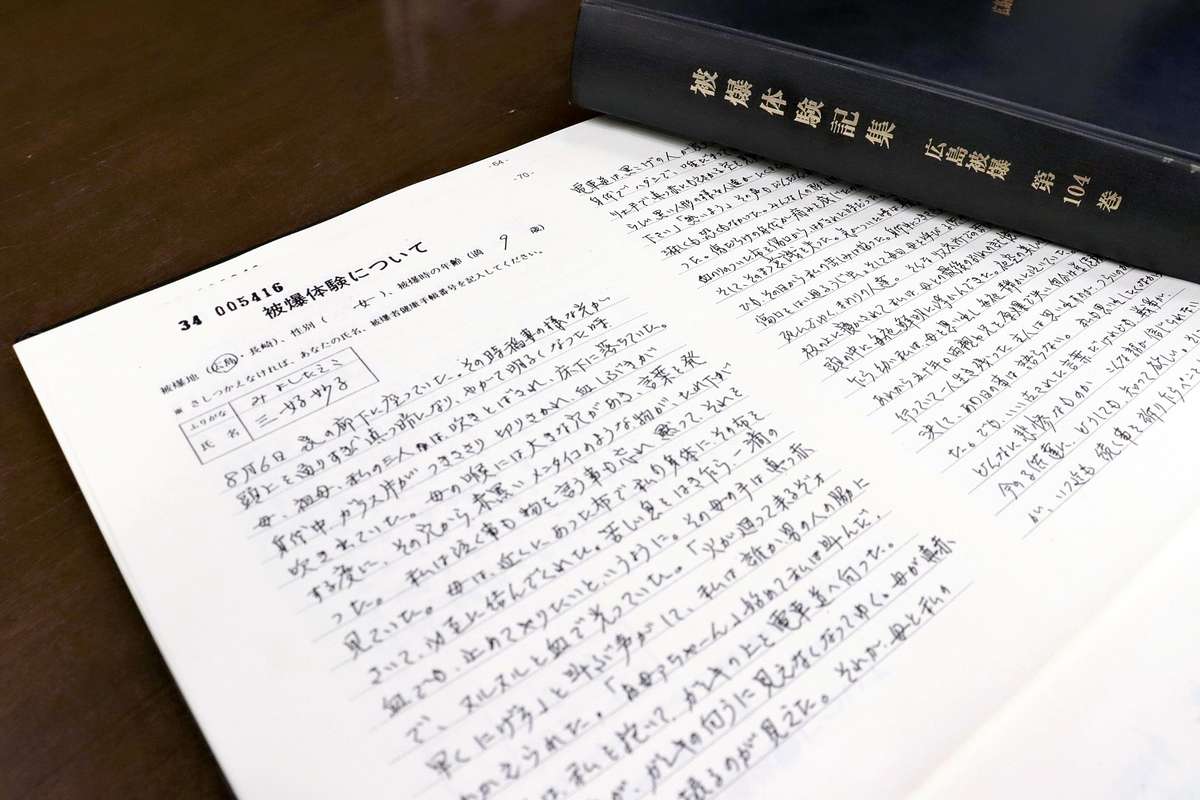
An account by a female hibakusha atomic bomb survivor is seen at the Hiroshima National Peace Memorial Hall for the Atomic Bomb Victims in Naka Ward, Hiroshima, on Friday. Written during a government survey conducted in 1995, it describes the horrors of the day she lost her mother and the sufferings she endured afterward.
20:00 JST, July 26, 2025
A government survey of hibakusha atomic bomb survivors conducted every 10 years since 1965 will not be held this year, according to the Health, Labor and Welfare Ministry.
The only survey conducted nationwide by the government concerning hibakusha was used to learn about their circumstances, and the 2015 edition will be the last. Its other purpose was to help pass the experiences of hibakusha on to future generations.
A survey was originally planned to be conducted this year, the 80th anniversary of the atomic bombings, but the ministry decided to end it following internal discussions. It cited “the burden of responding to the survey on the part of hibakusha, whose average age exceeds 85,”as a reason for the cancelation.
The ministry’s decision to end the survey was conveyed to all the prefectures and the two cities of Hiroshima and Nagasaki in December. As of the end of March, there were 99,130 people nationwide who hold a hibakusha health book, with an average age of 86.13.
“The fact-finding survey on A-bomb survivors” started in 1965, 20 years after the atomic bombs were dropped on Hiroshima and Nagasaki, by the then Health and Welfare Ministry. It was aimed at comprehensively assessing the health conditions of hibakusha, with its findings to be utilized for taking measures to support them, including through the provision of allowances.
Through 2015, the six surveys were conducted with the cooperation of all prefectures and the two cities.
The first four surveys, through 1995, covered all those who had hibakusha health books, ranging from 270,000 to 360,000 people, with inquiries made either through in-person visits or by post. The following two surveys covered a random sample of 50,000 to 60,000 hibakusha.
Each survey asked hibakusha about their age, place of residence, lifestyle and health conditions. The surveys found that a conspicuous number of hibakusha were bedridden or were in need.
They also revealed experiences of discrimination in employment and marriage and concerns about the health of children and grandchildren — called second- and third-generation hibakusha.
These findings have been utilized by the government to extend tailored support to hibakusha.
From the 1995 survey, a section was included for hibakusha to be able to describe their experiences freely. A total of 104,312 accounts were collected through the survey.






Most Read
Popular articles in the past 24 hours
-

My Spendthrift Mother Constantly Asks Me for Money
-
Japanese Students Use Traditional Pickle to Create Novel Wagashi ...
-
‘Dry Bonsai’ Gives New Life to Withered Trees, Allows Free Artist...
-

McDonald's Japan Raises Prices; Big Mac to Cost ¥500, Double Chee...
-

Nepal Bus Crash Kills 19 People, Injures 25 Including One Japanes...
-

Astellas Collaborates with Vir to Develop Its Experimental Prosta...
-

Japan’s Nikkei Stock Average Rises as AI-Related Stocks Shine; Co...
-

Early-Blooming Kawazu Cherry Blossoms Create Sea of Pink at Park ...
Popular articles in the past week
-

Producer Behind Pop Group XG Arrested for Cocaine Possession
-

Japan PM Takaichi’s Cabinet Resigns en Masse
-

Sanae Takaichi Elected Prime Minister of Japan; Keeps All Cabinet...
-
Japan's Govt to Submit Road Map for Growth Strategy in March, PM ...
-

Bus Carrying 40 Passengers Catches Fire on Chuo Expressway; All E...
-

U.S. Firm to Build Training Hub in Fukushima N-plant for Debris R...
-
Japan, U.S. Name 3 Inaugural Investment Projects; Reached Agreeme...
-

Riku-Ryu Pair Wins Gold Medal: Their Strong Bond Leads to Major C...
Popular articles in the past month
-
Producer Behind Pop Group XG Arrested for Cocaine Possession
-
Japan PM Takaichi’s Cabinet Resigns en Masse
-

Japan Institute to Use Domestic Commercial Optical Lattice Clock ...
-

Man Infected with Measles Reportedly Dined at Restaurant in Tokyo...
-

Israeli Ambassador to Japan Speaks about Japan’s Role in the Reco...
-

Videos Plagiarized, Reposted with False Subtitles Claiming ‘Ryuky...
-

Man Infected with Measles May Have Come in Contact with Many Peop...
-

Prudential Life Insurance Plans to Fully Compensate for Damages C...
Top Articles in Society
-
Producer Behind Pop Group XG Arrested for Cocaine Possession
-
Man Infected with Measles Reportedly Dined at Restaurant in Tokyo Station
-
Man Infected with Measles May Have Come in Contact with Many People in Tokyo, Went to Store, Restaurant Around When Symptoms Emerged
-

Woman with Measles Visited Hospital in Tokyo Multiple Times Before Being Diagnosed with Disease
-
Australian Woman Dies After Mishap on Ski Lift in Nagano Prefecture
JN ACCESS RANKING
-
Producer Behind Pop Group XG Arrested for Cocaine Possession
-
Japan PM Takaichi’s Cabinet Resigns en Masse
-
Japan Institute to Use Domestic Commercial Optical Lattice Clock to Set Japan Standard Time
-
Man Infected with Measles Reportedly Dined at Restaurant in Tokyo Station
-
Israeli Ambassador to Japan Speaks about Japan’s Role in the Reconstruction of Gaza