
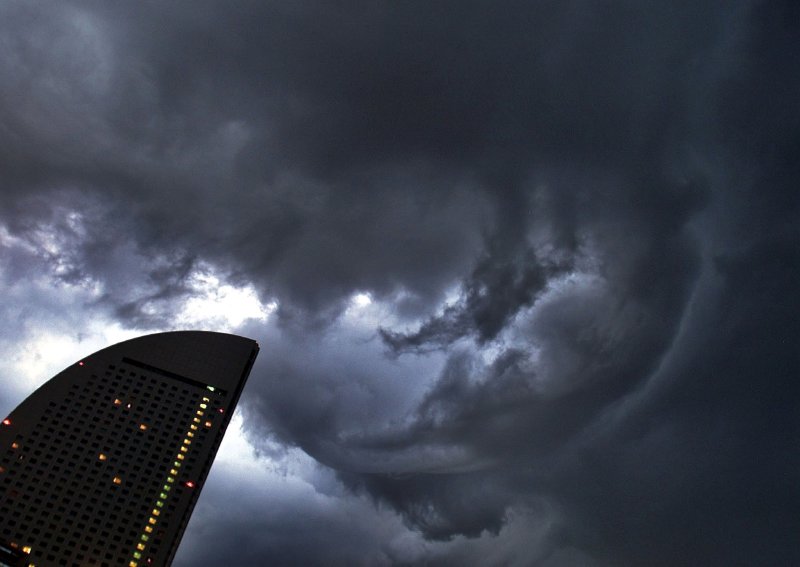
Clouds swirl over the Intercontinental Hotel in Yokohama
11:40 JST, September 2, 2022
Tokyo (Jiji Press)—The Japan Meteorological Agency said Thursday that this year’s early-summer rainy season ended later in many parts of the country than initially announced.
The agency said that the rainy season ended in late July in areas ranging from the Kyushu southwestern region to the Kanto-Koshin eastern and central region.
Previously, the season was believed to have ended in late June, making it the earliest end on record for seven regions.
The change means that five of the seven—Kanto-Koshin, Kinki, Chugoku, Shikoku and northern Kyushu—saw their rainy seasons end later than usual.
The agency was unable to identify the end of the rainy season for the Hokuriku central region and the southern Tohoku region in the country’s northeast, as rainy weather there continued into August.
Japan saw about 10 days of sunny weather around the country from late June, which led the agency to declare the end of the rainy season for the seven regions.
But meandering westerlies caused a series of cloudy and rainy days from mid-July, which the agency has determined should be considered as part of the rainy season.
The agency’s initial reports put the end of the rainy season around June 27 for Kanto-Koshin, June 28 for Hokuriku, Kinki, Chugoku, Shikoku and northern Kyushu and June 29 for southern Tohoku.
After the revision, the rainy season is viewed as having ended around July 22 in Shikoku and northern Kyushu, July 23 for Kanto-Koshin and Kinki and July 26 for Chugoku.
The start dates of the rainy season were also changed in seven regions, including in Tohoku, where it was moved up by nine days.
The agency said the same day that the average temperatures during June-August in northern, eastern and western Japan topped the usual levels by 0.9 degree Celsius, with western Japan tied for the hottest summer since the statistics began in 1946.
In the southernmost prefecture of Okinawa and the nearby island region of Amami, temperatures were higher than in usual years by 0.6 degree.
The amount of rainfall during the three months reached its third-highest level on record, higher than usual by 42 pct, in northern Japan. Rainfall beat average levels by 11 pct in eastern Japan but was lower by 15 pct in Okinawa and Amami and by 17 pct in western Japan.




Most Read
Popular articles in the past 24 hours
-

Toronto Blue Jays’ Kazuma Okamoto Blasts 1st HR of Spring
-
20 Trapped in Tokyo Skytree Lift, Rescued 5½ Hours Later
-
Japan Seeks to Counter China's Expanding Influence in Pacific by ...
-
Japan's Diet Begins Debate on Takaichi's Budget Plans, ‘Proactive...
-

Exhibition Featuring Yoshiharu Tsuge’s Manga World Underway in Ch...
-

CARTOON OF THE DAY (February 24)
-

Hanzomon Line Service Suspended between Kudanshita, Oshiage Stati...
-
Nikkei Rises Over 700 Points to Hit New Intraday High
Popular articles in the past week
-

Producer Behind Pop Group XG Arrested for Cocaine Possession
-

Japan, U.S. Name 3 Inaugural Investment Projects; Reached Agreeme...
-

iPS Treatments Pass Key Milestone, but Broader Applications Far f...
-
Tokyo Skytree's Elevator Stops, Trapping 20 People; All Rescued (...
-

Director Naomi Kawase's New Film Explores Heart Transplants in Ja...
-

Japan’s Major Real Estate Firms Expanding Overseas Businesses to ...
-
Survey Shows False Election Info Perceived as True
-

Milano Cortina 2026: Japan’s Mari Fukada Wins Gold in Women’s Sno...
Popular articles in the past month
-
Producer Behind Pop Group XG Arrested for Cocaine Possession
-

Japan PM Takaichi’s Cabinet Resigns en Masse
-

Japan Institute to Use Domestic Commercial Optical Lattice Clock ...
-

Man Infected with Measles Reportedly Dined at Restaurant in Tokyo...
-

Israeli Ambassador to Japan Speaks about Japan’s Role in the Reco...
-

Videos Plagiarized, Reposted with False Subtitles Claiming ‘Ryuky...
-

Man Infected with Measles May Have Come in Contact with Many Peop...
-

Prudential Life Insurance Plans to Fully Compensate for Damages C...
Top Articles in Society
-
Producer Behind Pop Group XG Arrested for Cocaine Possession
-
Man Infected with Measles Reportedly Dined at Restaurant in Tokyo Station
-
Man Infected with Measles May Have Come in Contact with Many People in Tokyo, Went to Store, Restaurant Around When Symptoms Emerged
-

Woman with Measles Visited Hospital in Tokyo Multiple Times Before Being Diagnosed with Disease
-
Australian Woman Dies After Mishap on Ski Lift in Nagano Prefecture
JN ACCESS RANKING
-
Producer Behind Pop Group XG Arrested for Cocaine Possession
-
Japan PM Takaichi’s Cabinet Resigns en Masse
-
Man Infected with Measles Reportedly Dined at Restaurant in Tokyo Station
-
Israeli Ambassador to Japan Speaks about Japan’s Role in the Reconstruction of Gaza
-
Videos Plagiarized, Reposted with False Subtitles Claiming ‘Ryukyu Belongs to China’; Anti-China False Information Also Posted in Japan