

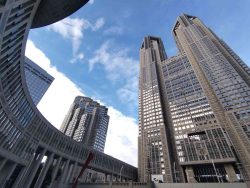
People are seen at a busy crossing in Shibuya, Tokyo.
21:00 JST, May 3, 2022
Sixty percent of people are in favor of constitutional amendment, according to a recent Yomiuri Shimbun survey, up from 56% in a poll conducted last spring.
It is the highest figure recorded since 2015, reflecting growing national security concerns amid Russia’s invasion of Ukraine and North Korean missile launches.
Meanwhile, 38% of respondents were against amending the top law, down from 40% in the previous survey.
Regarding amendment items, the highest number of respondents selected a provision to have armed forces for national self-defense, at 45%, followed by issues regarding emergency measures at 38%, and free education at 36%. Multiple answers were allowed.
On an amendment to Paragraph 2 of Article 9 in the Constitution — which prohibits Japan from having armed forces — 50% of respondents were in favor, up from 46%, while 47% of respondents were against amending the paragraph, unchanged from the previous survey.
Meanwhile, 80% of respondents said there was no need to amend Paragraph 1 of the article on the renunciation of war, unchanged from the previous survey.
Over half of the respondents said the government’s obligations and authority in disasters and pandemics should be stipulated in the Constitution, at 55%, compared to 42% of respondents who said such issues should be covered by standard legislation, not constitutional revision.
Regarding a plan to rezone single-seat constituencies in the House of Representatives to reduce vote-value disparity in national elections, 53% of respondents were in favor of the proposal and 44% were against it.
Support for the plan was higher in municipalities with larger populations. Sixty percent of respondents in major municipalities such as Tokyo’s 23 wards were in favor of the rezoning plan, while in smaller municipalities, 43% of respondents supported the proposal and 53% were against it.
Almost half of the respondents were in favor of merging two prefectures into one constituency for the House of Councillors elections to rectify disparities, at 48%. The same percentage of respondents wanted to scrap such mergers and called for merged constituencies to be reverted back to their original forms, with 27% in favor of legal revisions to achieve this and 21% in favor of constitutional revision.
In the Chugoku and Shikoku regions, which include the merged constituencies of Tottori and Shimane, and Tokushima and Kochi, 41% of respondents were in favor of constituency mergers, while 54% wanted merged constituencies to be reverted, with 30% calling for new legislation and 24% wanting constitutional revision to bring about the change.
In the survey, respondents in small municipalities and merged constituencies tended to be against changes that would decrease the number of lawmakers representing them in the Diet.





Most Read
Popular articles in the past 24 hours
-

Japanese Shipping Giants Halt Strait of Hormuz Transit as Iran Co...
-

U.S. Launches Attacks on Iran: Avoid Escalation of Conflict by An...
-

Sawtooth Roof Factory Stands as Monument to Ashikaga Textile Hist...
-
Parents of Japanese Teen Shot in U.S. Strive for Gun Control
-
Rental Lab Space in Tokyo Area More Than Doubles Since 2010, Offe...
-

Disinformation Spreads About Team Mirai, Ballot Readers; Online P...
-
Asahi Breweries to Stage Comeback with New Product in April; Comp...
-
Bank of Japan Deputy Governor Says Rate Hikes Likely to Continue
Popular articles in the past week
-

Nepal Bus Crash Kills 19 People, Injures 25 Including One Japanes...
-
Milano Cortina 2026: Japanese Gold Medalist Figure Skater Miura S...
-
Tokyo Spends Big on Children, Wins Over Parents
-

McDonald's Japan Raises Prices; Big Mac to Cost ¥500, Double Chee...
-
Japan’s Miura, Kihara Announce Withdrawal from Figure Skating Wor...
-

‘Dry Bonsai’ Gives New Life to Withered Trees, Allows Free Artist...
-

Exhibition Featuring Yoshiharu Tsuge’s Manga World Underway in Ch...
-

Yokohama to Test Out Renewable-Powered Offshore Floating Data Cen...
Popular articles in the past month
-

Producer Behind Pop Group XG Arrested for Cocaine Possession
-

Japan PM Takaichi’s Cabinet Resigns en Masse
-

Man Infected with Measles Reportedly Dined at Restaurant in Tokyo...
-

Israeli Ambassador to Japan Speaks about Japan’s Role in the Reco...
-

Videos Plagiarized, Reposted with False Subtitles Claiming ‘Ryuky...
-

Man Infected with Measles May Have Come in Contact with Many Peop...
-

Prudential Life Insurance Plans to Fully Compensate for Damages C...
-

Woman with Measles Visited Hospital in Tokyo Multiple Times Befor...
Top Articles in Society
-
Producer Behind Pop Group XG Arrested for Cocaine Possession
-
Man Infected with Measles Reportedly Dined at Restaurant in Tokyo Station
-
Man Infected with Measles May Have Come in Contact with Many People in Tokyo, Went to Store, Restaurant Around When Symptoms Emerged
-
Woman with Measles Visited Hospital in Tokyo Multiple Times Before Being Diagnosed with Disease
-

Bus Carrying 40 Passengers Catches Fire on Chuo Expressway; All Evacuate Safely
JN ACCESS RANKING
-
Producer Behind Pop Group XG Arrested for Cocaine Possession
-
Japan PM Takaichi’s Cabinet Resigns en Masse
-
Man Infected with Measles Reportedly Dined at Restaurant in Tokyo Station
-
Israeli Ambassador to Japan Speaks about Japan’s Role in the Reconstruction of Gaza
-
Videos Plagiarized, Reposted with False Subtitles Claiming ‘Ryukyu Belongs to China’; Anti-China False Information Also Posted in Japan