
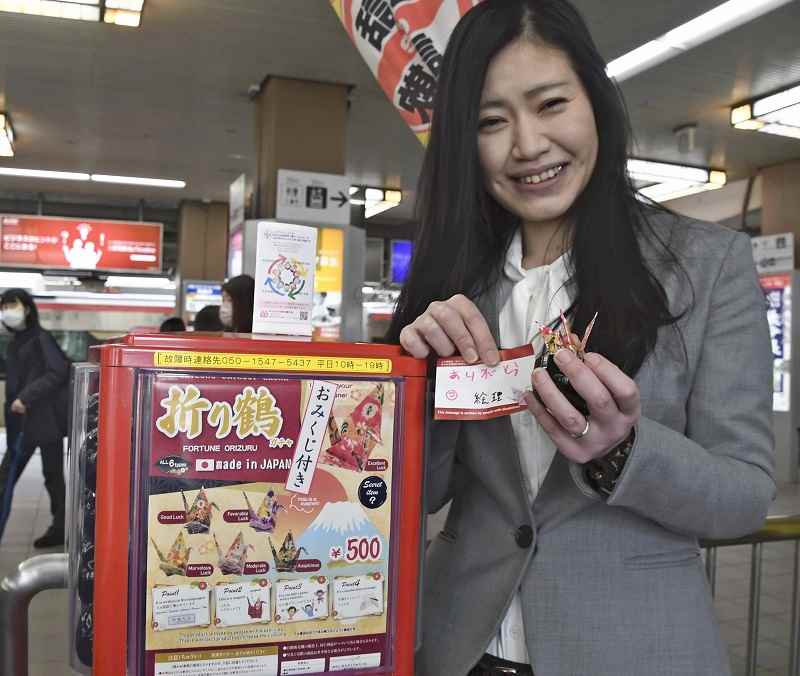
Yoko Okutake shows a capsule toy machine operated by her support network at Keisei Narita Station in Narita, Chiba Prefecture.
2:05 JST, April 25, 2022
NARITA, Chiba — Capsule toy machines that dispense paper cranes along with fortune-telling slips in Narita, Chiba Prefecture, and elsewhere are providing a means of work for people with various types of handicaps. The unique items reflect wishes that days of bustle with many inbound tourists will return after overcoming the COVID-19 crisis.
One of the machines has been installed at Aeon Mall Narita in the city. After inserting a ¥500 coin and turning the nob, a plastic capsule containing a paper crane along with a fortune-telling slip written in five languages, including English, Chinese and Korean, falls out.
There are six types of fortunes on the slips, and because it comes out of a machine, no one knows what fortune they will get.
“It’s very Japan-like and fun. It’s also good for a souvenir,” said a man from Britain who lives in the city.
Three such machines have been installed in Narita since end of last year, as well as one at Keisei Ueno Station in Taito Ward, Tokyo.
The machines are operated by the Support Network P&P for Employment of Handicapped People based in Kashiwa, Chiba Prefecture, in cooperation with nine workshops that support the employment of handicapped people. People with mental and physical handicaps share the production steps, such as folding paper into cranes, putting items into capsules and writing messages.
“Even people with handicaps can contribute to the production with skills they are good at,” said Yoko Okutake, the representative of the network.
Amid the prolonged coronavirus crisis, support workshops for handicapped people have suffered. Especially, according to Okutake, cancelations of music concerts and other events have especially impacted such workshops, because jobs as such checking and packaging event-related goods, which the workshops often take on, have drastically declined.
To overcome this, Okutake started to consider what kind of products with compatible production steps the network of workshops could produce.
Noticing that foreign tourists have a habit of grabbing unique souvenirs right before they leave Japan, Okutake came up the idea of combining paper cranes — easy to make even for handicapped people — capsule toys, which are popular among foreigners, and the fun of fortune-telling.
Setting the price a bit high means wages are higher than conventional jobs available at such workshops.
“People from various countries will learn about Japanese culture [through the items],” said a woman in her 50s who works at a workshop in Kashiwa, the same prefecture. “I’m also happy that the wage is rather high.”
Entry restrictions for newly arriving foreigners were significantly eased in March, but there is no bright outlook for the return to normal on inbound tourism.
“I hope sales of our product will lead to more support for handicapped people getting jobs,” said Okutake.




Most Read
Popular articles in the past 24 hours
-

3,000 Accounts Posting, Spreading Content Critical of Japan on X;...
-

Milano Cortina 2026: Sakamoto Serves as Flag Bearer; Japan Earns ...
-

Milano Cortina 2026: There Were Cheers across the Country, after ...
-

A Packed Bus Plunges off a Nepal Highway, Killing 19 and Injuring...
-
Luna Sea Drummer Shinya Dies at 56; Powerful Drummer Behind ‘Desi...
-

Milano Cortina 2026: ‘Magical’ Italian Games Close wi...
-

Milano Cortina 2026: Riku-Ryu Duo Stick Together During Closing C...
-

Emperor Receives Well-Wishes from Public on His 66th Birthday
Popular articles in the past week
-

Japan PM Takaichi’s Cabinet Resigns en Masse
-

Man Infected with Measles Reportedly Dined at Restaurant in Tokyo...
-

Sanae Takaichi Elected Prime Minister of Japan; Keeps All Cabinet...
-

Japan's Govt to Submit Road Map for Growth Strategy in March, PM ...
-

Bus Carrying 40 Passengers Catches Fire on Chuo Expressway; All E...
-

U.S. Firm to Build Training Hub in Fukushima N-plant for Debris R...
-

Japan, U.S. Name 3 Inaugural Investment Projects; Reached Agreeme...
-

Riku-Ryu Pair Wins Gold Medal: Their Strong Bond Leads to Major C...
Popular articles in the past month
-
Japan PM Takaichi’s Cabinet Resigns en Masse
-

Japan Institute to Use Domestic Commercial Optical Lattice Clock ...
-

Israeli Ambassador to Japan Speaks about Japan’s Role in the Reco...
-
Man Infected with Measles Reportedly Dined at Restaurant in Tokyo...
-

Videos Plagiarized, Reposted with False Subtitles Claiming ‘Ryuky...
-

Man Infected with Measles May Have Come in Contact with Many Peop...
-

Prudential Life Insurance Plans to Fully Compensate for Damages C...
-

Woman with Measles Visited Hospital in Tokyo Multiple Times Befor...
Top Articles in Society
-

Producer Behind Girls Group XG Arrested for Cocaine Possession
-
Man Infected with Measles Reportedly Dined at Restaurant in Tokyo Station
-
Man Infected with Measles May Have Come in Contact with Many People in Tokyo, Went to Store, Restaurant Around When Symptoms Emerged
-
Woman with Measles Visited Hospital in Tokyo Multiple Times Before Being Diagnosed with Disease
-

Australian Woman Dies After Mishap on Ski Lift in Nagano Prefecture
JN ACCESS RANKING
-
Japan PM Takaichi’s Cabinet Resigns en Masse
-
Japan Institute to Use Domestic Commercial Optical Lattice Clock to Set Japan Standard Time
-
Israeli Ambassador to Japan Speaks about Japan’s Role in the Reconstruction of Gaza
-
Man Infected with Measles Reportedly Dined at Restaurant in Tokyo Station
-
Videos Plagiarized, Reposted with False Subtitles Claiming ‘Ryukyu Belongs to China’; Anti-China False Information Also Posted in Japan