
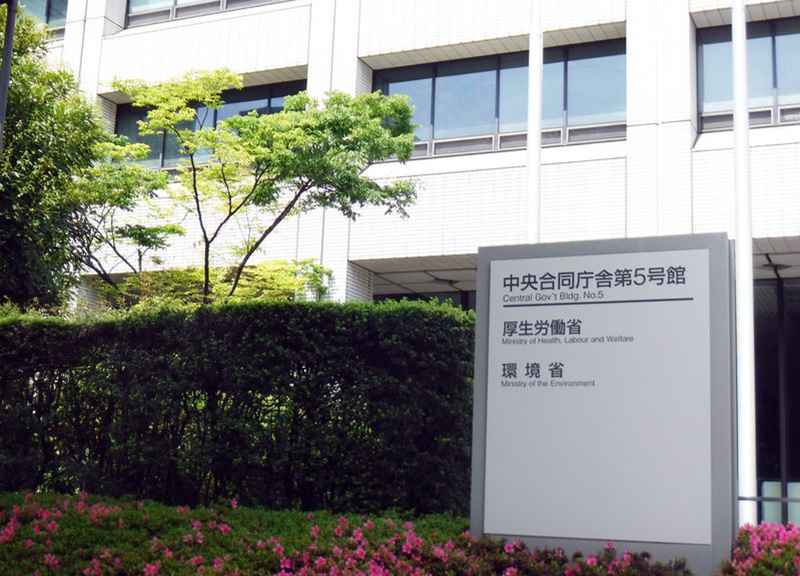
The building that houses the Health, Labor and Welfare Ministry in Chiyoda Ward, Tokyo
16:38 JST, February 9, 2022
Hospitalized COVID-19 patients whose symptoms are not expected to worsen will be discharged as early as four days after admission under a new government policy to strengthen countermeasures against the omicron coronavirus variant.
The Health, Labor and Welfare Ministry, which announced the policy Tuesday, aims to prevent a shortage of COVID beds by encouraging hospitals to release patients earlier.
According to the government’s criteria, coronavirus patients are categorized into four stages in order of severity: severe (if a ventilator is required); moderate I and II (patients with pneumonia or breathing difficulties); and mild.
Under the new policy, patients who have not reached the moderate II level four days after admission will be encouraged to recuperate at government-provided accommodation facilities or return home.
The policy also recommends patients categorized as moderate I or mild to “proactively consider” transferring to a backup hospital.
Currently, hospital discharge is determined by doctors based on government criteria, under which COVID-19 patients with mild or moderate symptoms can be sent home if at least 10 days have passed since the onset of symptoms and at least 72 hours have passed since their recovery, among other factors.
The government had been calling for hospitals to consider discharging patients within 10 days of the onset of the disease if their condition is mild. The new policy provides concrete guidelines to encourage early discharge, based on National Hospital Organization data released in January showing that only 0.9% of patients were classified as moderate II or severe four days after hospitalization.
However, the government has asked hospitals to be careful about elderly patients as they may become seriously ill even after four days.
The new policy also calls for boosting medical services at temporary healthcare centers, government-designated accommodation and elderly facilities to ensure that patients who are discharged early have somewhere to go.
When quasi-emergency measures are in place, the government will increase the subsidies for medical institutions that dispatch nurses and other staff to such facilities from ¥5,520 to ¥8,280 an hour per person.
The government also plans to expand the number of logistical support hospitals that accept patients after their condition has improved.
The new policy included a recommendation for children aged 2 and older to “wear masks as much as possible,” as part of measures to prevent the spread of the virus at nurseries.
Under the policy, parents will not have to pay for substitute childcare centers that look after their children when their regular nurseries or other such facilities are closed for pandemic-related reasons, as the government plans to increase the subsidy for such services.
Workplace rollout to start Feb. 21
The workplace booster vaccination rollout will start on Feb. 21, Noriko Horiuchi, the minister in charge of promoting vaccinations, announced at a press conference Tuesday.
It was initially scheduled to start on Feb. 28, but some companies were able to start earlier than planned.
On Tuesday, Horiuchi met separately with Kenro Hori, chairman of the Japan Dental Association, and Nobuo Yamamoto, chairman of the Japan Pharmaceutical Association, and asked them to encourage dental patients and pharmacy customers to get vaccinated.






Most Read
Popular articles in the past 24 hours
-
Japan's Budget on Track for Quick Passage, but Ruling Parties to ...
-

Ransomware Attacks Hitting Japan's Small, Midsize Firms
-

German Journalist Traces Footsteps of Great-Grandfather Who Was P...
-

10 Foreign Tourists Sustain Injuries After Fire at Capsule Hotel ...
-

World Baseball Classic: Venezuela Beats Japan in Nail-biting Back...
-

World Baseball Classic: Red Sox’s Abreu Hits 3-run Homer, Giving ...
-

World Baseball Classic: Venezuela Beats Japan in Back-and-Forth Q...
-
Rapid Services on JR Chuo Line Suspended; Accident at Kokubunji S...
Popular articles in the past week
-

Japan Figure Skating Legend Yuzuru Hanyu Is Proud Disaster Surviv...
-
Govt to Utilize ODA for Ensuring Economic Security; Securing Ener...
-
15 Measles Patients Confirmed in Tokyo in Past 6 Days; 1 May Have...
-
Massive Sewer Pipe Found Jutting Out of Highway in Osaka
-
Japan Govt to Tighten Requirements to Receive Permanent Residency...
-
Power Outage Forces About 980 Passengers in Yokohama to Walk to T...
-
JR Tokai Breaks Ground on Yamanashi Maglev Station; Will Be Part ...
-

Parents in Japan to Get Instagram Notifications When Teens Repeat...
Popular articles in the past month
-

Producer Behind Pop Group XG Arrested for Cocaine Possession
-

Japan PM Takaichi’s Cabinet Resigns en Masse
-

Man Infected with Measles Reportedly Dined at Restaurant in Tokyo...
-
Japan Figure Skating Legend Yuzuru Hanyu Is Proud Disaster Surviv...
-

iPS Treatments Pass Key Milestone, but Broader Applications Far f...
-

Sanae Takaichi Elected Prime Minister of Japan; Keeps All Cabinet...
-

South Korea Tightens Rules on Foreigners Buying Homes in Seoul Me...
-

Nepal Bus Crash Kills 19 People, Injures 25 Including One Japanes...
Top Articles in Society
-
Producer Behind Pop Group XG Arrested for Cocaine Possession
-
Man Infected with Measles Reportedly Dined at Restaurant in Tokyo Station
-
15 Measles Patients Confirmed in Tokyo in Past 6 Days; 1 May Have Come into Contact with Many in Shibuya
-

Bus Carrying 40 Passengers Catches Fire on Chuo Expressway; All Evacuate Safely
-

Ibaraki Pref.’s 1st Foreign Bus Driver Hired in Tsukuba
JN ACCESS RANKING
-
Producer Behind Pop Group XG Arrested for Cocaine Possession
-
Japan PM Takaichi’s Cabinet Resigns en Masse
-
Man Infected with Measles Reportedly Dined at Restaurant in Tokyo Station
-
Japan Figure Skating Legend Yuzuru Hanyu Is Proud Disaster Survivor and Gold Medalist, Vows to Continue Support Efforts
-
iPS Treatments Pass Key Milestone, but Broader Applications Far from Guaranteed