
17:28 JST, January 20, 2022
Quasi-emergency priority measures implemented in Hiroshima, Yamaguchi and Okinawa prefectures on Jan. 9 seem to have blunted the spike in novel coronavirus cases, with some experts predicting that the peak may have passed in some areas.
New cases in these prefectures have largely leveled off, apparently due to restrictions imposed under the measures.
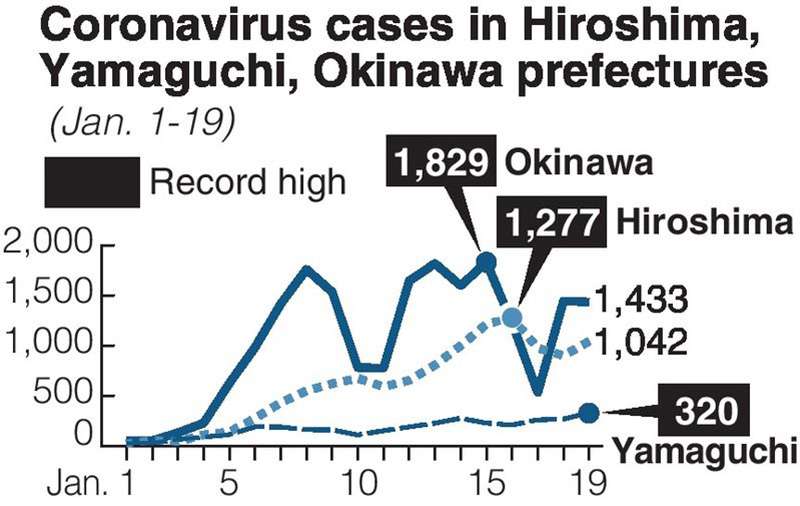
Daily cases in Okinawa Prefecture surged from 51 on Jan. 2 to 1,759 on Jan. 8. The prefecture logged a record 1,829 new cases on Jan. 15, but signs of a downward trend are emerging. The prefecture has logged lower tallies than the figure confirmed on the same day a week earlier, over the last few days.
Hiroshima Prefecture logged a record 1,277 new cases on Jan. 16, but since then daily cases have hovered around 900 to 1,000. Case numbers also have plateaued in the city of Iwakuni in Yamaguchi Prefecture.
Dining establishments in the three prefectures are being asked to shorten their business hours and limit customer numbers.
Yamaguchi and Hiroshima have also asked restaurants and bars not to serve alcohol, while Okinawa is allowing establishments to do so if they have received official certification for their infection prevention measures.
However, an association comprising 1,000 restaurants in Okinawa Prefecture said about 70% of its members have decided to close for the time being.
“Some of the establishments that ignored previous requests to suspend their operations have closed their doors this time,” a prefectural government official told The Yomiuri Shimbun. “It seems there is a strong sense of urgency among business operators because of the spread of the highly infectious omicron variant.”
On Jan. 8, the infection routes of new cases that were linked to friends and acquaintances or dining establishments stood at 47.9% in the prefecture, but the figure had fallen to 9.8% by Wednesday. Recently, many new cases have been linked to family members.
“The restrictions have had a massive impact,” said University of the Ryukyus Prof. Jiro Fujita, who heads the Okinawa prefectural government’s expert panel. “I think this wave of infections has almost reached its peak.”
Hiroshima Gov. Hidehiko Yuzaki believes the situation in his prefecture is also set to improve. “The number of cases could start declining soon,” Yuzaki said at a press conference Tuesday.
Fujita urged other local governments to learn from how these prefectures responded following the latest outbreaks.
“The omicron variant is like the seasonal flu in that it has a short incubation period, among other similarities. Infections can increase rapidly, but it’s possible that the time needed to bring the situation under control will also be shorter,” Fujita said. “Other local governments should understand that there will be a tough fight ahead, but it will be short term.”






Most Read
Popular articles in the past 24 hours
-

Ransomware Attacks Hitting Japan's Small, Midsize Firms
-
Japan's Budget on Track for Quick Passage, but Ruling Parties to ...
-

German Journalist Traces Footsteps of Great-Grandfather Who Was P...
-

10 Foreign Tourists Sustain Injuries After Fire at Capsule Hotel ...
-

World Baseball Classic: Venezuela Beats Japan in Nail-biting Back...
-
Rapid Services on JR Chuo Line Suspended; Accident at Kokubunji S...
-
Rapid Services Resume on JR Chuo Line; Suspension Caused by Accid...
-

World Baseball Classic: Red Sox’s Abreu Hits 3-run Homer, Giving ...
Popular articles in the past week
-

Japan Figure Skating Legend Yuzuru Hanyu Is Proud Disaster Surviv...
-
Govt to Utilize ODA for Ensuring Economic Security; Securing Ener...
-
15 Measles Patients Confirmed in Tokyo in Past 6 Days; 1 May Have...
-
Massive Sewer Pipe Found Jutting Out of Highway in Osaka
-
Japan Govt to Tighten Requirements to Receive Permanent Residency...
-
Power Outage Forces About 980 Passengers in Yokohama to Walk to T...
-
JR Tokai Breaks Ground on Yamanashi Maglev Station; Will Be Part ...
-

Parents in Japan to Get Instagram Notifications When Teens Repeat...
Popular articles in the past month
-

Producer Behind Pop Group XG Arrested for Cocaine Possession
-

Japan PM Takaichi’s Cabinet Resigns en Masse
-

Man Infected with Measles Reportedly Dined at Restaurant in Tokyo...
-
Japan Figure Skating Legend Yuzuru Hanyu Is Proud Disaster Surviv...
-

iPS Treatments Pass Key Milestone, but Broader Applications Far f...
-

Sanae Takaichi Elected Prime Minister of Japan; Keeps All Cabinet...
-

South Korea Tightens Rules on Foreigners Buying Homes in Seoul Me...
-

Nepal Bus Crash Kills 19 People, Injures 25 Including One Japanes...
Top Articles in Society
-
Producer Behind Pop Group XG Arrested for Cocaine Possession
-
Man Infected with Measles Reportedly Dined at Restaurant in Tokyo Station
-
15 Measles Patients Confirmed in Tokyo in Past 6 Days; 1 May Have Come into Contact with Many in Shibuya
-

Bus Carrying 40 Passengers Catches Fire on Chuo Expressway; All Evacuate Safely
-

Ibaraki Pref.’s 1st Foreign Bus Driver Hired in Tsukuba
JN ACCESS RANKING
-
Producer Behind Pop Group XG Arrested for Cocaine Possession
-
Japan PM Takaichi’s Cabinet Resigns en Masse
-
Man Infected with Measles Reportedly Dined at Restaurant in Tokyo Station
-
Japan Figure Skating Legend Yuzuru Hanyu Is Proud Disaster Survivor and Gold Medalist, Vows to Continue Support Efforts
-
iPS Treatments Pass Key Milestone, but Broader Applications Far from Guaranteed