
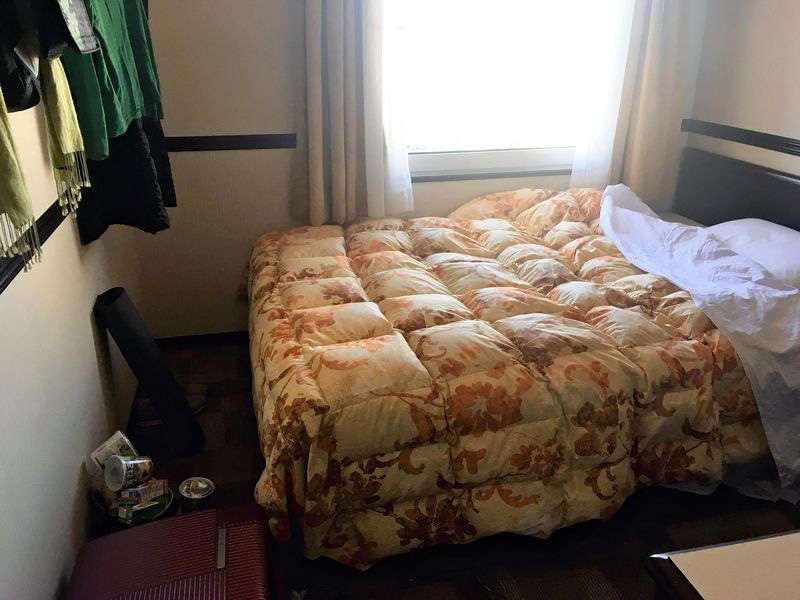
A hotel room for the quarantine of close contacts
16:40 JST, December 28, 2021
Municipalities are breathing a sigh of relief at the government’s decision to narrow the definition of people in close contact with airplane passengers infected with the omicron variant of the coronavirus, as they were on the verge of running out of accommodations to house them.
However, the revision only applies to people who enter Japan from Tuesday Dec. 28 and later, and people already self-isolating at accommodation facilities are lamenting their inability to spend the New Year holidays with their families.
Quick decision
Chiba Prefecture, which is home to Narita Airport, has secured about 900 rooms. They are currently occupied by 770 close contacts.
On Monday, Chiba Gov. Toshihito Kumagai asked Health, Labor and Welfare Minister Shigeyuki Goto to review the government’s definition of a close contact.
“If it hadn’t been reviewed quickly, our facilities would have overflowed eventually,” Kumagai said. “Many people are expected to return to Japan at the end of the year. We appreciate the government’s decision at this time.”
Following the spread of the omicron variant overseas, the government tightened the criteria for close contacts.
A close contact had been defined as a passenger who sat somewhere within five rows — in the same row, or in the two in front and back — of a person infected with the novel coronavirus on an airplane. In the case of passengers who tested positive for the omicron variant, however, all passengers on board the same plane were defined as close contacts, and had to stay at facilities prepared either by central or local governments for 14 days after their arrival.
Some municipalities coped with the strict criteria by moving close contacts to rooms secured for COVID-19 patients. However, the rapid increase had filled up the facilities, overwhelming some municipalities.
The government’s revision will not apply retroactively to flights that returned to Japan before Tuesday.
“Frankly, I was appalled by the change,” said a Tokyo company executive in his 50s who has quarantined at a hotel in Chiba Prefecture since Dec. 22. “I wanted to go back to my hometown in Aichi Prefecture with my kids during the New Year holidays. I want my time back.”
A 23-year-old college student from the Kansai region has been in a hotel since Dec. 19.
“I was supposed to spend the Christmas and New Year’s holidays with my family. It’s hard to live in a small room, but that was the decision at that time, so it can’t be helped,” the student said.
Exceptions to the rule
Some municipalities that have no more room in their facilities are allowing close contacts to self-isolate at home.
Since Dec. 16, the Kanagawa prefectural government has let close contacts stay at home on the condition that they can sufficiently isolate themselves there and do not live with elderly people or others who are at high risk of infection.
As of Saturday, the prefecture had 1,241 close contacts and could not accommodate them all in the 339 rooms it had prepared.
“Given the need to secure facilities for COVID-19 patients, there are only limited rooms available for close contacts,” a prefectural government official said.







Most Read
Popular articles in the past 24 hours
-
Japan's Budget on Track for Quick Passage, but Ruling Parties to ...
-

Ransomware Attacks Hitting Japan's Small, Midsize Firms
-

Japan-Based USS Tripoli, Marine Unit to Be Sent to Middle East, U...
-
7 Men Arrested Over Robbery of ¥423 Mil. on Tokyo Street; Members...
-

German Journalist Traces Footsteps of Great-Grandfather Who Was P...
-

10 Foreign Tourists Sustain Injuries After Fire at Capsule Hotel ...
-

World Baseball Classic: Red Sox’s Abreu Hits 3-run Homer, Giving ...
-

Shohei Ohtani Homers in WBC Q’final Against Venezuela; Pitch by J...
Popular articles in the past week
-

Japan Figure Skating Legend Yuzuru Hanyu Is Proud Disaster Surviv...
-
Govt to Utilize ODA for Ensuring Economic Security; Securing Ener...
-
15 Measles Patients Confirmed in Tokyo in Past 6 Days; 1 May Have...
-
Massive Sewer Pipe Found Jutting Out of Highway in Osaka
-
Japan Govt to Tighten Requirements to Receive Permanent Residency...
-
Power Outage Forces About 980 Passengers in Yokohama to Walk to T...
-
JR Tokai Breaks Ground on Yamanashi Maglev Station; Will Be Part ...
-

Imperial Family Watches World Baseball Classic Game Against Austr...
Popular articles in the past month
-

Producer Behind Pop Group XG Arrested for Cocaine Possession
-

Japan PM Takaichi’s Cabinet Resigns en Masse
-

Man Infected with Measles Reportedly Dined at Restaurant in Tokyo...
-
Japan Figure Skating Legend Yuzuru Hanyu Is Proud Disaster Surviv...
-

iPS Treatments Pass Key Milestone, but Broader Applications Far f...
-

Sanae Takaichi Elected Prime Minister of Japan; Keeps All Cabinet...
-

South Korea Tightens Rules on Foreigners Buying Homes in Seoul Me...
-

Nepal Bus Crash Kills 19 People, Injures 25 Including One Japanes...
Top Articles in Society
-
Producer Behind Pop Group XG Arrested for Cocaine Possession
-
Man Infected with Measles Reportedly Dined at Restaurant in Tokyo Station
-
15 Measles Patients Confirmed in Tokyo in Past 6 Days; 1 May Have Come into Contact with Many in Shibuya
-

Bus Carrying 40 Passengers Catches Fire on Chuo Expressway; All Evacuate Safely
-

Ibaraki Pref.’s 1st Foreign Bus Driver Hired in Tsukuba
JN ACCESS RANKING
-
Producer Behind Pop Group XG Arrested for Cocaine Possession
-
Japan PM Takaichi’s Cabinet Resigns en Masse
-
Man Infected with Measles Reportedly Dined at Restaurant in Tokyo Station
-
Japan Figure Skating Legend Yuzuru Hanyu Is Proud Disaster Survivor and Gold Medalist, Vows to Continue Support Efforts
-
iPS Treatments Pass Key Milestone, but Broader Applications Far from Guaranteed