
15:03 JST, March 2, 2021
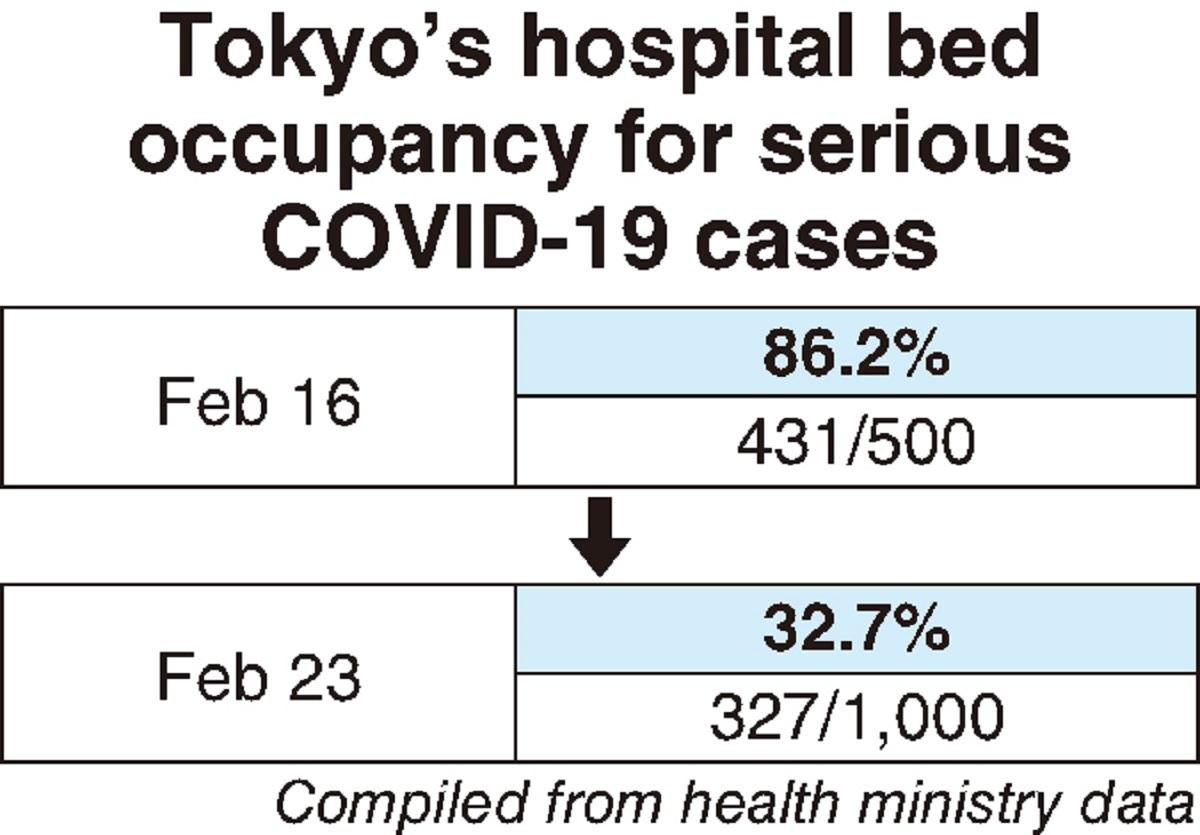
The occupancy rate of hospital beds for seriously ill COVID-19 patients in Tokyo has dropped to 32.7% as of Feb. 23 from the previous week’s 86.2%, according to the weekly figure released by the Health, Labor and Welfare Ministry.
The fall in the rate is mainly because the number of such hospital beds secured in Tokyo increased to 1,000 from 500 when counted under the standards set by the ministry.
Thus, the occupancy rate in Tokyo has dipped into the Stage 3 level of 20% or above from the worst level of Stage 4, which is 50% or above. This will likely have an impact on the ongoing discussions regarding the lifting of the state of emergency in place for Tokyo. The surrounding prefectures of Kanagawa, Chiba and Saitama are also under the state of emergency.
The ministry defines seriously ill COVID-19 patients mainly as those who are admitted to intensive care units (ICU) or advanced care units, and calculates the number of beds for the seriously ill based on the capacity of ICUs and such advanced care units.
On the other hand, the Tokyo metropolitan government had set its own criteria for the seriously ill, who “are considered to be those patients who need ventilators or ECMO.”
The metropolitan government had been reporting to the ministry the number of beds that can handle patients falling into this category only.
However, because Tokyo’s standards differ from those in other prefectures, the ministry in January requested the metropolitan government to adjust them to those set by the ministry.
Subsequently, the metropolitan government checked the number of beds in each medical institution under the ministry’s criteria to confirm in February that there were 1,000 beds available for the severely ill.
On Feb. 16, there were 431 seriously ill patients for 500 beds (86.2%) in Tokyo. Under the new counting method, the occupancy rate on Feb. 23 showed 327 patients for 1,000 beds (32.7%).
“The metropolitan government has now adopted the index that makes the Tokyo situation comparable to the others across the country, so we can discuss it under the same conditions,” said a senior ministry official.
A senior metropolitan government official said: “The number of seriously ill patients has been decreasing, but it is still higher than what we had during the peak of the second wave last summer. The health care system continues to be under strain, and the situation remains unpredictable.”






Most Read
Popular articles in the past 24 hours
-

Moai Statue Shows Lasting Bond Between Miyagi Pref. Town, Easter ...
-
Japan's Defense Ministry: North Korea Appears to Have Fired Balli...
-

Milano Cortina 2026: Japan’s Oguri Wins Para Snowboard Silver at ...
-

National Intelligence Council: Proposed Body Must Be Utilized To ...
-

Aichi Fisheries Cooperatives Use Smart Tech to Farm Triploid Oyst...
-
Teachers Support Students’ Inquiry Learning behind the Scenes
-
Japan's Lower House Passes Budget Proposal; Could Be Delayed in U...
-

CARTOON OF THE DAY (March 14)
Popular articles in the past week
-

Japan Figure Skating Legend Yuzuru Hanyu Is Proud Disaster Surviv...
-
Govt to Utilize ODA for Ensuring Economic Security; Securing Ener...
-
15 Measles Patients Confirmed in Tokyo in Past 6 Days; 1 May Have...
-
Massive Sewer Pipe Found Jutting Out of Highway in Osaka
-
Japan Govt to Tighten Requirements to Receive Permanent Residency...
-
JR Tokai Breaks Ground on Yamanashi Maglev Station; Will Be Part ...
-
Power Outage Forces About 980 Passengers in Yokohama to Walk to T...
-

Beckoning Cats Get Makeover to Fit Modern Lifestyles with Sleek D...
Popular articles in the past month
-

Producer Behind Pop Group XG Arrested for Cocaine Possession
-

Japan PM Takaichi’s Cabinet Resigns en Masse
-

Man Infected with Measles Reportedly Dined at Restaurant in Tokyo...
-

Videos Plagiarized, Reposted with False Subtitles Claiming ‘Ryuky...
-
Japan Figure Skating Legend Yuzuru Hanyu Is Proud Disaster Surviv...
-

iPS Treatments Pass Key Milestone, but Broader Applications Far f...
-

Sanae Takaichi Elected Prime Minister of Japan; Keeps All Cabinet...
-

Nepal Bus Crash Kills 19 People, Injures 25 Including One Japanes...
Top Articles in Society
-
Producer Behind Pop Group XG Arrested for Cocaine Possession
-
Man Infected with Measles Reportedly Dined at Restaurant in Tokyo Station
-
15 Measles Patients Confirmed in Tokyo in Past 6 Days; 1 May Have Come into Contact with Many in Shibuya
-

Bus Carrying 40 Passengers Catches Fire on Chuo Expressway; All Evacuate Safely
-

Ibaraki Pref.’s 1st Foreign Bus Driver Hired in Tsukuba
JN ACCESS RANKING
-
Producer Behind Pop Group XG Arrested for Cocaine Possession
-
Japan PM Takaichi’s Cabinet Resigns en Masse
-
Man Infected with Measles Reportedly Dined at Restaurant in Tokyo Station
-
Videos Plagiarized, Reposted with False Subtitles Claiming ‘Ryukyu Belongs to China’; Anti-China False Information Also Posted in Japan
-
Japan Figure Skating Legend Yuzuru Hanyu Is Proud Disaster Survivor and Gold Medalist, Vows to Continue Support Efforts