
Pond Frogs Resistant to Hornet’s Venom, Study Finds; Discovery Could Aid Medical Research (Update 1)
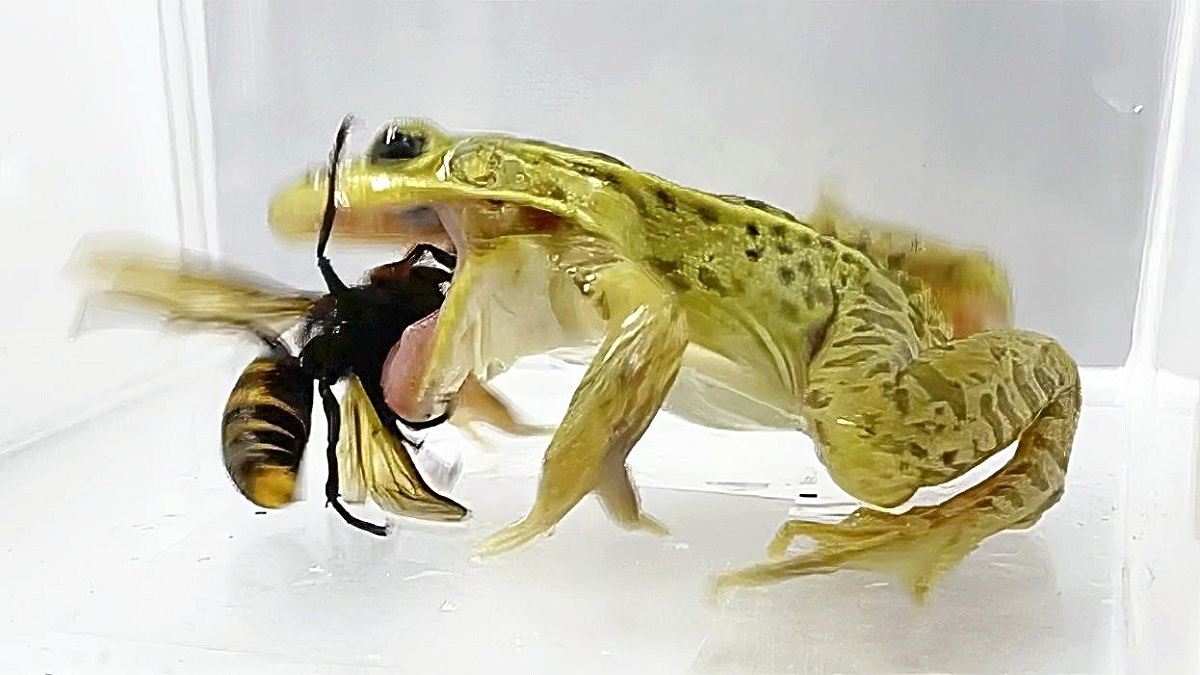
A black-spotted pond frog preys on a hornet.
16:21 JST, December 6, 2025 (updated at 14:40 JST, Dec. 7)
Black-spotted pond frogs can survive the sting of a giant hornet, a research team from Kobe University has confirmed.
Understanding how the frogs, which are commonly found in rice paddies in Japan, withstand the stings could potentially help reduce the severe pain experienced by humans when they are stung by a hornet, according to the team.
In addition to pain, hornet venom can cause tissue destruction, hemolysis and cardiac dysfunction. It can also kill small animals such as mice. Birds and spiders are known predators of the insect, but dead hornets have also been found in the frogs’ stomachs.
The research team led by Kobe University Prof. Shinji Sugiura, an expert in ecology, conducted an experiment in which they put live hornets, including Asian giant hornets, in close proximity to wild pond frogs.
The results showed that 43 of the 45 frogs attacked the hornets, and 37 of them successfully ate them. The frogs were repeatedly stung in the face, throat and inside the mouth, but they neither weakened nor died.
The research team published their findings in an international academic journal. They said there is a possibility that the tongues and throats of the amphibians can withstand stings, and that their bodies may have mechanisms to detoxify the venom and neutralize the pain.
“If we can elucidate the mechanisms behind their venom resistance and pain suppression, it could be useful for researching pain relief and anti-inflammation,” said Sugiura.








Most Read
Popular articles in the past 24 hours
-

JR Tokai Breaks Ground on Yamanashi Maglev Station; Will Be Part ...
-

‘King Kazu’ Discusses His Connection to Fukushima
-

Japan’s Gunma Official Suspended For Unauthorized Absence From Wo...
-

Milano Cortina 2026: Japan’s Alpine Skier Muraoka Extends P...
-
Rising Kabuki Star Works to Ensure Deaf Audience's Enjoyment of P...
-

Lady Bess: Iroha Okuda, Mayuko Kominami Discuss Performing Elizab...
-

Trump Discourages Iranian Soccer Team from Attending the World Cu...
-

Driver Dies in Collision with Express Train at Crossing in Mito; ...
Popular articles in the past week
-

Japan Figure Skating Legend Yuzuru Hanyu Is Proud Disaster Surviv...
-

Nippon Life Insurance's U.S. Arm Sues OpenAI Over Legal Assistanc...
-

Govt to Utilize ODA for Ensuring Economic Security; Securing Ener...
-

Massive Sewer Pipe Found Jutting Out of Highway in Osaka
-
15 Measles Patients Confirmed in Tokyo in Past 6 Days; 1 May Have...
-

Beckoning Cats Get Makeover to Fit Modern Lifestyles with Sleek D...
-

Japan Govt to Tighten Requirements to Receive Permanent Residency...
-

Japan Govt Survey Finds Just 10% of Workers Want Working Hours to...
Popular articles in the past month
-

Producer Behind Pop Group XG Arrested for Cocaine Possession
-

Japan PM Takaichi’s Cabinet Resigns en Masse
-

Man Infected with Measles Reportedly Dined at Restaurant in Tokyo...
-

Videos Plagiarized, Reposted with False Subtitles Claiming ‘Ryuky...
-
Japan Figure Skating Legend Yuzuru Hanyu Is Proud Disaster Surviv...
-

iPS Treatments Pass Key Milestone, but Broader Applications Far f...
-

Sanae Takaichi Elected Prime Minister of Japan; Keeps All Cabinet...
-

Nepal Bus Crash Kills 19 People, Injures 25 Including One Japanes...
Top Articles in Science & Nature
-
iPS Treatments Pass Key Milestone, but Broader Applications Far from Guaranteed
-

Record 700 Startups to Gather at SusHi Tech Tokyo in April; Event Will Center on Themes Like Artificial Intelligence and Robotics
-
iPS Cell Products for Parkinson’s, Heart Disease OK’d for Commercialization by Japan Health Ministry Panel
-

Japan to Ban Use of Power Banks on Airplanes
-

Parents in Japan to Get Instagram Notifications When Teens Repeatedly Search for Suicide Content
JN ACCESS RANKING
-
Producer Behind Pop Group XG Arrested for Cocaine Possession
-
Japan PM Takaichi’s Cabinet Resigns en Masse
-
Man Infected with Measles Reportedly Dined at Restaurant in Tokyo Station
-
Videos Plagiarized, Reposted with False Subtitles Claiming ‘Ryukyu Belongs to China’; Anti-China False Information Also Posted in Japan
-
Japan Figure Skating Legend Yuzuru Hanyu Is Proud Disaster Survivor and Gold Medalist, Vows to Continue Support Efforts