
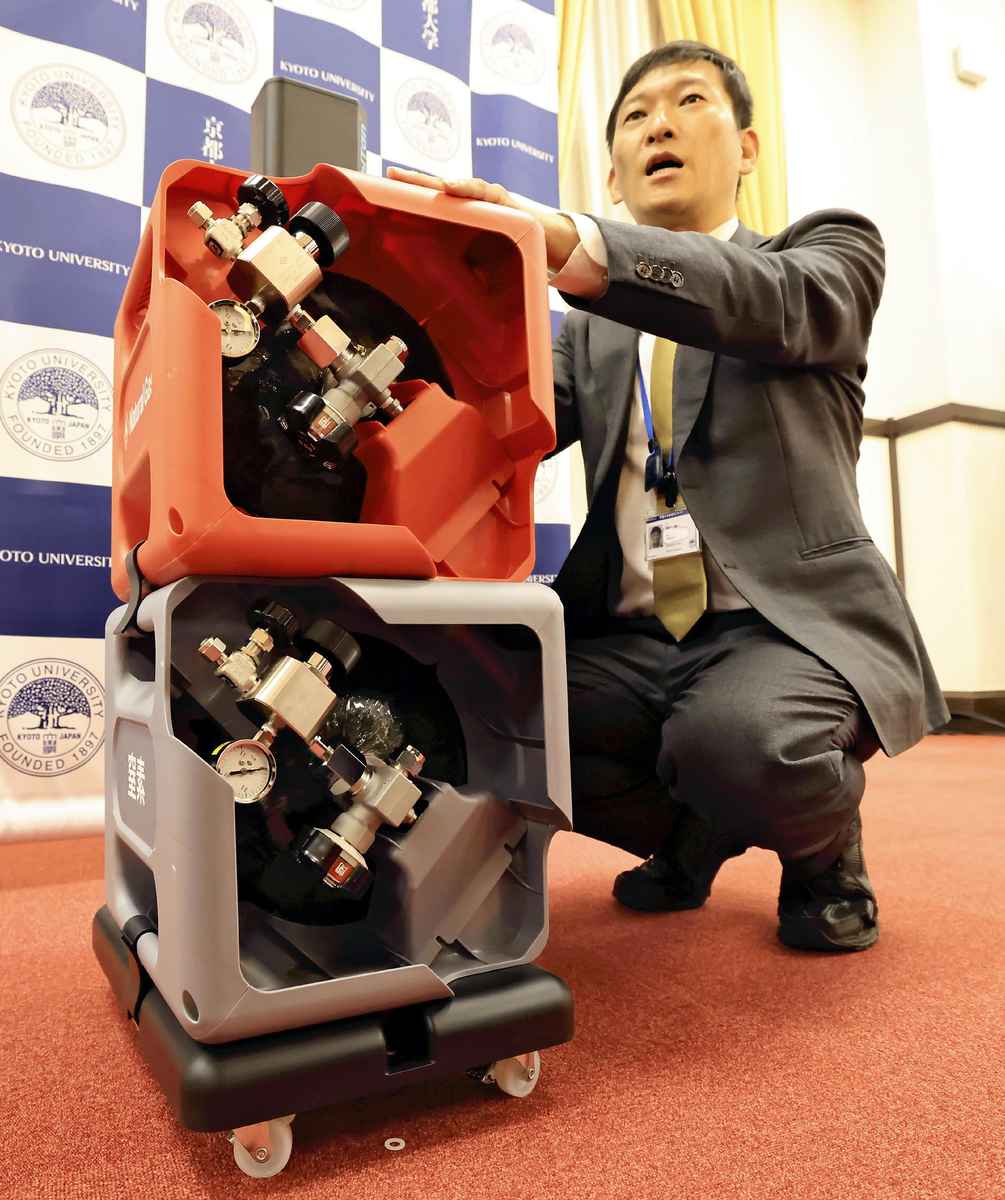
CubiTans, advanced high-pressure gas containers designed for efficient gas storage, are seen in Sakyo Ward, Kyoto, on Wednesday.
15:08 JST, October 9, 2025
Metal-organic frameworks (MOFs) are starting to see real-world use both in Japan and aboard, thanks primarily to the efforts of startups. Kyoto University Distinguished Prof. Susumu Kitagawa won the Nobel Prize in Chemistry on Wednesday for their work in the development of MOFs.
In 2015, former staff of Kitagawa’s laboratory, along with others, established the Kobe-based Atomis Inc., a Kyoto University spin-off focused on developing products using MOFs. The firm developed CubiTan, an advanced high-pressure gas container for more efficient gas storage and distribution, taking advantage of the MOF’s ability to absorb large amounts of gas. CubiTan was exhibited at the 2025 Osaka-Kansai Expo.
By working with Atomis, Nippon Fusso Co. in Sakai, Osaka Prefecture, commercialized a fluororesin coating technology that incorporates MOFs in 2020. When this coating is used inside metal tanks for storing acids, the MOFs absorb the acid, improving the tanks’ corrosion resistance.
“Much time has passed since Kitagawa’s 1997 paper, but we have finally been able to commercialize it in Japan,” said Atomis founder Masakazu Higuchi. Higuchi is an associate professor at the university and has been doing research under Kitagawa for many years.
In 2016, British startup MOF Technologies Ltd., also known as Nuada, developed a product using MOFs to store and release a gas that prolongs the life of fruits and vegetables. This is thought to be the world’s first commercial use of MOFs.
A technology for capturing carbon dioxide, a greenhouse gas, is also attracting attention. The devices, developed by Canadian startup Svante Technologies Inc., capture CO2 from emissions at cement plants and similar facilities.
In February 2024, major city gas provider Toho Gas Co. based in Nagoya began testing similar devices at a facility in Aichi Prefecture, as it aims to create a technology for capturing CO2 from factory emissions.
According to Higuchi, at least 51 MOF-related startups have been launched worldwide. “Social implementation of MOF-related technology has been steadily progressing,” he said, “primarily thanks to the efforts of startups, and the pace is likely to pick up.”


Related Tags



Most Read
Popular articles in the past 24 hours
-

78% Interested in Reconstruction from 2011 Disaster; Concern High...
-

Japan’s Nikkei Stock Average Rise Lifted by AI Stocks, Easing Con...
-

15 Years since Great East Japan Earthquake: How Can Affected Area...
-

2 Mt. Fuji Hikers Identified as Police Warn People Not to Climb i...
-

Parents in Japan to Get Instagram Notifications When Teens Repeat...
-

CARTOON OF THE DAY (March 11)
-

Japan’s Mitsui O.S.K. Lines Container Ship Anchored in Persian Gu...
-

Tokyo Conference 2026 Opens, Discusses Rebuilding Multilateralism...
Popular articles in the past week
-

Ibaraki Pref.'s 1st Foreign Bus Driver Hired in Tsukuba
-

Nippon Life Insurance's U.S. Arm Sues OpenAI Over Legal Assistanc...
-

Govt to Utilize ODA for Ensuring Economic Security; Securing Ener...
-

Amid Strait of Hormuz Blockade, Shipping Companies Scramble to Ge...
-
Japan Govt Survey Finds Just 10% of Workers Want Working Hours to...
-

Japan's 2nd Round of U.S. Investments May Be Worth Over $100 Bill...
-

Beckoning Cats Get Makeover to Fit Modern Lifestyles with Sleek D...
-

Imperial Family Watches World Baseball Classic Game Against Austr...
Popular articles in the past month
-

Producer Behind Pop Group XG Arrested for Cocaine Possession
-

Japan PM Takaichi’s Cabinet Resigns en Masse
-

Man Infected with Measles Reportedly Dined at Restaurant in Tokyo...
-

Videos Plagiarized, Reposted with False Subtitles Claiming ‘Ryuky...
-

iPS Treatments Pass Key Milestone, but Broader Applications Far f...
-

Sanae Takaichi Elected Prime Minister of Japan; Keeps All Cabinet...
-

Nepal Bus Crash Kills 19 People, Injures 25 Including One Japanes...
-

South Korea Tightens Rules on Foreigners Buying Homes in Seoul Me...
Top Articles in Science & Nature
-
iPS Treatments Pass Key Milestone, but Broader Applications Far from Guaranteed
-
Record 700 Startups to Gather at SusHi Tech Tokyo in April; Event Will Center on Themes Like Artificial Intelligence and Robotics
-
iPS Cell Products for Parkinson’s, Heart Disease OK’d for Commercialization by Japan Health Ministry Panel
-

Japan to Ban Use of Power Banks on Airplanes
-

Mt. Meakan in Japan’s Hokkaido Erupts, Plume Reaches 100 Meters
JN ACCESS RANKING
-
Producer Behind Pop Group XG Arrested for Cocaine Possession
-
Japan PM Takaichi’s Cabinet Resigns en Masse
-
Man Infected with Measles Reportedly Dined at Restaurant in Tokyo Station
-
Videos Plagiarized, Reposted with False Subtitles Claiming ‘Ryukyu Belongs to China’; Anti-China False Information Also Posted in Japan
-
iPS Treatments Pass Key Milestone, but Broader Applications Far from Guaranteed