
‘Man of Belief’: Japanese Nobel Prize Winner Sakaguchi Pursues Research Despite Skepticism from Peers
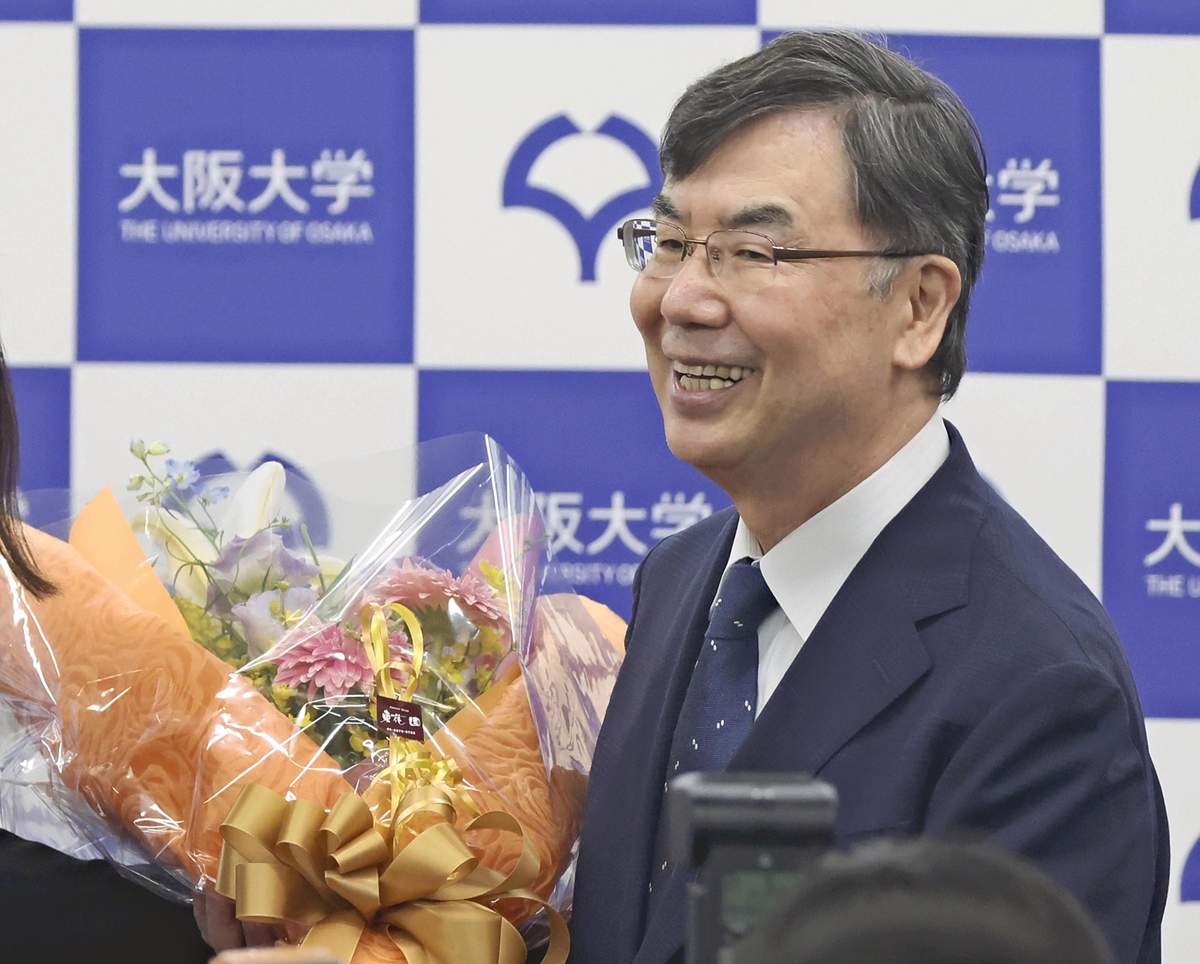
Shimon Sakaguchi receives a bouquet at a press conference in Suita, Osaka Prefecture, on Monday.
1:00 JST, October 8, 2025
“A man of belief.”
This is how many of his fellow researchers describe Shimon Sakaguchi, one of the three winners of the 2025 Nobel Prize in Physiology or Medicine.
Sakaguchi has continued his research, despite people saying it likely will not lead to anything.
Sakaguchi’s research on regulatory T cells, which suppress immune responses, was long met with skepticism and dismissed as hard to believe. Having led a somewhat solitary life in research, he persisted in his pursuit, opening up a new frontier in immunology.
After graduating from high school in Nagahama, Shiga Prefecture, he aimed for Kyoto University’s Faculty of Medicine but was not able to get in on his first attempt. He spent the following year studying at home, without attending a prep school.
“Even when I came across things I didn’t understand, I had no choice but to think them through myself,” Sakaguchi said, recalling when he began forging the persistence that eventually led to his achievements.
The following year, he was accepted into the university, where he began studying immunology. He learned about the possible existence of unknown immune cells and immersed himself in research.
However, a paper by a researcher whose work was similar to his own was refuted by a U.S. research team.
Though his peers left, he remained convinced by the phenomenon he discovered through laboratory experiments and continued his research.
In 1995, nearly 20 years after Sakaguchi began his research, he finally discovered the protein marking regulatory T cells. Once his discovery was confirmed by other researchers, the tide turned.
The word he cherishes is “un-don-kon,” which literally means luck, plodding and persistence.
“The world is flooded with all kinds of information, and trends come and go, but maintaining interest in what you really want to know is the essence of being a researcher,” said Sakaguchi.


Related Tags



Most Read
Popular articles in the past 24 hours
-

Director Naomi Kawase's New Film Explores Heart Transplants in Ja...
-

Japan’s Nikkei Stock Average Rises on Tech Rally and Takaichi's S...
-
Takaichi Expected to Express Desire for Constitutional Revision P...
-
Japanese Man Living in Iraq Suspected of Illegally Entering U.S. ...
-

Security Services Law Unconstitutional: Do Not Restrict Career Ch...
-
New Leader of Japan's CRA Opposition Party Faces Challenge of For...
-

Milano Cortina 2026: Snowboarding Star Fukada Wins Gold in Hard-F...
-

Tokyo Exhibition Featuring VR Walk Through 2025 Osaka-Kansai Expo...
Popular articles in the past week
-

Japan PM Takaichi’s Cabinet Resigns en Masse
-

Man Infected with Measles Reportedly Dined at Restaurant in Tokyo...
-

Videos Plagiarized, Reposted with False Subtitles Claiming ‘Ryuky...
-

Sanae Takaichi Elected 105th Prime Minister of Japan; Keeps All C...
-

Japan's Govt to Submit Road Map for Growth Strategy in March, PM ...
-

Milano Cortina 2026: Figure Skaters Riku Miura, Ryuichi Kihara Pa...
-
Tokyo’s New Record-Breaking Fountain Named ‘Tokyo Aqua Symphony’
-

Bus Carrying 40 Passengers Catches Fire on Chuo Expressway; All E...
Popular articles in the past month
-
Japan PM Takaichi’s Cabinet Resigns en Masse
-

Japan Institute to Use Domestic Commercial Optical Lattice Clock ...
-

Israeli Ambassador to Japan Speaks about Japan’s Role in the Reco...
-
Man Infected with Measles Reportedly Dined at Restaurant in Tokyo...
-

Man Infected with Measles May Have Come in Contact with Many Peop...
-

Prudential Life Insurance Plans to Fully Compensate for Damages C...
-
Videos Plagiarized, Reposted with False Subtitles Claiming ‘Ryuky...
-

Woman with Measles Visited Hospital in Tokyo Multiple Times Befor...
Top Articles in Science & Nature
-
Japan Institute to Use Domestic Commercial Optical Lattice Clock to Set Japan Standard Time
-
Japan to Face Shortfall of 3.39 Million Workers in AI, Robotics in 2040; Clerical Workers Seen to Be in Surplus
-
Record 700 Startups to Gather at SusHi Tech Tokyo in April; Event Will Center on Themes Like Artificial Intelligence and Robotics
-

Japan to Ban Use of Power Banks on Airplanes
JN ACCESS RANKING
-
Japan PM Takaichi’s Cabinet Resigns en Masse
-
Japan Institute to Use Domestic Commercial Optical Lattice Clock to Set Japan Standard Time
-
Israeli Ambassador to Japan Speaks about Japan’s Role in the Reconstruction of Gaza
-
Man Infected with Measles Reportedly Dined at Restaurant in Tokyo Station
-
Man Infected with Measles May Have Come in Contact with Many People in Tokyo, Went to Store, Restaurant Around When Symptoms Emerged