
Sakaguchi Says Persistence Led to Nobel Prize, Urges Young People to ‘Cherish What Interests You’
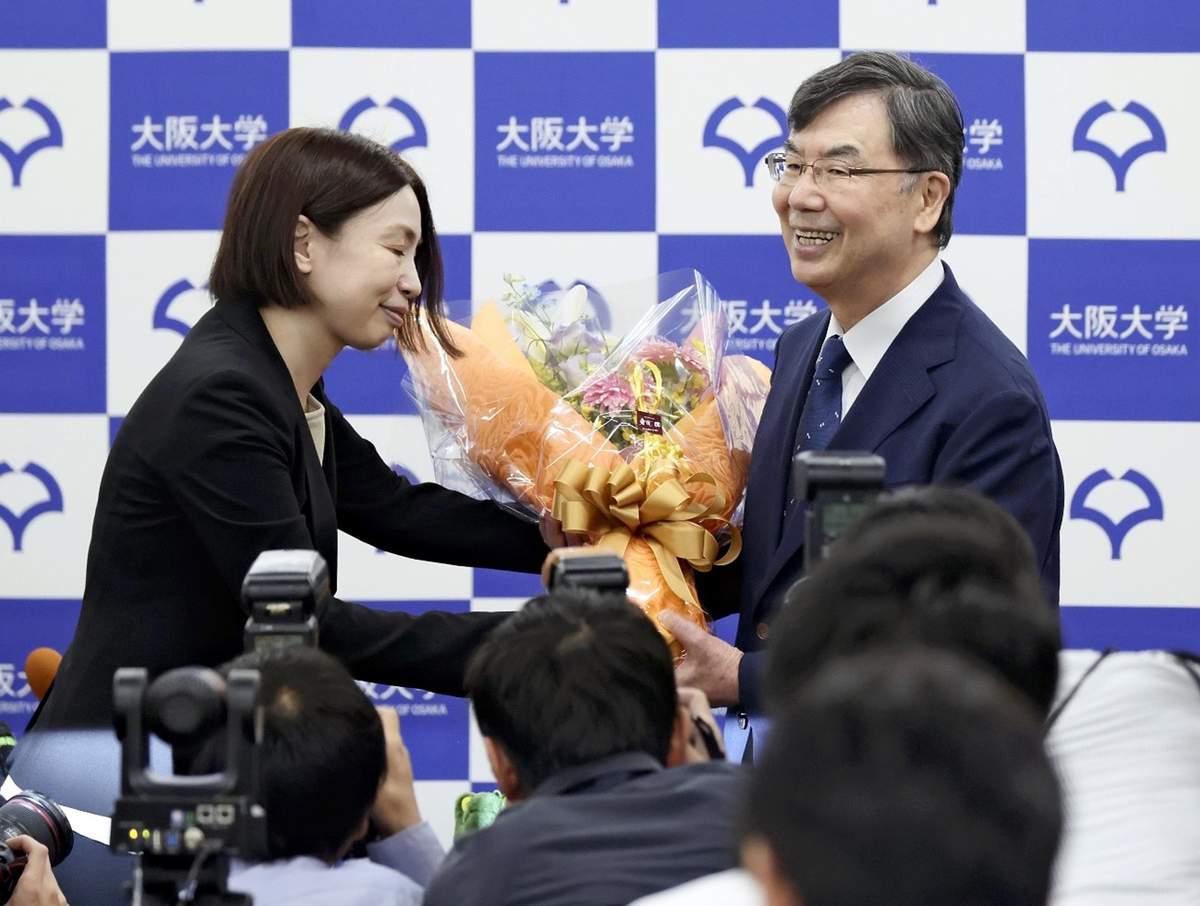
Shimon Sakaguchi, right, receives a bouquet from an employee of the University of Osaka in Suita, Osaka Prefecture, on Monday night.
13:50 JST, October 7, 2025
OSAKA — New Nobel laureate Shimon Sakaguchi reflected on a difficult time when his theories were not accepted, at a press conference held after he was awarded the 2025 Nobel Prize in Physiology or Medicine.
Sakaguchi is a specially appointed professor at the University of Osaka who pioneered new approaches to treating and preventing immune disorders. “My stubborn persistence led to winning the award today,” he said with a smile.
Loud applause and the sound of camera shutters broke out as Sakaguchi, 74, received a bouquet of flowers at 8 p.m. Monday at the press conference held at the university’s campus in Suita, Osaka Prefecture.
Wearing a dark navy jacket and blue tie, Sakaguchi carefully explained his discovery of “regulatory T cells” that suppress excessive immune responses, for which he was awarded the Nobel prize, and the potential applications in medicine.
Asked how he felt about receiving the award, Sakaguchi said, “I thought there might be a reward if this research progressed a bit further, but receiving this honor at this stage is surprising and a privilege.”
He was shy when asked who he had told first about the Nobel prize, saying, “My wife and I have worked together for a long time, so …” His wife, Noriko, 71, is a doctor who has long supported his research and is a visiting professor in the same laboratory.
Sakaguchi’s face was serious, however, when reporters’ questions turned to the content of his research.
Immune-suppressing cells were actively researched in the 1970s, but their existence was difficult to confirm, and discussions rapidly lost momentum in the early 1980s. Sakaguchi has said in past interviews that even when publishing papers at the time, “People were surprised that anyone was still doing this kind of research.”
“It wasn’t a very popular idea, and securing research funding was difficult,” he said.
Sakaguchi added, “But I believe I received this award on behalf of people around the world who shared this vision,” showing consideration for colleagues who persisted with the same research topic.
Asked what he wanted to do now, Sakaguchi smiled gently and said, “I want to keep working for a little longer, while I still can do my research.”
“Until now, I’ve done basic research, but I want to work on things that connect to actual treatment and prevention,” he said. “I hope to contribute in a way that advances the research field.”
Why does the immune system sometimes attack itself? Sakaguchi said that question was the starting point of his research.
Sakaguchi was also asked about his personal motto. “I don’t have any refined four-character idioms,” he said, reflecting that he had tackled experiments and papers by telling himself “take it one day at a time.”
“If you cherish what interests you, it gradually takes shape, and before you know it, you reach an interesting place. If that happens, any field can be fascinating,” he said. This is his message for future generations, learned through years of research.
‘My No. 1 colleague’
His wife Noriko was also at the press conference, and Sakaguchi expressed his thanks to her, calling her “my number one supporter and colleague, who has seen the same view.”
They met in their 20s at the Aichi Cancer Center. Sakaguchi was a research student there, while Noriko was undergoing on-the-job training as a student of Nagoya City University. They married in 1979.
Noriko became a dermatologist and traveled to the United States with Sakaguchi in 1983. She supported his experiments while he continued his research on regulatory T cells.
The couple is currently pursuing their dream of developing therapeutic medicine at RegCell, Inc., a start-up they established with others.
“I’m enjoying new challenges,” Sakaguchi said, and Noriko described herself as “now in the midst of my youth.” They intend to continue working together in the years to come.


Related Tags


Most Read
Popular articles in the past 24 hours
-

Toronto Blue Jays’ Kazuma Okamoto Blasts 1st HR of Spring
-
20 Trapped in Tokyo Skytree Lift, Rescued 5½ Hours Later
-
Japan Seeks to Counter China's Expanding Influence in Pacific by ...
-

Aggression against Ukraine: Malignant Precedent Must Not Be Set t...
-
Japan's Diet Begins Debate on Takaichi's Budget Plans, ‘Proactive...
-
Joruri Bunraku Narrative Performed in Honor of Donald Keene by La...
-
Japan Asks U.S. Not to Worsen Tariffs; Chief Cabinet Secretary Ki...
-
Milano Cortina 2026: Gold Medal Olympic Figure Skaters Riku Miura...
Popular articles in the past week
-

Producer Behind Pop Group XG Arrested for Cocaine Possession
-

Sanae Takaichi Elected Prime Minister of Japan; Keeps All Cabinet...
-

Japan's Govt to Submit Road Map for Growth Strategy in March, PM ...
-
Japan, U.S. Name 3 Inaugural Investment Projects; Reached Agreeme...
-

iPS Treatments Pass Key Milestone, but Broader Applications Far f...
-

Riku-Ryu Pair Wins Gold Medal: Their Strong Bond Leads to Major C...
-

Tokyo Skytree's Elevator Stops, Trapping 20 People; All Rescued (...
-

Director Naomi Kawase's New Film Explores Heart Transplants in Ja...
Popular articles in the past month
-
Producer Behind Pop Group XG Arrested for Cocaine Possession
-

Japan PM Takaichi’s Cabinet Resigns en Masse
-

Japan Institute to Use Domestic Commercial Optical Lattice Clock ...
-

Man Infected with Measles Reportedly Dined at Restaurant in Tokyo...
-

Israeli Ambassador to Japan Speaks about Japan’s Role in the Reco...
-

Videos Plagiarized, Reposted with False Subtitles Claiming ‘Ryuky...
-

Man Infected with Measles May Have Come in Contact with Many Peop...
-

Prudential Life Insurance Plans to Fully Compensate for Damages C...
Top Articles in Science & Nature
-
iPS Treatments Pass Key Milestone, but Broader Applications Far from Guaranteed
-
Record 700 Startups to Gather at SusHi Tech Tokyo in April; Event Will Center on Themes Like Artificial Intelligence and Robotics
-
iPS Cell Products for Parkinson’s, Heart Disease OK’d for Commercialization by Japan Health Ministry Panel
-

Japan to Ban Use of Power Banks on Airplanes
JN ACCESS RANKING
-
Producer Behind Pop Group XG Arrested for Cocaine Possession
-
Japan PM Takaichi’s Cabinet Resigns en Masse
-
Man Infected with Measles Reportedly Dined at Restaurant in Tokyo Station
-
Israeli Ambassador to Japan Speaks about Japan’s Role in the Reconstruction of Gaza
-
Videos Plagiarized, Reposted with False Subtitles Claiming ‘Ryukyu Belongs to China’; Anti-China False Information Also Posted in Japan