
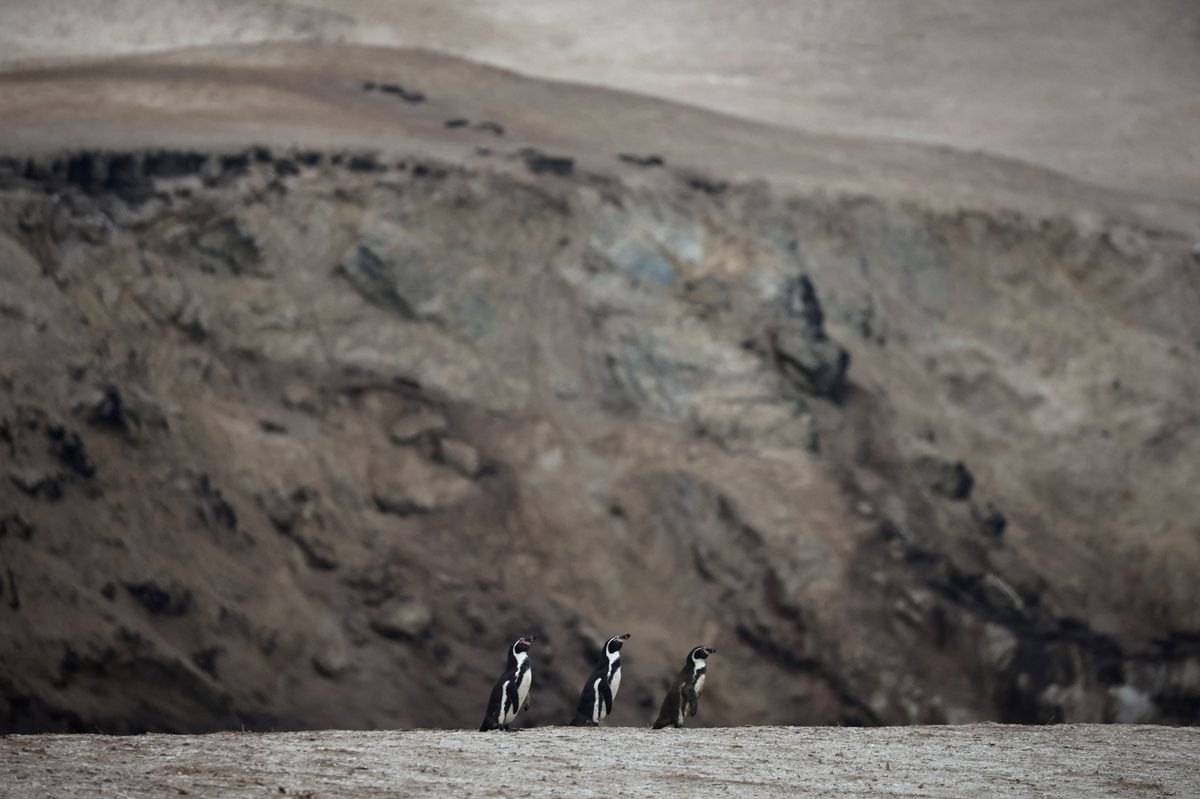
Humboldt penguins walk together at the Punta San Juan reserve in Marcona, Peru, on June 21.
11:01 JST, August 14, 2025
LIMA (Reuters) — Scientists along Peru’s central Pacific coast are sounding the alarm that more action is needed to protect seabirds, sea lions, and penguins as climate change, disease and overfishing threaten their survival.
Research shows the number of guano birds has dropped by more than three-quarters in the past three years to around 500,000, according to local biologists, down from a population of 4 million in 2022.
These black-and-white coastal birds form an important part of Peruvian wildlife, producing large quantities of excrement used as a natural fertilizer.
“We are very alarmed by this sharp decline,” said Susana Cardenas, director of the Environmental Sustainability Center at Peru’s Cayetano Heredia University in an interview with Reuters. She monitors marine life at the Punta San Juan reserve roughly 530 kilometers south of Lima.
Breeding centers like the one Cardenas runs are helping to protect bird populations that she described as “golden egg-laying hens” because they were so fragile, yet valuable.
Peru’s state agency AgroRural counted 587,000 guano seabirds in June, spread across 22 islands and eight coastal points, that include cormorants, boobies and pelicans. That figure is down from an average of 4 million registered in recent decades by Peru’s Agriculture Ministry.
Scientists said that the sharp decline began with an outbreak of avian flu in 2022 that killed tens of thousands of birds, penguins and sea lions. The El Nino weather phenomenon disrupted marine ecosystems the following year, and forced birds to migrate. Then in 2024, overfishing of anchoveta — a primary food source from the anchovy fish family — further depleted populations.
At Punta San Juan, only 200,000 guano birds, 2,500 Humboldt penguins and 11,000 sea lions remain, the research center found.
The decline in bird numbers is hurting the guano fertilizer harvest, important for the local farming industry.
This nutrient-rich fertilizer is collected every five years under government supervision and exported in controlled quantities. The last collection was in 2024, but with fewer birds, the “sustainability of this activity will be at risk,” Cardenas added.
Peru’s Agriculture Ministry said in a response to a Reuters request for comment on the decline that it was developing a national plan for the repopulation of guano birds with various different conservation entities.
In April, authorities allowed the biggest catch quota in seven years of anchoveta, used in fishmeal, citing larger populations. But biologists said that the anchoveta populations were still not large enough to sustain both fishing and the bird populations that depend on them.
Sea lions and penguins that live in colonies along the Pacific coasts of Peru and Chile were also at risk from dwindling food supplies caused by changing weather patterns and overfishing.
Humboldt penguins could be extinct in 100 years, Cardenas said, if protections failed to increase. “Their population is trending downward, especially in protected areas where growth is most needed.”







Most Read
Popular articles in the past 24 hours
-

3,000 Accounts Posting, Spreading Content Critical of Japan on X;...
-

Milano Cortina 2026: Sakamoto Serves as Flag Bearer; Japan Earns ...
-

My Spendthrift Mother Constantly Asks Me for Money
-

A Packed Bus Plunges off a Nepal Highway, Killing 19 and Injuring...
-

Milano Cortina 2026: There Were Cheers across the Country, after ...
-

Luna Sea Drummer Shinya Dies at 56; Powerful Drummer Behind ‘Desi...
-

Milano Cortina 2026: Riku-Ryu Duo Stick Together During Closing C...
-

Emperor Receives Well-Wishes from Public on His 66th Birthday
Popular articles in the past week
-

Japan PM Takaichi’s Cabinet Resigns en Masse
-

Man Infected with Measles Reportedly Dined at Restaurant in Tokyo...
-

Sanae Takaichi Elected Prime Minister of Japan; Keeps All Cabinet...
-

Japan's Govt to Submit Road Map for Growth Strategy in March, PM ...
-

Bus Carrying 40 Passengers Catches Fire on Chuo Expressway; All E...
-

U.S. Firm to Build Training Hub in Fukushima N-plant for Debris R...
-

Japan, U.S. Name 3 Inaugural Investment Projects; Reached Agreeme...
-

Riku-Ryu Pair Wins Gold Medal: Their Strong Bond Leads to Major C...
Popular articles in the past month
-
Japan PM Takaichi’s Cabinet Resigns en Masse
-

Japan Institute to Use Domestic Commercial Optical Lattice Clock ...
-

Israeli Ambassador to Japan Speaks about Japan’s Role in the Reco...
-
Man Infected with Measles Reportedly Dined at Restaurant in Tokyo...
-

Videos Plagiarized, Reposted with False Subtitles Claiming ‘Ryuky...
-

Man Infected with Measles May Have Come in Contact with Many Peop...
-

Prudential Life Insurance Plans to Fully Compensate for Damages C...
-

Woman with Measles Visited Hospital in Tokyo Multiple Times Befor...
Top Articles in Science & Nature
-
Japan Institute to Use Domestic Commercial Optical Lattice Clock to Set Japan Standard Time
-

iPS Treatments Pass Key Milestone, but Broader Applications Far from Guaranteed
-

Record 700 Startups to Gather at SusHi Tech Tokyo in April; Event Will Center on Themes Like Artificial Intelligence and Robotics
-

iPS Cell Products for Parkinson’s, Heart Disease OK’d for Commercialization by Japan Health Ministry Panel
-

Japan to Ban Use of Power Banks on Airplanes
JN ACCESS RANKING
-
Japan PM Takaichi’s Cabinet Resigns en Masse
-
Japan Institute to Use Domestic Commercial Optical Lattice Clock to Set Japan Standard Time
-
Israeli Ambassador to Japan Speaks about Japan’s Role in the Reconstruction of Gaza
-
Man Infected with Measles Reportedly Dined at Restaurant in Tokyo Station
-
Videos Plagiarized, Reposted with False Subtitles Claiming ‘Ryukyu Belongs to China’; Anti-China False Information Also Posted in Japan