
Ruling, Opposition Parties Deepening Confrontation over Economic Policies after PM Ishiba Announces He Will Step Down
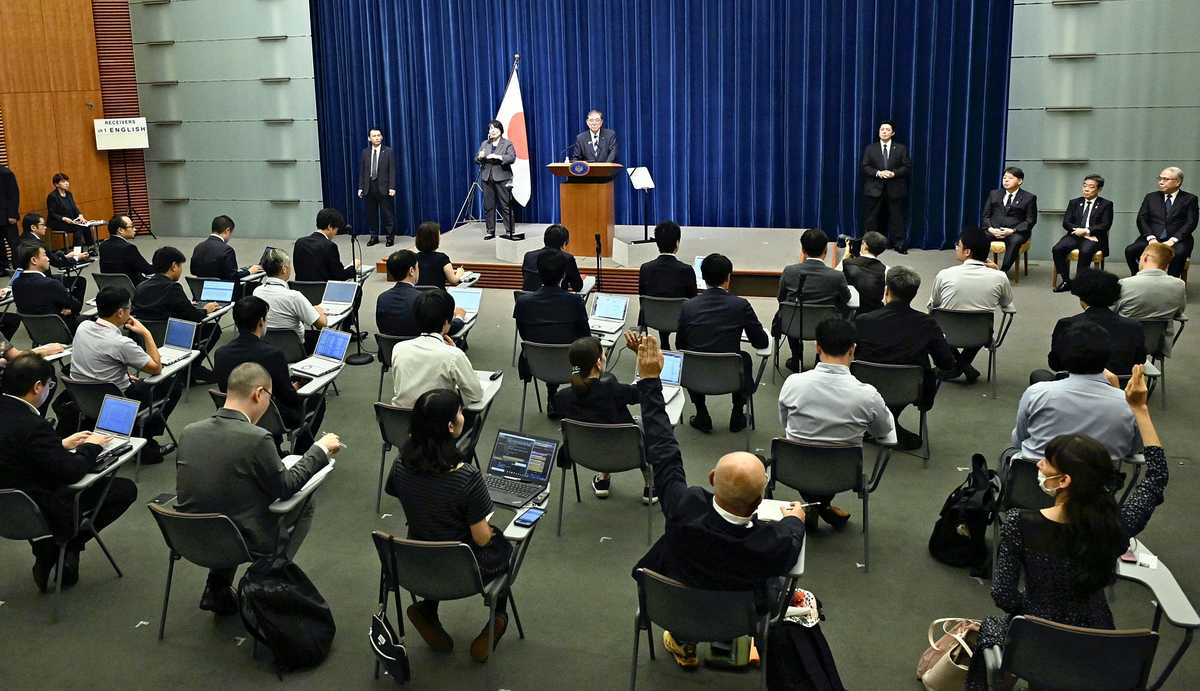
Prime Minister Shigeru Ishiba speaks at a press conference in which he announced his intent to step down, in the Prime Minister’s Office on Sunday.
18:09 JST, September 8, 2025
The gaps in opinions between the ruling and opposition parties will likely deepen further as Prime Minister Shigeru Ishiba, who has placed importance on measures to cope with rising prices as his administration’s priority issue, decided to step down as president of the Liberal Democratic Party without achieving results.
Although the government has finished the most difficult phase of its tariff negotiations with the United States, the impact of those levies on the business performance of Japanese companies will begin to surface from now.
The government is facing a mountain of challenges over economic policy.
“To have a policy take root in which wage increases exceed rising prices, it is necessary to accelerate measures to deal with the issue,” Ishiba said at a press conference on Sunday.
Real wages, which reflect price fluctuations, in July rose 0.5% from a year ago, as an interim figure, marking the first increase in seven months. However, the rise was mainly due to an increase in summer bonuses.
Many economists predict that real wages will decrease again from now.
One of the reasons why real wages have not increased remarkably is because prices continue to rise.
The national consumer price index, excluding fresh food prices that tend to fluctuate greatly, in July rose 3.1% from a year ago, marking the eighth consecutive month of an increase at a rate above 3%. Rice prices rose especially high: as much as 90.7%.
Although the Ishiba administration had tried to halt increases in rice prices by releasing government-stockpiled rice, prices of the staple grain in the market have still remained high.
In the latest House of Councillors election, the ruling camp of the LDP and Komeito presented an election pledge to provide ¥20,000 per person of cash benefits to all the people of the country, and the amount would be ¥40,000 per person for children and adults in households for which resident taxes are waived.
In August after the election, the prime minister changed his stance to agreeing with the Constitutional Democratic Party of Japan to hold discussions between the ruling coalition and the opposition party. In doing so, Ishiba was enthusiastic about realizing his policy goal.
However, opposition parties have insisted that the consumption tax rate should be lowered, or the tax itself should be abolished, as a measure to cope with price rises.
In regard to this point, the gaps in the opinions of the ruling and opposition parties are still wide.
Confrontational stances have also deepened between the ruling and opposition camps over how to secure alternate sources of government revenue to abolish a temporary additional tax rate on gasoline prices and details in designing a system to make high school education free of charge.
In the tariff negotiations with the United States, President Donald Trump signed an executive order which stipulates that a tariff rate on automobiles imported from Japan will be lowered from the current level of 27.5% to 15%.
The Trump administration also reviewed its “reciprocal tariffs” imposed on various kinds of products imported from Japan.
However, the president’s executive order did not stipulate a most-favored-nation treatment that tariff rates on medicines and semiconductor products imported from Japan do not surpass tariff rates on those products imported from other countries.
Regarding $550 billion (about ¥80 trillion) in investment in the United States that Japan agreed upon with the administration, Trump secured the right to select destinations for the money, which is to be invested by the Japanese side.
In addition, the U.S. government has suggested that if Japan does not honor the deal, tariff rates on imports from Japan will be raised.
In Japanese business circles, an increasing number of people hold deepening concerns that domestic price rises and the high U.S. tariffs will worsen corporate business results.
The new administration that emerges from the LDP presidential election will likely step in quickly to implement economic stimulus measures, but those need to be truly effective.
A source at a major company told The Yomiuri Shimbun on Sunday, “I do not want [Diet members] to prolong a political vacuum.”
Yoshinobu Tsutsui, chairman of the Japan Business Federation (Keidanren), issued a comment on Sunday, saying, “We have a mountain of important policy tasks regarding domestic and foreign affairs for which no time can be wasted.”
“I want a new leader [of the LDP] who is chosen in the party presidential election to establish a stable political situation and speedily implement policies,” he added.



Most Read
Popular articles in the past 24 hours
-
Kesennuma, Miyagi Pref., Locals Raise Carp Streamers as Symbol of...
-

Iran Situation: Significance of Rule of Law Must Be Conveyed
-

Toyota Advancing Plant-Based Biofuel Development in Fukushima Tow...
-

Trump Says Iran Had a New Site for Developing Nuclear Weapons
-

2 People Reportedly Found on Mt. Fuji; Hiking Trail Currently Clo...
-
CARTOON OF THE DAY (March 10)
-

Rapeseed Flowers Reach Peak Viewing Period at Tokyo's Showa Kinen...
-
Memorial Service Marks 81st Anniversary of Tokyo Air Raid; Crown ...
Popular articles in the past week
-

Ibaraki Pref.'s 1st Foreign Bus Driver Hired in Tsukuba
-

Amid Strait of Hormuz Blockade, Shipping Companies Scramble to Ge...
-
Govt to Utilize ODA for Ensuring Economic Security; Securing Ener...
-
Japan Govt Survey Finds Just 10% of Workers Want Working Hours to...
-
Japan's 2nd Round of U.S. Investments May Be Worth Over $100 Bill...
-

Nippon Life Insurance's U.S. Arm Sues OpenAI Over Legal Assistanc...
-

Imperial Family Watches World Baseball Classic Game Against Austr...
-

Beckoning Cats Get Makeover to Fit Modern Lifestyles with Sleek D...
Popular articles in the past month
-

Producer Behind Pop Group XG Arrested for Cocaine Possession
-

Japan PM Takaichi’s Cabinet Resigns en Masse
-

Man Infected with Measles Reportedly Dined at Restaurant in Tokyo...
-

Videos Plagiarized, Reposted with False Subtitles Claiming ‘Ryuky...
-

iPS Treatments Pass Key Milestone, but Broader Applications Far f...
-

Sanae Takaichi Elected Prime Minister of Japan; Keeps All Cabinet...
-

Nepal Bus Crash Kills 19 People, Injures 25 Including One Japanes...
-

South Korea Tightens Rules on Foreigners Buying Homes in Seoul Me...
Top Articles in Politics
-
Japan PM Takaichi’s Cabinet Resigns en Masse
-
Sanae Takaichi Elected Prime Minister of Japan; Keeps All Cabinet Appointees from Previous Term
-

Japan’s Govt to Submit Road Map for Growth Strategy in March, PM Takaichi to Announce in Upcoming Policy Speech
-
CRA Leadership Election Will Center on Party Rebuilding; Lower House Defeat Leaves Divisions among Former CDPJ, Komeito Members
-
LDP Begins Training New Lawmakers to Avoid Scandal, Gaffes; Historic Victory in Latest Election Heightens Focus on Party
JN ACCESS RANKING
-
Producer Behind Pop Group XG Arrested for Cocaine Possession
-
Japan PM Takaichi’s Cabinet Resigns en Masse
-
Man Infected with Measles Reportedly Dined at Restaurant in Tokyo Station
-
Videos Plagiarized, Reposted with False Subtitles Claiming ‘Ryukyu Belongs to China’; Anti-China False Information Also Posted in Japan
-
iPS Treatments Pass Key Milestone, but Broader Applications Far from Guaranteed