
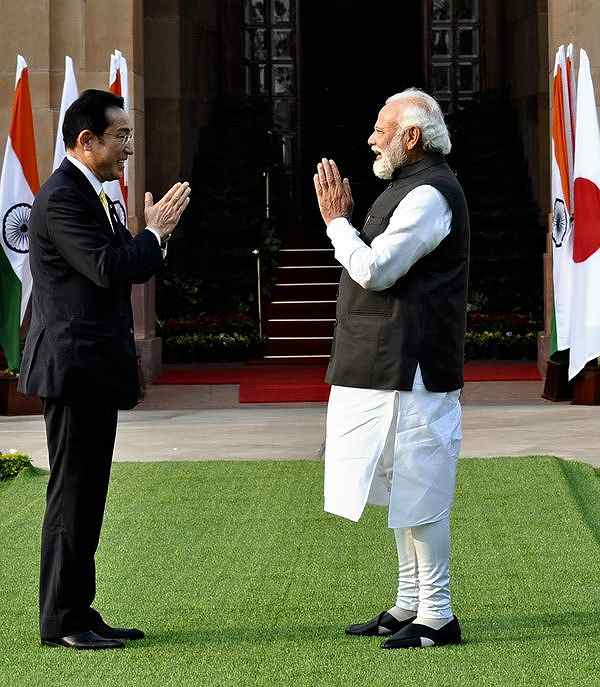
Prime Minister Fumio Kishida, left, and Indian Prime Minister Narendra Modi exchange greetings in New Delhi on Saturday.
15:36 JST, March 20, 2022
NEW DELHI — Prime Minister Fumio Kishida’s determination to touch upon Ukraine in a joint statement with Indian Prime Minister Narendra Modi was rewarded Saturday, despite India’s measured stance on the Russia-Ukraine crisis.
The agenda for Kishida’s visit to India was already partly in place when Russia invaded its smaller neighbor, but events in Ukraine became a major topic of the leaders’ meeting.
India has refrained from directly criticizing Russia, abstaining from a vote on a nonbinding resolution at the U.N. General Assembly that condemned Moscow’s military aggression.
In a joint statement issued after a March 3 videoconference, the heads of the Quad countries — Japan, Australia, India and the United States — failed to point the finger directly at Russia.
The Japan-India summit meeting focused on how Tokyo could help bring New Delhi into the framework of the international community, which strives to act collectively to pressure Russia.
Kishida felt strongly that the meeting would be a failure if the joint statement did not mention the Ukraine crisis, according to a source close to the prime minister.
The document had yet to be finalized when Kishida arrived in India, and diplomats from both sides worked on specific wording until the very last minute.
In the statement, the two leaders expressed their serious concern about the ongoing conflict and humanitarian crisis in Ukraine, while avoiding any direct criticism of Russia.
Following Moscow’s shaking of the international order, it is seen as increasingly important that the Quad group strengthen cooperation to rein in China’s hegemonic zeal.
India is a member of the Shanghai Cooperation Organization — a transcontinental alliance led by China and Russia — despite having border disputes with Beijing. Kishida reportedly looked for points of agreement during the Japan-India summit meeting by taking into account India’s circumstances.
“We agreed to strongly oppose any attempt to unilaterally change the status quo by force in the East and South China Seas, as well as any economic coercion,” Kishida said at a joint press conference Saturday.
It is thought that Kishida’s words were directed toward China and its aggressive maritime expansion.






Most Read
Popular articles in the past 24 hours
-
Japan's Budget on Track for Quick Passage, but Ruling Parties to ...
-

Japan-Based USS Tripoli, Marine Unit to Be Sent to Middle East, U...
-

Ransomware Attacks Hitting Japan's Small, Midsize Firms
-

7 Men Arrested Over Robbery of ¥423 Mil. on Tokyo Street; Members...
-

North Korea Fires about 10 Missiles toward Sea in Show of Force, ...
-

German Journalist Traces Footsteps of Great-Grandfather Who Was P...
-

Hiroshima: Yamato Museum to Reopen on April 23 after Major Renova...
-
CARTOON OF THE DAY (March 14)
Popular articles in the past week
-

Japan Figure Skating Legend Yuzuru Hanyu Is Proud Disaster Surviv...
-
Govt to Utilize ODA for Ensuring Economic Security; Securing Ener...
-
15 Measles Patients Confirmed in Tokyo in Past 6 Days; 1 May Have...
-
Massive Sewer Pipe Found Jutting Out of Highway in Osaka
-
Japan Govt to Tighten Requirements to Receive Permanent Residency...
-
Power Outage Forces About 980 Passengers in Yokohama to Walk to T...
-
JR Tokai Breaks Ground on Yamanashi Maglev Station; Will Be Part ...
-

Beckoning Cats Get Makeover to Fit Modern Lifestyles with Sleek D...
Popular articles in the past month
-

Producer Behind Pop Group XG Arrested for Cocaine Possession
-

Japan PM Takaichi’s Cabinet Resigns en Masse
-

Man Infected with Measles Reportedly Dined at Restaurant in Tokyo...
-
Japan Figure Skating Legend Yuzuru Hanyu Is Proud Disaster Surviv...
-

iPS Treatments Pass Key Milestone, but Broader Applications Far f...
-

Sanae Takaichi Elected Prime Minister of Japan; Keeps All Cabinet...
-

South Korea Tightens Rules on Foreigners Buying Homes in Seoul Me...
-

Nepal Bus Crash Kills 19 People, Injures 25 Including One Japanes...
Top Articles in Politics
-
Japan PM Takaichi’s Cabinet Resigns en Masse
-
Sanae Takaichi Elected Prime Minister of Japan; Keeps All Cabinet Appointees from Previous Term
-

Japan’s Govt to Submit Road Map for Growth Strategy in March, PM Takaichi to Announce in Upcoming Policy Speech
-
LDP Begins Training New Lawmakers to Avoid Scandal, Gaffes; Historic Victory in Latest Election Heightens Focus on Party
-
Japan PM Sanae Takaichi Welcomes Peach Ambassadors Koga Momo Musume to Official Residence
JN ACCESS RANKING
-
Producer Behind Pop Group XG Arrested for Cocaine Possession
-
Japan PM Takaichi’s Cabinet Resigns en Masse
-
Man Infected with Measles Reportedly Dined at Restaurant in Tokyo Station
-
Japan Figure Skating Legend Yuzuru Hanyu Is Proud Disaster Survivor and Gold Medalist, Vows to Continue Support Efforts
-
iPS Treatments Pass Key Milestone, but Broader Applications Far from Guaranteed