
Foreign Ministry Documents Show U.S. Dissatisfaction with Japan’s Persian Gulf Presence in 1990
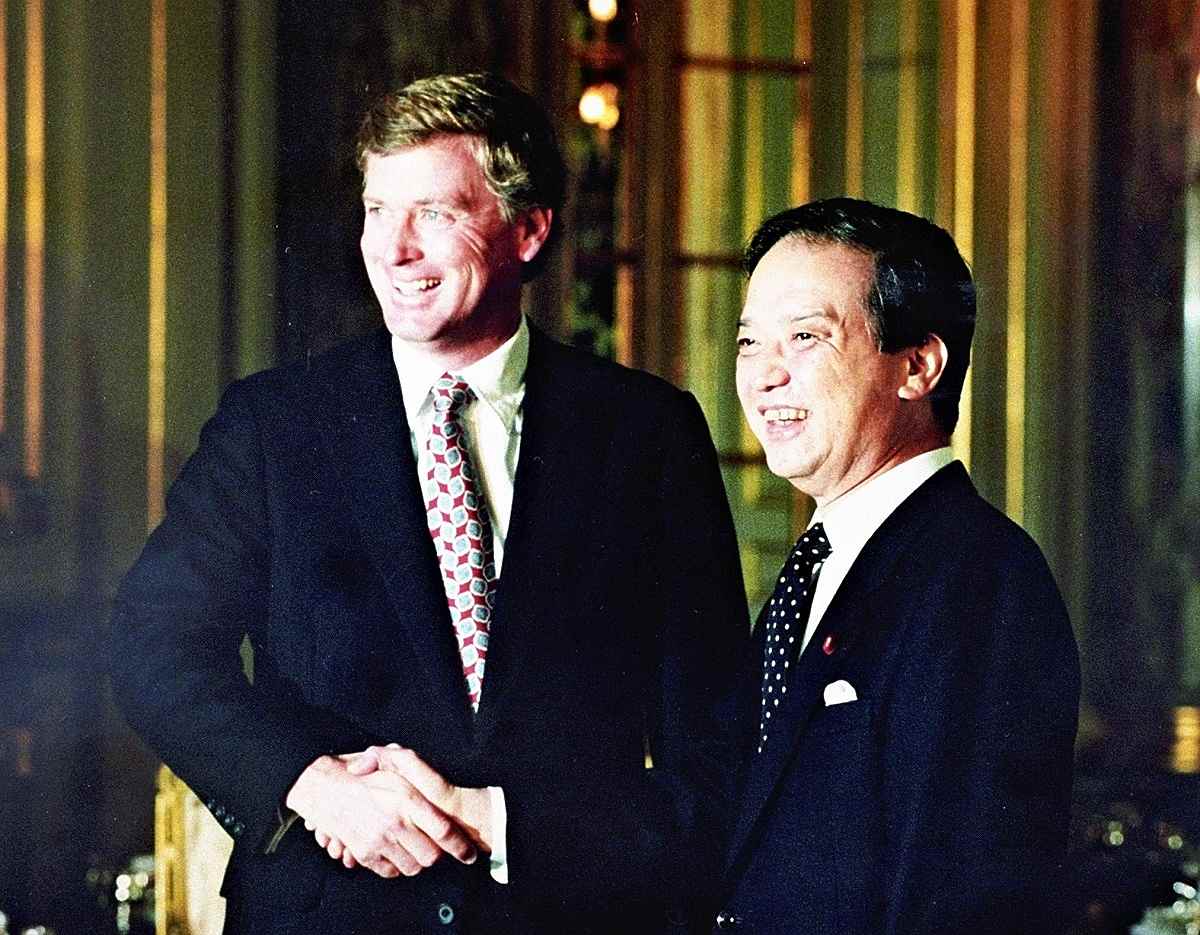
Then U.S. Vice President Dan Quayle, left, shakes hands with then Prime Minister Toshiki Kaifu at the State Guest House Akasaka Palace in Minato Ward, Tokyo, on Nov. 14, 1990.
11:41 JST, December 28, 2020
In the wake of the 1990 Gulf crisis, then U.S. Vice President Dan Quayle complained in a meeting with then Japanese Prime Minister Toshiki Kaifu that Japan did not have a stronger presence in the Gulf region, reflecting Washington’s discontent over the Self-Defense Forces not being dispatched to the area, according to diplomatic documents released Wednesday.
Quayle expressed concerns in a separate meeting about the possibility that young U.S. military personnel would have to sacrifice themselves to protect Japan’s vital oil supply.
The vice president visited Japan in November 1990 to attend the enthronement ceremony of the now Emperor Emeritus. Iraq’s invasion of Kuwait triggered the Gulf crisis in August that year.
Under pressure from Washington, the Japanese government attempted to pass a bill for a U.N. peace cooperation law that would allow the Self-Defense Forces to support logistics for the multinational forces. However, the bill was scrapped in an extraordinary Diet session that autumn.
According to documents compiled by the Foreign Ministry, Quayle asked Kaifu during a Nov. 14 meeting if there was any way Japan could have a presence in the Gulf.
Kaifu replied that deliberations in the Diet focused not only on financial support but also other contributions, including human resources, but the bill was not enacted. The prime minister added that he felt he was insufficiently persuasive and he would do his best to see how Japan could make an international contribution.
Nevertheless, Quayle reiterated that Japan’s lack of a presence was noticed, implying he was not convinced.
Another document shows that Quayle expressed his dissatisfaction with Japan to then Singapore Prime Minister Lee Kuan Yew in their meeting on Nov. 13.The vice president said that to protect oil supplies, which were more important to Japan than the United States, young Americans could be forced to make sacrifices that their Japanese counterparts would avoid. Lee conveyed the message to Kaifu later that day.
The Gulf crisis became the Gulf War in January 1991. Japan provided $13 billion — equivalent to ¥1.69 trillion at the time — for the multinational forces’ operations. After a cease-fire was declared in April, the Maritime Self-Defense Force was dispatched to assist with minesweeping operations in the Persian Gulf.
However, Japan was criticized by some in the international community for conducting “checkbook diplomacy” and that its actions were “too little, too late.”



Most Read
Popular articles in the past 24 hours
-
Japan's Budget on Track for Quick Passage, but Ruling Parties to ...
-
Japan-Based USS Tripoli, Marine Unit to Be Sent to Middle East, U...
-
7 Men Arrested Over Robbery of ¥423 Mil. on Tokyo Street; Members...
-

Ransomware Attacks Hitting Japan's Small, Midsize Firms
-

National Intelligence Council: Proposed Body Must Be Utilized To ...
-
Japan's Defense Ministry: North Korea Appears to Have Fired Balli...
-
North Korea Fires about 10 Missiles toward Sea in Show of Force, ...
-

‘Kokuho’ Wins Record 10 Awards at Japan Academy Film Prize; Demon...
Popular articles in the past week
-

Japan Figure Skating Legend Yuzuru Hanyu Is Proud Disaster Surviv...
-
Govt to Utilize ODA for Ensuring Economic Security; Securing Ener...
-
15 Measles Patients Confirmed in Tokyo in Past 6 Days; 1 May Have...
-
Massive Sewer Pipe Found Jutting Out of Highway in Osaka
-
Japan Govt to Tighten Requirements to Receive Permanent Residency...
-
Power Outage Forces About 980 Passengers in Yokohama to Walk to T...
-
JR Tokai Breaks Ground on Yamanashi Maglev Station; Will Be Part ...
-
Beckoning Cats Get Makeover to Fit Modern Lifestyles with Sleek D...
Popular articles in the past month
-

Producer Behind Pop Group XG Arrested for Cocaine Possession
-

Japan PM Takaichi’s Cabinet Resigns en Masse
-

Man Infected with Measles Reportedly Dined at Restaurant in Tokyo...
-
Japan Figure Skating Legend Yuzuru Hanyu Is Proud Disaster Surviv...
-

iPS Treatments Pass Key Milestone, but Broader Applications Far f...
-

Sanae Takaichi Elected Prime Minister of Japan; Keeps All Cabinet...
-

South Korea Tightens Rules on Foreigners Buying Homes in Seoul Me...
-

Nepal Bus Crash Kills 19 People, Injures 25 Including One Japanes...
Top Articles in Politics
-
Japan PM Takaichi’s Cabinet Resigns en Masse
-
Sanae Takaichi Elected Prime Minister of Japan; Keeps All Cabinet Appointees from Previous Term
-

Japan’s Govt to Submit Road Map for Growth Strategy in March, PM Takaichi to Announce in Upcoming Policy Speech
-
LDP Begins Training New Lawmakers to Avoid Scandal, Gaffes; Historic Victory in Latest Election Heightens Focus on Party
-
Japan PM Sanae Takaichi Welcomes Peach Ambassadors Koga Momo Musume to Official Residence
JN ACCESS RANKING
-
Producer Behind Pop Group XG Arrested for Cocaine Possession
-
Japan PM Takaichi’s Cabinet Resigns en Masse
-
Man Infected with Measles Reportedly Dined at Restaurant in Tokyo Station
-
Japan Figure Skating Legend Yuzuru Hanyu Is Proud Disaster Survivor and Gold Medalist, Vows to Continue Support Efforts
-
iPS Treatments Pass Key Milestone, but Broader Applications Far from Guaranteed