
Japan Aims to Leverage Close Ties with U.S. to Fend Off China’s Information War Over Taiwan
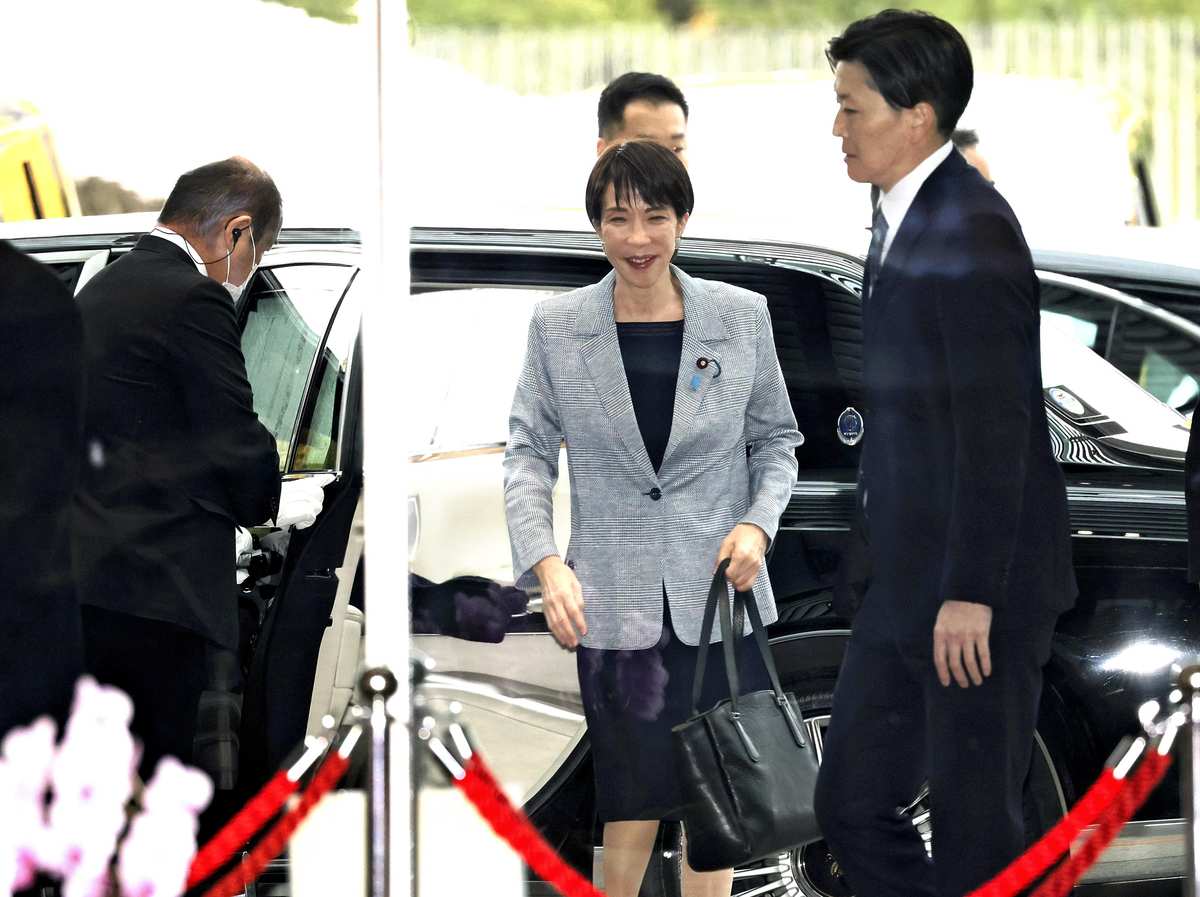
Prime Minister Sanae Takaichi enters the Prime Minister’s Office on Tuesday.
15:50 JST, November 26, 2025
Japan aims to leverage its robust alliance with the United States as a countermeasure against the information war blending fact and fiction launched by China, which intends to rally the United States and the international community.
The day after direct phone talks between U.S. President Donald Trump and Chinese President Xi Jinping, Prime Minister Sanae Takaichi emphasized the Japan-U.S. alliance in a phone call with Trump on Tuesday.
Takaichi addressed reporters at the Prime Minister’s Office at about 11 a.m., only about 30 minutes after the phone call with Trump, and said she discussed the “recent U.S.-China relations” with Trump, including the outcome of the leaders’ phone call from the previous night. Takaichi underscored the closeness of her relationship with Trump, saying they can call each other anytime.
Behind her proactive outreach lies a sense of crisis in the government that the U.S.-China talks “could fuel the perception that Trump is siding with China over Japan.” In fact, Beijing has promoted the narrative that Trump expressed understanding of China’s position on Taiwan, clearly aiming to co-opt the United States and drive a wedge between Tokyo and Washington.
While Trump, seeking gains in trade negotiations with Beijing, aims to visit China next April, he values allies on issues like stabilizing the supply chain for rare earths, where China has tightened export controls.
A U.S. official from the Republican Party told The Yomiuri Shimbun that Trump’s real intention was to maintain a certain distance from the Japan-China confrontation while keeping China in check.
Trump’s prompt phone call to Takaichi right after speaking with Xi is seen as “a sign that he cares about relations with Japan even while moving forward in dialogue with China,” according to a senior Japanese Foreign Ministry official.
While Tokyo intends to keep reaching out to Washington, strengthening messaging to the international community is also urgent. China’s U.N. ambassador sent a letter to U.N. Secretary General Antonio Guterres raising issues over Takaichi’s remark in the Diet earlier this month about Taiwan. Japan’s U.N. Ambassador Kazuyuki Yamazaki sent a rebuttal letter to Guterres on Tuesday, insisting that Japan’s defense policy is “exclusively defense-oriented” and defines the situations in which the right of collective self-defense would be exercised “in a restrictive manner.”
His letter stated: “China’s assertion that Japan would exercise the right of self-defense even in the absence of an armed attack is erroneous.”
China has criticized Japan over the Self-Defense Forces’ missile deployment on Yonaguni Island in Okinawa Prefecture and even invoked the “former enemy states clause” in the U.N. Charter. China appears to be attempting to turn Takaichi’s remark into an international issue and create the impression that “Japan unilaterally altered” the status quo regarding Taiwan.
Chief Cabinet Secretary Minoru Kihara told reporters Tuesday that “Japan is open” to direct dialogue with China to resolve the situation.
“We cannot accept China’s claims which contradict facts and will firmly refute them,” he said.
A Japan-China battle that is conscious of international public opinion will likely continue.


Related Tags

Most Read
Popular articles in the past 24 hours
-

Japanese Shipping Giants Halt Strait of Hormuz Transit as Iran Co...
-

U.S. Launches Attacks on Iran: Avoid Escalation of Conflict by An...
-

Sawtooth Roof Factory Stands as Monument to Ashikaga Textile Hist...
-
Parents of Japanese Teen Shot in U.S. Strive for Gun Control
-

Rental Lab Space in Tokyo Area More Than Doubles Since 2010, Offe...
-

Disinformation Spreads About Team Mirai, Ballot Readers; Online P...
-
Asahi Breweries to Stage Comeback with New Product in April; Comp...
-
Bank of Japan Deputy Governor Says Rate Hikes Likely to Continue
Popular articles in the past week
-

Nepal Bus Crash Kills 19 People, Injures 25 Including One Japanes...
-
Milano Cortina 2026: Japanese Gold Medalist Figure Skater Miura S...
-
Tokyo Spends Big on Children, Wins Over Parents
-

McDonald's Japan Raises Prices; Big Mac to Cost ¥500, Double Chee...
-

‘Dry Bonsai’ Gives New Life to Withered Trees, Allows Free Artist...
-
Japan’s Miura, Kihara Announce Withdrawal from Figure Skating Wor...
-

Exhibition Featuring Yoshiharu Tsuge’s Manga World Underway in Ch...
-

Yokohama to Test Out Renewable-Powered Offshore Floating Data Cen...
Popular articles in the past month
-

Producer Behind Pop Group XG Arrested for Cocaine Possession
-

Japan PM Takaichi’s Cabinet Resigns en Masse
-

Man Infected with Measles Reportedly Dined at Restaurant in Tokyo...
-

Israeli Ambassador to Japan Speaks about Japan’s Role in the Reco...
-

Videos Plagiarized, Reposted with False Subtitles Claiming ‘Ryuky...
-

Man Infected with Measles May Have Come in Contact with Many Peop...
-

Prudential Life Insurance Plans to Fully Compensate for Damages C...
-

Woman with Measles Visited Hospital in Tokyo Multiple Times Befor...
Top Articles in Politics
-
Japan PM Takaichi’s Cabinet Resigns en Masse
-

Sanae Takaichi Elected Prime Minister of Japan; Keeps All Cabinet Appointees from Previous Term
-

Japan’s Govt to Submit Road Map for Growth Strategy in March, PM Takaichi to Announce in Upcoming Policy Speech
-

LDP Wins Historic Landslide Victory
-

LDP Wins Landslide Victory, Secures Single-party Majority; Ruling Coalition with JIP Poised to Secure Over 300 seats (UPDATE 1)
JN ACCESS RANKING
-
Producer Behind Pop Group XG Arrested for Cocaine Possession
-
Japan PM Takaichi’s Cabinet Resigns en Masse
-
Man Infected with Measles Reportedly Dined at Restaurant in Tokyo Station
-
Israeli Ambassador to Japan Speaks about Japan’s Role in the Reconstruction of Gaza
-
Videos Plagiarized, Reposted with False Subtitles Claiming ‘Ryukyu Belongs to China’; Anti-China False Information Also Posted in Japan