
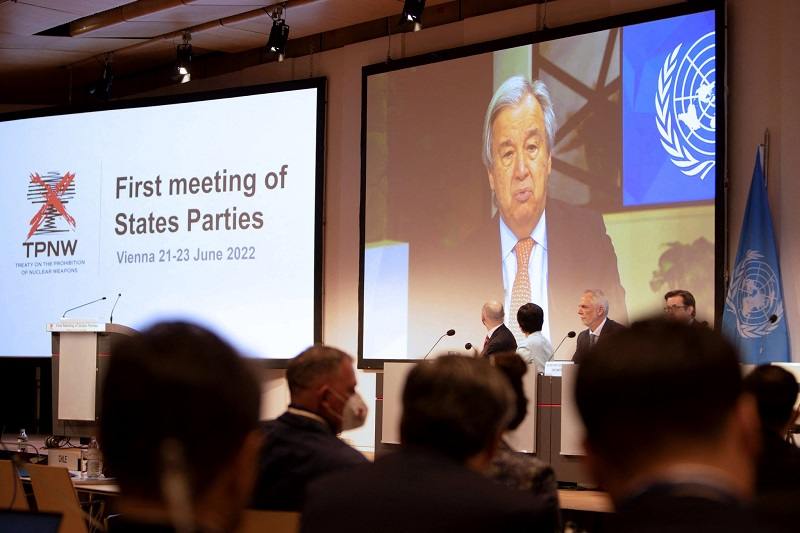
Audience members listen to U.N. Secretary-General Antonio Guterres during a meeting of parties to the Treaty on the Prohibition of Nuclear Weapons in Vienna on Tuesday.
17:52 JST, June 24, 2022
VIENNA (Jiji Press) — The first meeting of parties to the Treaty on the Prohibition of Nuclear Weapons wrapped up in Vienna on Thursday with an action plan to scrap nuclear arms.
In the Vienna action plan, participants emphasized the “complementarity” of the treaty with the Nuclear Nonproliferation Treaty, in response to questions over the consistency of the two treaties. The NPT allows the possession of nuclear weapons by the United States, Britain, France, China and Russia.
The participating states also vowed to take steps to increase the number of signatories to the nuclear weapons ban treaty, which has not been signed by any nuclear powers or Japan, and set up an international trust fund to support victims of nuclear bombing and testing.
The treaty, which reflects the opinions of activists and hibakusha atomic bomb survivors, had been criticized for lacking specific measures. Following the adoption of the action plan, attention now shifts to an NPT review conference to be held in New York in August.
Participants to the three-day meeting in Vienna also adopted the Vienna declaration to confirm their resolve to eliminate nuclear weapons. “The catastrophic humanitarian consequences of nuclear weapons cannot be adequately addressed,” the political declaration stressed.
The current situation in which nuclear arms are used as instruments of policy “highlights now more than ever the fallacy of nuclear deterrence doctrines,” the document said, while Russia’s invasion of Ukraine has led some to attach more importance to nuclear deterrence.
The signatories “are alarmed and dismayed by threats to use nuclear weapons and increasingly strident nuclear rhetoric,” the declaration stated without naming Russia.
At the Vienna meeting, the government of Japan, the only country attacked with atomic bombs, was not present even as an observer, while many other nonsignatory countries including NATO member Germany participated as observers.
Meanwhile, hibakusha atomic bomb survivors and the mayors of Hiroshima and Nagasaki, the two atomic-bombed cities, took part in meeting sessions.
The next meeting of the signatories to the nuclear ban treaty will take place at the U.N. headquarters in New York between Nov. 27 and Dec. 1, 2023.
At a news conference in Japan on Friday, Deputy Chief Cabinet Secretary Seiji Kihara declined to comment on the Vienna declaration, which expressed the signatories’ deep concerns about the lack of action by nuclear haves and their allies to reduce their reliance on nuclear weapons.









Most Read
Popular articles in the past 24 hours
-
Rising Kabuki Star Works to Ensure Deaf Audience's Enjoyment of P...
-

Lady Bess: Iroha Okuda, Mayuko Kominami Discuss Performing Elizab...
-

Japan Considering Taking Part in U.S. ‘Golden Dome’ Defense Syste...
-

Japan's TEPCO Releases Footage from Fukushima N-Plant Reactor
-

46 Evacuated from UAE, Oman on Japanese Govt-chartered Flight
-

Driver Dies in Collision with Express Train at Crossing in Mito; ...
-

Japan's Sanyo Shinkansen Suspended Again; Between Okayama, Aioi S...
-
Raise Interest Rate, Stop Yen’s Fall to Stabilize Prices
Popular articles in the past week
-

Japan Figure Skating Legend Yuzuru Hanyu Is Proud Disaster Surviv...
-

Nippon Life Insurance's U.S. Arm Sues OpenAI Over Legal Assistanc...
-
Govt to Utilize ODA for Ensuring Economic Security; Securing Ener...
-
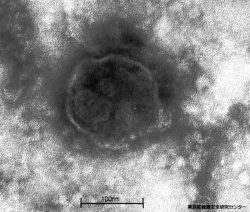
15 Measles Patients Confirmed in Tokyo in Past 6 Days; 1 May Have...
-
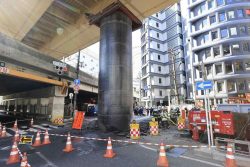
Massive Sewer Pipe Found Jutting Out of Highway in Osaka
-
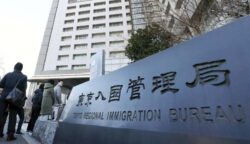
Japan Govt to Tighten Requirements to Receive Permanent Residency...
-

Beckoning Cats Get Makeover to Fit Modern Lifestyles with Sleek D...
-
Japan Govt Survey Finds Just 10% of Workers Want Working Hours to...
Popular articles in the past month
-

Producer Behind Pop Group XG Arrested for Cocaine Possession
-

Japan PM Takaichi’s Cabinet Resigns en Masse
-

Man Infected with Measles Reportedly Dined at Restaurant in Tokyo...
-

Videos Plagiarized, Reposted with False Subtitles Claiming ‘Ryuky...
-
Japan Figure Skating Legend Yuzuru Hanyu Is Proud Disaster Surviv...
-

iPS Treatments Pass Key Milestone, but Broader Applications Far f...
-

Sanae Takaichi Elected Prime Minister of Japan; Keeps All Cabinet...
-

Nepal Bus Crash Kills 19 People, Injures 25 Including One Japanes...
Top Articles in Politics
-
Japan PM Takaichi’s Cabinet Resigns en Masse
-
Sanae Takaichi Elected Prime Minister of Japan; Keeps All Cabinet Appointees from Previous Term
-

Japan’s Govt to Submit Road Map for Growth Strategy in March, PM Takaichi to Announce in Upcoming Policy Speech
-
LDP Begins Training New Lawmakers to Avoid Scandal, Gaffes; Historic Victory in Latest Election Heightens Focus on Party
-

Japan PM Sanae Takaichi Welcomes Peach Ambassadors Koga Momo Musume to Official Residence
JN ACCESS RANKING
-
Producer Behind Pop Group XG Arrested for Cocaine Possession
-
Japan PM Takaichi’s Cabinet Resigns en Masse
-
Man Infected with Measles Reportedly Dined at Restaurant in Tokyo Station
-
Videos Plagiarized, Reposted with False Subtitles Claiming ‘Ryukyu Belongs to China’; Anti-China False Information Also Posted in Japan
-
Japan Figure Skating Legend Yuzuru Hanyu Is Proud Disaster Survivor and Gold Medalist, Vows to Continue Support Efforts