
New World of ‘The Tale of Genji’ Born from Back-Translation; Sisters Who Translated Waley’s English Version to Hold Speaking Event in Tokyo
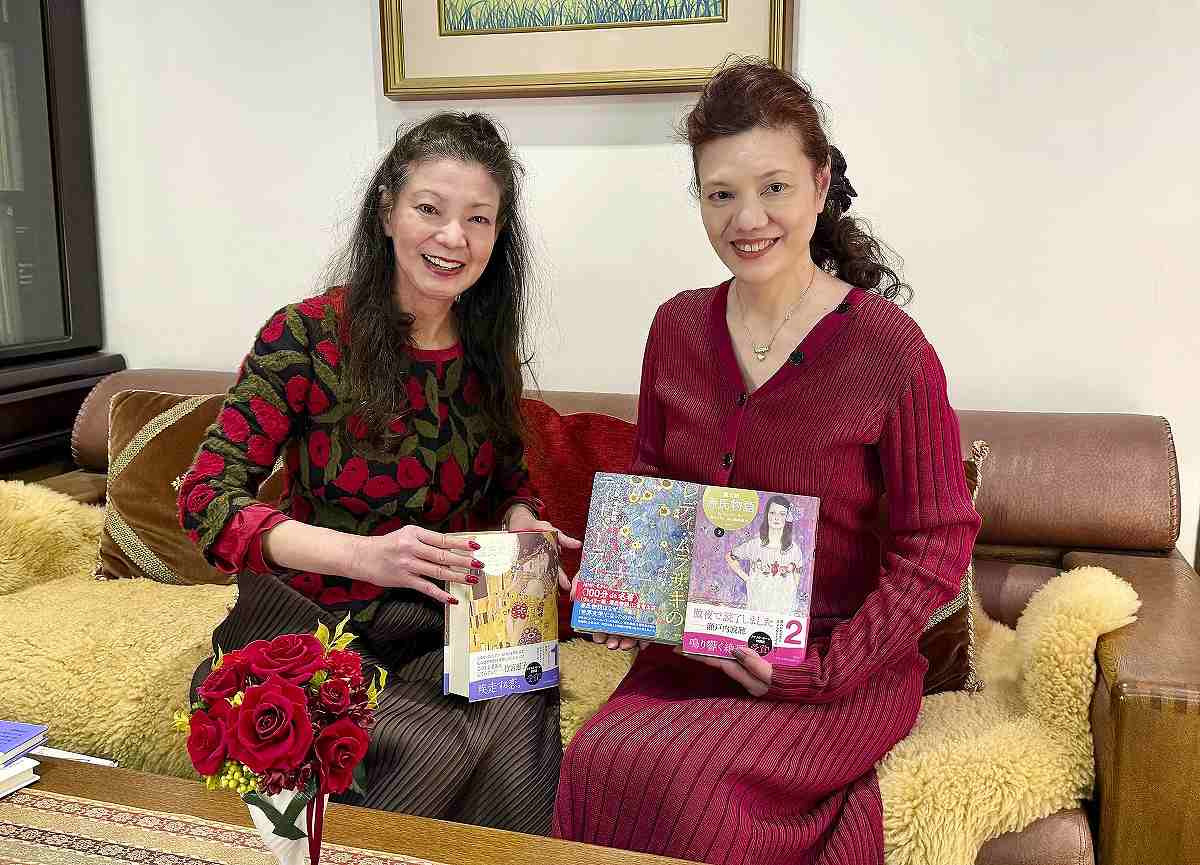
Marie Mariya, left, and Megumi Moriyama, hold their version of “The Tale of Genji” at their Tokyo residence on Jan. 19.
16:58 JST, February 4, 2026
Poets Marie Mariya and Megumi Moriyama, sisters who translated an English version of “The Tale of Genji” into Japanese, will speak at an event at Tokyo’s Setagaya Literary Museum on Feb. 14.
The English version was translated by British Orientalist Arthur Waley (1889-1966) about 100 years ago.
The event is part of a Donald Keene exhibition currently underway at the museum. The sisters are expected to talk about Waley’s edition of Genji — now revived in modern Japanese — as well as what they discovered during the translation process.
“It was utterly fascinating,” said haiku poet Mariya during an interview at the sisters’ Tokyo home in January. “That’s what first came to mind when I read Waley’s Genji.”
Moriyama, who is two years younger than Mariya, said: “It was incredibly exciting and thrilling. I never once found it boring.”
The sisters played Hyakunin Isshu karuta as children and later read “The Tale of Genji” published by Japanese authors. Fluent in English, they wanted to convey the feeling of Waley’s Genji to Japanese readers, drawing on their experience as poets.
It took them 3½ years to complete the translation, publishing the final volume in 2019.
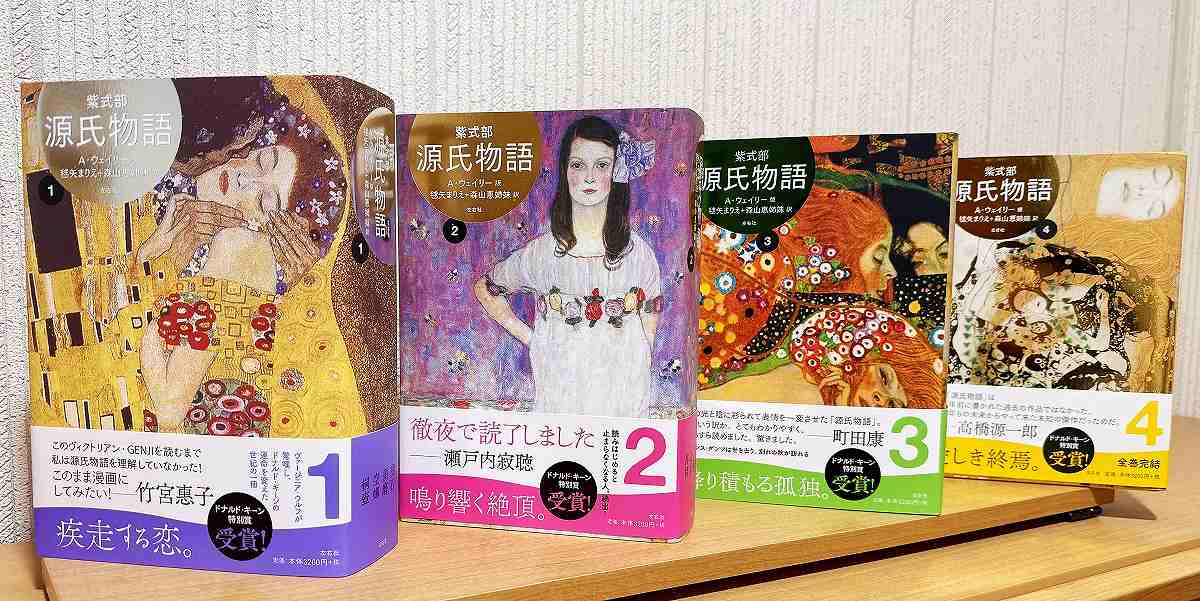
The complete four-volume set of “The Tale of Genji” translated by Marie Mariya and Megumi Moriyam
Waley’s elegant prose was revived in beautiful Japanese. The protagonist, Hikaru Genji, is written as “Shining Prince” in katakana. He is a radiant presence, as if descended from the heavens. Their Japanese translation is highly regarded and continues to be reprinted.
‘The Tale of Genji’ and Keene
The original “The Tale of Genji” by Murasaki Shikibu was written about 1,000 years ago during the mid-Heian period (794-late to the 12th century).
Waley, a linguistic genius, began reading the work after seeing an ukiyo-e print depicting a scene from the chapter “Suma” while working at the British museum. He decided to translate the work himself, publishing six volumes between 1925 and 1933.
Keene was also deeply moved by Waley’s translation.
In autumn 1940, while a student at Columbia University, Keene saw a copy of Waley’s translation at a bookstore in New York and became engrossed in it.
“The Tale of Genji,” which is devoid of war, offered solace to Keene, who hated the fact that the war was spreading across Europe.
In his autobiography, Keene wrote: “I was utterly captivated by The Tale of Genji. Arthur Waley’s translation was dreamlike and enchanting, vividly portraying a beautiful world far away.”
Keene decided to pursue studying Japanese literature after the war partly because of this encounter.
Appeal of Waley’s translation
When it was published, Waley’s edition created a sensation in literary circles. Hailed by numerous critics as a major Japanese masterpiece, it became a bestseller and was translated into French, Italian and other languages.
It not only showcased the high literary quality of both the original and the translation but also introduced Europeans to the existence of an aristocratic society in 11th century Japan where people expressed themselves through the art of waka poetry.
Britain at that time was in a period of transition, with the Victorian era just ended and having experienced World War I. The literary world was starting to depict human psychology, known as a stream of consciousness, which broke through during the Victorian-era stagnation bound by form and principle.
However, this type of writing had already existed since at least the 11th century in Japan, and it is said to have had a major impact in Europe.
‘Spiral translation’
“We were told that translating ‘The Tale of Genji’ would be a 10-year job,” said Moriyama. “We finished it in 3½ years, so it was a relatively short period of time.”
Mariya and Moriyama did not divide the translation work; they both worked on the entire text and immersed themselves in translation work for 10 hours every day. Moreover, they didn’t use computers, instead writing by hand in their notebooks. They exchanged translations, edited each other’s work, and after discussions, combined them into one piece.
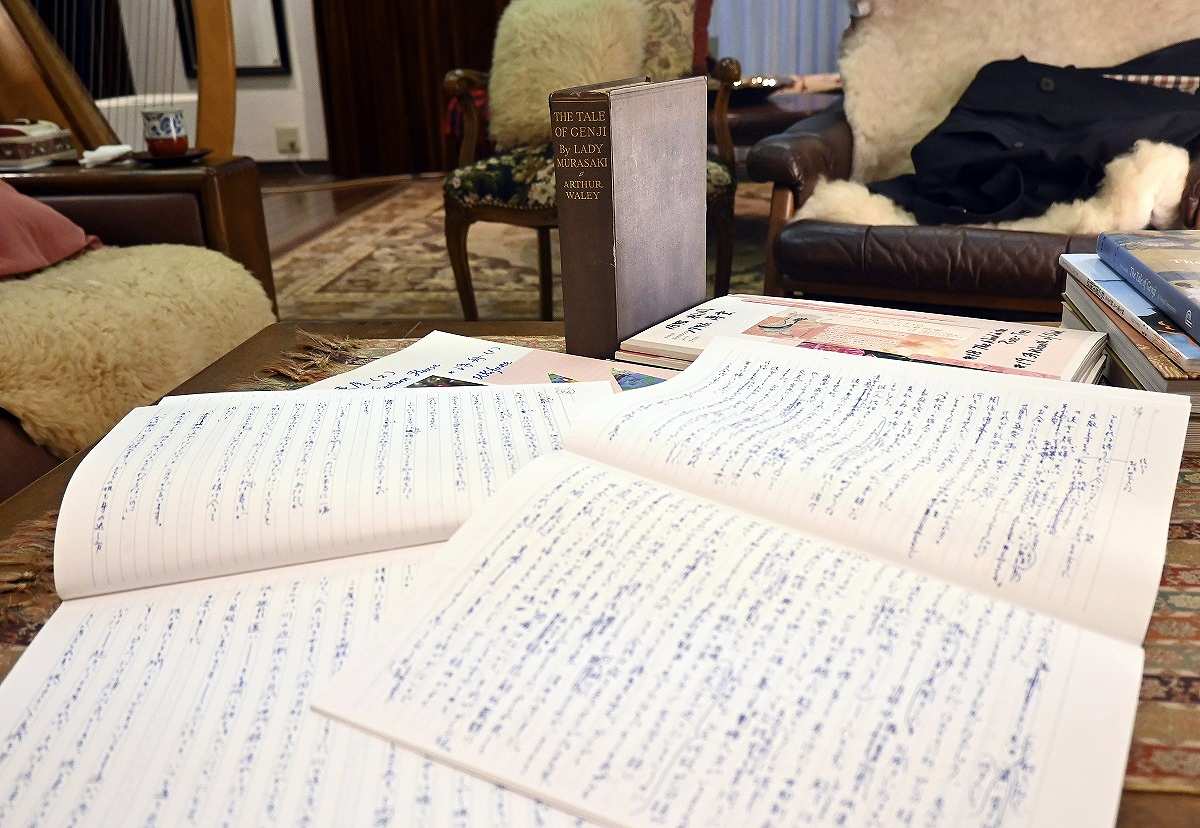
Translation notes are written in notebooks next to the first volume of Arthur Waley’s 1925 edition of “The Tale of Genji.”
In the sisters’ edition, not only are ruby characters provided for some kanji characters, Mariya and Moriyama have also written katakana and kanji ruby characters for certain words and phrases. For example, “kicho” in kanji is written as “curtain” in katakana and “wardrobe lady” in katakana is written as “koi” in kanji. By doing so, this makes it easier for modern Japanese readers to understand the material.
“Murasaki Shikibu’s Genji, Waley’s Genji, our Genji — even though they are all the same ‘The Tale of Genji,’ each has its own charm and offers new discoveries,” said Mariya.
The sisters’ work, which translates Waley’s English version back into Japanese, differs from the original “The Tale of Genji,” as it incorporates European culture and the passage of about 100 years.
The two call it a “spiral translation.”
Mariya and Moriyama said that like a spiral, it winds into new dimensions, and that is how “The Tale of Genji,” which was originally written 1,000 years ago, continues to be read by people today, allowing the work to live on.
The event will be held at 2 p.m. on Feb. 14. Admission is ¥500, and tickets will be sold on a first-come, first-served basis from noon on the day of the event.
Japanese version
毬矢まりえさん、森山恵さん姉妹は、英国で約100年前に英訳された源氏物語を逆輸入のように和訳出版しました。二人の対談イベントが14日、世田谷文学館で開催されます。




Most Read
Popular articles in the past 24 hours
-

My Spendthrift Mother Constantly Asks Me for Money
-
Japanese Students Use Traditional Pickle to Create Novel Wagashi ...
-

‘Dry Bonsai’ Gives New Life to Withered Trees, Allows Free Artist...
-

McDonald's Japan Raises Prices; Big Mac to Cost ¥500, Double Chee...
-

Nepal Bus Crash Kills 19 People, Injures 25 Including One Japanes...
-

Astellas Collaborates with Vir to Develop Its Experimental Prosta...
-

Japan’s Nikkei Stock Average Rises as AI-Related Stocks Shine; Co...
-

Early-Blooming Kawazu Cherry Blossoms Create Sea of Pink at Park ...
Popular articles in the past week
-

Producer Behind Pop Group XG Arrested for Cocaine Possession
-

Japan PM Takaichi’s Cabinet Resigns en Masse
-

Sanae Takaichi Elected Prime Minister of Japan; Keeps All Cabinet...
-

Japan's Govt to Submit Road Map for Growth Strategy in March, PM ...
-

Bus Carrying 40 Passengers Catches Fire on Chuo Expressway; All E...
-

U.S. Firm to Build Training Hub in Fukushima N-plant for Debris R...
-

Japan, U.S. Name 3 Inaugural Investment Projects; Reached Agreeme...
-

Riku-Ryu Pair Wins Gold Medal: Their Strong Bond Leads to Major C...
Popular articles in the past month
-
Producer Behind Pop Group XG Arrested for Cocaine Possession
-
Japan PM Takaichi’s Cabinet Resigns en Masse
-

Japan Institute to Use Domestic Commercial Optical Lattice Clock ...
-

Man Infected with Measles Reportedly Dined at Restaurant in Tokyo...
-

Israeli Ambassador to Japan Speaks about Japan’s Role in the Reco...
-

Videos Plagiarized, Reposted with False Subtitles Claiming ‘Ryuky...
-

Man Infected with Measles May Have Come in Contact with Many Peop...
-

Prudential Life Insurance Plans to Fully Compensate for Damages C...
Top Articles in JN Specialities
-
Exhibition Shows Keene’s Interactions with Showa-Era Writers in Tokyo, Features Newspaper Columns, Related Materials
-

The Japan News / Weekly Edition (2/20-2/26)
-

Step Back in Time at Historical Estate Renovated into a Commercial Complex in Tokyo
-

The Japan News / Weekly Edition (1/30-2/5)
-
Senior Japanese Citizens Return to University to Gain Knowledge, Find New Career, Make Friends
JN ACCESS RANKING
-
Producer Behind Pop Group XG Arrested for Cocaine Possession
-
Japan PM Takaichi’s Cabinet Resigns en Masse
-
Japan Institute to Use Domestic Commercial Optical Lattice Clock to Set Japan Standard Time
-
Man Infected with Measles Reportedly Dined at Restaurant in Tokyo Station
-
Israeli Ambassador to Japan Speaks about Japan’s Role in the Reconstruction of Gaza