
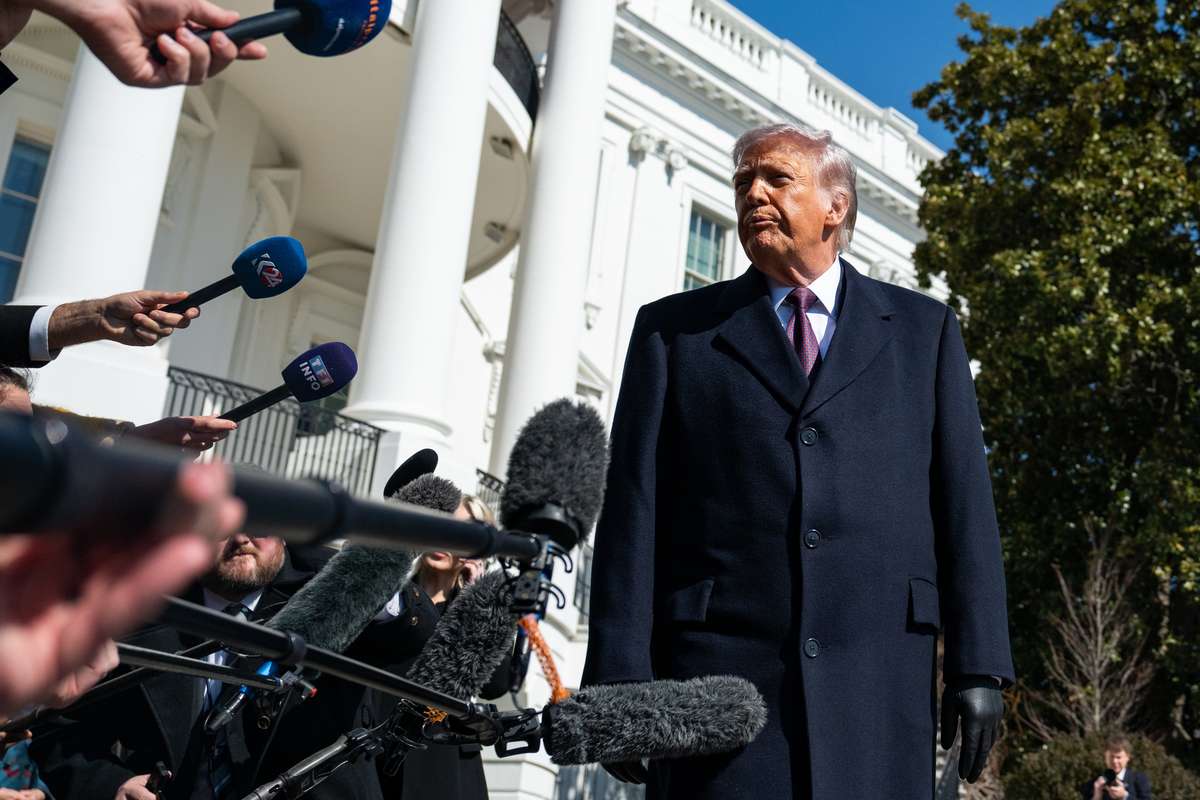
President Donald Trump speaks to reporters outside the White House last month.
17:07 JST, March 12, 2026
The Trump administration took a major step toward replacing the global tariffs that the Supreme Court recently invalidated, announcing new investigations of unfair trading practices that will almost certainly result later this summer in permanent new taxes on U.S. imports.
Jamieson Greer, the president’s chief trade negotiator, said Wednesday that he is launching an investigation of “structural excess capacity and production in the manufacturing sectors” of China, the European Union, Japan, Mexico, South Korea, India, Taiwan, Malaysia, Vietnam, Thailand, Singapore, Switzerland, Norway, Indonesia, Bangladesh and Cambodia.
The investigation, which the administration previewed last month, will be conducted under Section 301 of the 1974 Trade Act. President Donald Trump relied on the same provision in his first term to impose sweeping tariffs on Chinese products, which largely remain in effect.
Greer’s announcement came less than three weeks after the Supreme Court ruled that many of the tariffs Trump imposed last year, relying on a 1977 economic emergency powers law, were unconstitutional. At the time, the president vowed to continue his campaign to reshape global trade using other legal authorities.
“The policy remains the same. The tools may change depending upon the vagaries of courts,” Greer told reporters.
Within hours of his Supreme Court defeat, the president turned to another trade tool, Section 122 of the 1974 act, to impose a global 10 percent tariff. Under the law, that measure – which Trump said he would increase to 15 percent – expires after 150 days.
Earlier this week, the Liberty Justice Center, the nonprofit legal group that successfully challenged Trump’s emergency tariffs, sued the president over the new temporary levies, saying the financial conditions required by the law had not been met.
The administration intends to conduct the new Section 301 investigation, and a second probe of U.S. trading partners’ use of forced labor, on an “accelerated time frame.” The aim is to have new tariffs ready to replace the Section 122 measures when they lapse.
The investigation, which will include public hearings and consultations with other nations, will highlight a long-standing U.S. complaint that the global trading system is allegedly tilted against American producers.
Countries such as China maintain a web of government policies that subsidize their manufacturing sectors while making it hard for U.S. companies to sell to their citizens. The result, according to the administration, is a persistent U.S. trade deficit and the decline of U.S. manufacturing.
“We need to protect American jobs, and we need to make sure we have fair trade with our trading partners,” Greer said.
The Trump administration has negotiated trade deals with most of the countries it now plans to investigate, raising the prospect of new tariffs on their goods. In his comments to reporters, Greer suggested that those levies could be used as leverage, compelling those nations to fulfill their promises to open markets and forswear the use of forced labor.
Wednesday’s announcement is just the start of the administration’s efforts to reinvent a lasting tariff regime after its Supreme Court rebuke. Greer said additional Section 301 investigations are planned, citing a Feb. 20 administration news release that listed pharmaceutical pricing practices, digital services taxes, discrimination against U.S. technology companies and ocean pollution as future subjects.
The Commerce Department is pursuing separate probes that are expected to result in tariffs on specific industries, including robotics and wind turbines.





Most Read
Popular articles in the past 24 hours
-

Japan Figure Skating Legend Yuzuru Hanyu Is Proud Disaster Surviv...
-

Hawaii Museum on Tsunami Including Japan's 2011 Disaster at Risk ...
-

Japan Train Company to Increase Fares, Including in Tokyo Metropo...
-

Japan’s Mitsui O.S.K. Lines Container Ship Anchored in Persian Gu...
-

Struggling Onosato Pulls out of Spring Tourney
-

Japan’s Mitsui O.S.K. Lines Container Ship Anchored in Persian Gu...
-

Tail of ANA Plane Struck Runway During Landing in Houston; No Inj...
-

Iran Targets Busiest International Airport as Top UN Body Demands...
Popular articles in the past week
-
Japan Figure Skating Legend Yuzuru Hanyu Is Proud Disaster Surviv...
-

Nippon Life Insurance's U.S. Arm Sues OpenAI Over Legal Assistanc...
-

Ibaraki Pref.'s 1st Foreign Bus Driver Hired in Tsukuba
-
Govt to Utilize ODA for Ensuring Economic Security; Securing Ener...
-
Massive Sewer Pipe Found Jutting Out of Highway in Osaka
-
Amid Strait of Hormuz Blockade, Shipping Companies Scramble to Ge...
-

Beckoning Cats Get Makeover to Fit Modern Lifestyles with Sleek D...
-
Japan Govt Survey Finds Just 10% of Workers Want Working Hours to...
Popular articles in the past month
-

Producer Behind Pop Group XG Arrested for Cocaine Possession
-

Japan PM Takaichi’s Cabinet Resigns en Masse
-

Man Infected with Measles Reportedly Dined at Restaurant in Tokyo...
-

Videos Plagiarized, Reposted with False Subtitles Claiming ‘Ryuky...
-

iPS Treatments Pass Key Milestone, but Broader Applications Far f...
-

Sanae Takaichi Elected Prime Minister of Japan; Keeps All Cabinet...
-

Nepal Bus Crash Kills 19 People, Injures 25 Including One Japanes...
-

South Korea Tightens Rules on Foreigners Buying Homes in Seoul Me...
Top Articles in News Services
-
Survey Shows False Election Info Perceived as True
-
Japan’s Nikkei Stock Average Falls as US-Iran Tensions Unsettle Investors (UPDATE 1)
-
Japan’s Nikkei Stock Average Rises on Tech Rally and Takaichi’s Spending Hopes (UPDATE 1)
-

Japan to Ban Use of Power Banks on Airplanes
-

North Korea Unveils Image of Kim Jong Un’s Teenage Daughter Firing Rifle
JN ACCESS RANKING
-
Producer Behind Pop Group XG Arrested for Cocaine Possession
-
Japan PM Takaichi’s Cabinet Resigns en Masse
-
Man Infected with Measles Reportedly Dined at Restaurant in Tokyo Station
-
Videos Plagiarized, Reposted with False Subtitles Claiming ‘Ryukyu Belongs to China’; Anti-China False Information Also Posted in Japan
-
iPS Treatments Pass Key Milestone, but Broader Applications Far from Guaranteed