
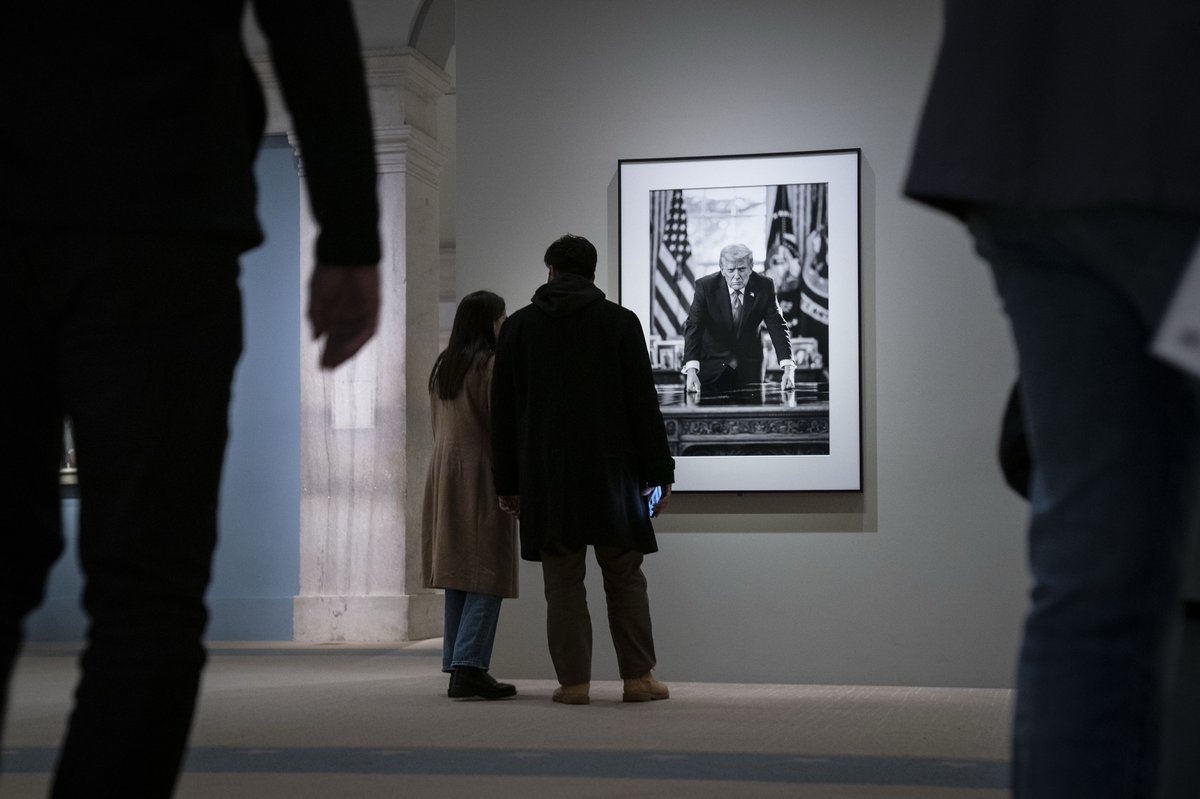
Visitors view an updated portrait of President Donald Trump, with abridged text adjoining it, on Saturday at the National Portrait Gallery in D.C.
12:49 JST, January 11, 2026
The National Portrait Gallery removed a swath of text that mentioned President Donald Trump’s two impeachments and the Jan. 6, 2021, insurrection as it swapped out a prominent photo of him this week.
Trump and the White House posted on social media Friday and Saturday to highlight the updated portrait in the “America’s Presidents” exhibition, which now features a framed black-and-white photo by White House photographer Daniel Torok. It shows Trump staring intensely, with his fists on the Resolute Desk – an image the president first shared on his Truth Social account last year.
It replaced a photo by Washington Post photojournalist Matt McClain, which showed Trump with his hands folded in front of him, and was accompanied by a longer caption recounting Trump’s first term and his reelection. “Impeached twice, on charges of abuse of power and incitement of insurrection after supporters attacked the U.S. Capitol on January 6, 2021, he was acquitted by the Senate in both trials,” it read, in part.
A Trump official specifically complained about that passage months earlier, when the president was trying to force out the portrait gallery’s director.
The placard has been replaced with one whose caption is so short that the outline of the old sign was visible on the wall beneath it, simply noting Trump’s years in office. It now contrasts with portraits of other former presidents, including Joe Biden, Barack Obama, George W. Bush and Bill Clinton, which all hang alongside wall text highlighting events during their time in office. Clinton’s notes his impeachment.
National Portrait Gallery spokeswoman Concetta Duncan said the museum is “exploring” less descriptive “tombstone labels” for some new exhibits and displays, and she noted that Trump’s portrait in the popular exhibition has changed before.
Neither the Smithsonian nor the White House directly responded when asked if the Trump administration had requested the changes. The revamp comes several months after Trump bashed former portrait gallery director Kim Sajet as “highly partisan,” leading to her resignation, and after the White House threatened to withhold Smithsonian funding if the institution doesn’t cooperate with the administration’s review of museum content for “improper ideology.”
Trump’s allies in government have recently led efforts to brand the public sphere with his preferred personal descriptors in ways large and small, adding his name to the Kennedy Center and U.S. Institute of Peace and installing plaques in the White House that laud Trump and disparage his political rivals such as former presidents Biden and Obama. Last year, the Colorado Capitol replaced a portrait of Trump after he complained about it.
Besides noting the 2021 attack on the U.S. Capitol by Trump’s supporters and his impeachments in the House, the old placard mentioned his Supreme Court appointments, his 2020 election loss to Biden and his efforts to lead the development of coronavirus vaccines. The text also said that the former photo portrait by McClain was supposed to remain on view until Trump’s commissioned painting was unveiled. (The previous portrait and its biographical label still appeared on the Smithsonian website as of Saturday afternoon.)
The National Portrait Gallery portrayed the changes as unremarkable, saying that it previously rotated two photos of Trump through the collection.
A notice posted on the gallery’s website announced the exhibition would temporarily close for updates from April 6 to May 14. It did not specify whether the other labels for former presidents would be changed during that period.
A former Smithsonian historian, who spoke on the condition of anonymity because they were not authorized to speak for the institution, said that the National Portrait Gallery’s relatively long wall texts have stood out in comparison to shorter labels at many other art museums. “Because it’s a museum which combines art and portraiture, it has always had a biographical component to its labels to explain and contextualize the individual who’s being portrayed,” they said, adding that “you can outline the parameters of somebody’s career in a very neutral fashion.”
“Tombstone” labels – museum jargon for bare-bones signs that list only essential information such as the artist, date of creation and medium – are common at art museums such as the Guggenheim or MoMA, as well as other Smithsonian art museums.
This isn’t the first time the Smithsonian has removed material mentioning congressional attempts to remove Trump from office since he launched a public campaign to remove what he calls “woke” ideology from U.S. cultural institutions. In July, the National Museum of American History briefly removed – then restored – references to his impeachments in its “The American Presidency: A Glorious Burden” exhibition.
The institution said it had taken the text out “because the other topics in this section had not been updated since 2008.” The change was part of a content review that the Smithsonian agreed to undertake, following pressure from the White House to remove Sajet as the portrait gallery’s director.
At the time, a White House official provided The Washington Post with a list of instances in which Sajet allegedly criticized Trump or promoted improper ideology. It specifically included the caption on his presidential portrait, for mentioning his impeachments and the Capitol attack.
Although the Smithsonian Board of Regents affirmed that only its secretary could decide the institution’s personnel, Sajet later stepped down and has not been permanently replaced. Elliot Gruber serves as acting director.
The changes ignited concerns about political interference at the Smithsonian and how the institution charged with preserving American history could be shaped by the Trump administration’s efforts to exert more control over its work.
Torok became the White House photographer during Trump’s second term. One of his first official portraits drew attention for its similarity to the president’s 2023 mug shot, for his indictment on criminal charges in Atlanta.
His photo now hanging in the National Portrait Gallery shows the president leaning over his desk in the Oval Office, fists clenched, looking directly into the camera. Trump posted the photo on Truth Social in October, writing that he was “getting ready to leave our imprint on the World.”
Torok celebrated the Smithsonian display on social media on Friday and previously described the photo on Instagram as “Powerful!”
The photo strikingly echoes a quieter image of John F. Kennedy. The president was captured from behind, hunched over in nearly the same position as Trump, in a 1961 photograph called “The Loneliest Job.”
Trump has struck the same pose in other photos, including one Stephen Voss shot for Time in October.






Most Read
Popular articles in the past 24 hours
-

3,000 Accounts Posting, Spreading Content Critical of Japan on X;...
-

Milano Cortina 2026: Sakamoto Serves as Flag Bearer; Japan Earns ...
-
Milano Cortina 2026: There Were Cheers across the Country, after ...
-

A Packed Bus Plunges off a Nepal Highway, Killing 19 and Injuring...
-
Luna Sea Drummer Shinya Dies at 56; Powerful Drummer Behind ‘Desi...
-

Milano Cortina 2026: ‘Magical’ Italian Games Close wi...
-
Milano Cortina 2026: Riku-Ryu Duo Stick Together During Closing C...
-
Emperor Receives Well-Wishes from Public on His 66th Birthday
Popular articles in the past week
-

Japan PM Takaichi’s Cabinet Resigns en Masse
-

Man Infected with Measles Reportedly Dined at Restaurant in Tokyo...
-

Sanae Takaichi Elected Prime Minister of Japan; Keeps All Cabinet...
-

Japan's Govt to Submit Road Map for Growth Strategy in March, PM ...
-

Bus Carrying 40 Passengers Catches Fire on Chuo Expressway; All E...
-

U.S. Firm to Build Training Hub in Fukushima N-plant for Debris R...
-

Japan, U.S. Name 3 Inaugural Investment Projects; Reached Agreeme...
-

Riku-Ryu Pair Wins Gold Medal: Their Strong Bond Leads to Major C...
Popular articles in the past month
-
Japan PM Takaichi’s Cabinet Resigns en Masse
-

Japan Institute to Use Domestic Commercial Optical Lattice Clock ...
-

Israeli Ambassador to Japan Speaks about Japan’s Role in the Reco...
-
Man Infected with Measles Reportedly Dined at Restaurant in Tokyo...
-

Videos Plagiarized, Reposted with False Subtitles Claiming ‘Ryuky...
-

Man Infected with Measles May Have Come in Contact with Many Peop...
-

Prudential Life Insurance Plans to Fully Compensate for Damages C...
-

Woman with Measles Visited Hospital in Tokyo Multiple Times Befor...
Top Articles in News Services
-
Survey Shows False Election Info Perceived as True
-
Prudential Life Expected to Face Inspection over Fraud
-
Hong Kong Ex-Publisher Jimmy Lai’s Sentence Raises International Outcry as China Defends It
-

Japan’s Nikkei Stock Average Touches 58,000 as Yen, Jgbs Rally on Election Fallout (UPDATE 1)
-
Japan’s Nikkei Stock Average Falls as US-Iran Tensions Unsettle Investors (UPDATE 1)
JN ACCESS RANKING
-
Japan PM Takaichi’s Cabinet Resigns en Masse
-
Japan Institute to Use Domestic Commercial Optical Lattice Clock to Set Japan Standard Time
-
Israeli Ambassador to Japan Speaks about Japan’s Role in the Reconstruction of Gaza
-
Man Infected with Measles Reportedly Dined at Restaurant in Tokyo Station
-
Videos Plagiarized, Reposted with False Subtitles Claiming ‘Ryukyu Belongs to China’; Anti-China False Information Also Posted in Japan