
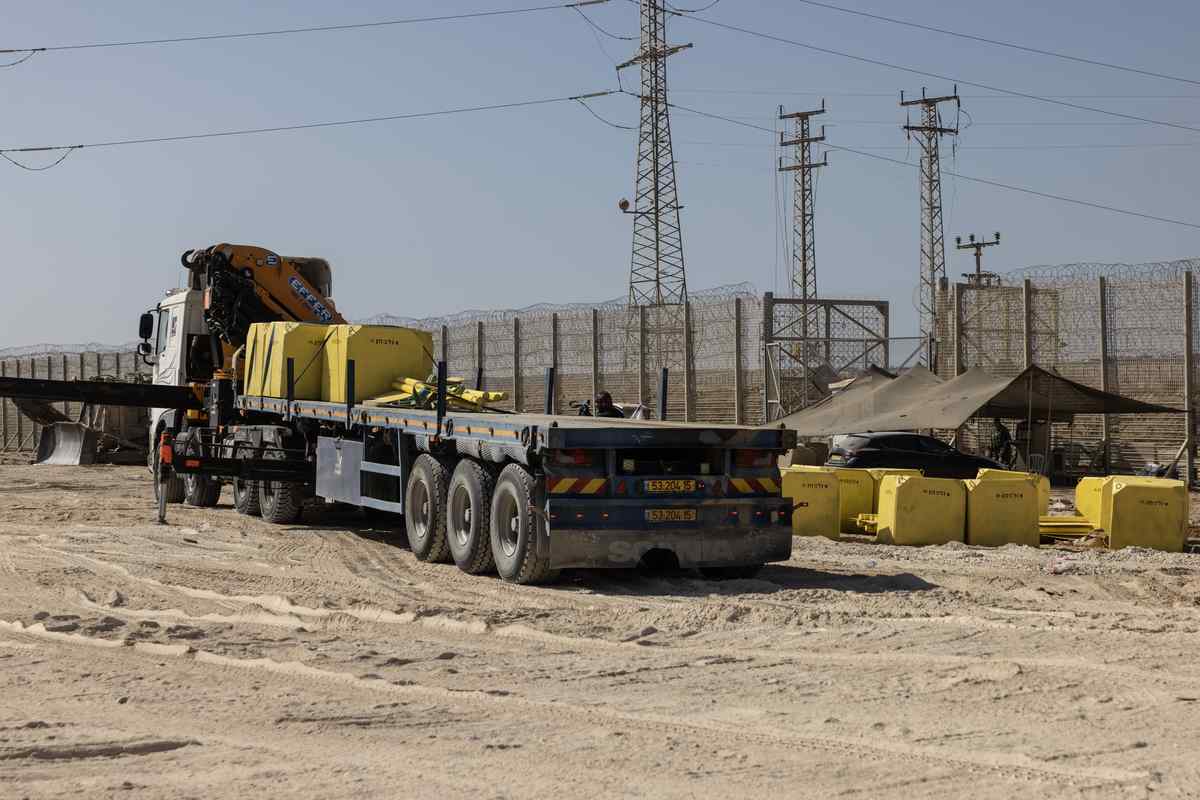
A truck carrying the yellow cement blocks used for Israel’s demarcation line in Gaza as part of a U.S.-backed ceasefire.
13:28 JST, January 9, 2026
For Palestinians living near Israel’s demarcation line in Gaza, the war never stopped.
In the three months since a U.S.-backed ceasefire began, Israeli troops, tanks and drones have fired on residents almost daily in areas close to or abutting the line. The attacks have killed at least 250 people out of the more than 400 who have died since Oct. 10, according to the local health authority, which does not distinguish between civilians and combatants. Thousands more have been displaced, the United Nations and other humanitarian groups say.
Israel says it is responding to attempts by Hamas operatives to cross the line, either to attack troops or to gather intelligence, in violation of the ceasefire agreement that required Israeli forces to partially withdraw. The boundary, known as the “Yellow Line,” splits Gaza roughly in half, with the Israeli military in the east, much of the south and part of the north, and the vast majority of Palestinians crammed into the west.
The line, which is only partly marked by yellow-painted concrete blocks, was meant to be temporary, a first step toward Israel’s eventual withdrawal. But as the ceasefire took hold, Israeli forces worked quickly to reinforce their positions and establish new ones along the line, according to satellite imagery reviewed by Will Goodhind, an investigator and geospatial analyst for the open-access research project Contested Ground.
Since then, Israeli leaders, including military chief of staff Eyal Zamir, have referred to the boundary as a “new border line.” And on several occasions, troops have pushed into areas west of the line, moving the yellow blocks overnight or without warning, residents and the U.N. said. In one instance last month, a community kitchen supported by the World Food Program along Gaza’s Salah al-Din road closed in the evening and by morning, it was suddenly on the Israeli side of the boundary, the U.N. agency said.
The Israel Defense Forces has denied shifting the line. But as talks to advance the truce have stalled, Palestinians worry the stalemate will normalize a dangerous status quo – one that experts say would entrench Israel’s presence and de facto divide the territory, leaving the estimated 2.1 million people now in western Gaza perpetually isolated and displaced.
“It hasn’t been calm since we returned here,” said 60-year-old Reda Elewa, a resident of the Shejaiya neighborhood in eastern Gaza City. “On the ground, it has never stopped – artillery, quadcopters, gunfire,” he said.
Shortly after the ceasefire was announced, Elewa and his family returned to Shejaiya, where the plot of land their home once occupied is around 160 feet from the line. “They plan to move closer and push us out,” he said of Israel’s military activity. “There is no real ceasefire.”
For Israel, maintaining the Yellow Line is key to pressuring Hamas, which led the attacks on Israeli communities on Oct. 7, 2023, that killed about 1,200 people and saw about 250 others taken to Gaza as hostages. Israel launched a punishing military campaign in response, killing more than 71,000 Palestinians, according to the Gaza Health Ministry.
“Israel will never leave Gaza,” Defense Minister Israel Katz said last month at an event organized by the Makor Rishon news outlet. As part of the ceasefire deal, “there will be a significant security zone, even after we transition phases,” he said.
But while the ceasefire plan envisions an “international security force” that would eventually deploy to Gaza and help oversee its demilitarization, the Trump administration has struggled to persuade nations to join. When asked last week whether Israeli forces would be withdrawing from Gaza, President Donald Trump, who had just met with Israeli Prime Minister Benjamin Netanyahu, said it was “a separate subject” from the disarmament of Hamas. “We’ll talk about that,” he said.
In the meantime, Israeli forces have dug in further, clearing new ground, expanding compounds and building up high berms along the line.
“In this case, the Yellow Line becomes a new de facto border,” said Ofer Guterman, a former senior analyst with Israel’s Military Intelligence Directorate and a researcher at the Institute for National Security Studies in Tel Aviv. “This arrangement works for both: Israel gets a security buffer protecting its communities, and Hamas keeps its weapons, controls the population, and rebuilds its civilian rule over most of Gaza’s residents.”
But for the Palestinian civilians who have borne the brunt of the war, that type of understanding offers little comfort, both for their immediate circumstances and for the enclave’s future. Residents who lived in eastern Gaza either have lost or can no longer access their homes, businesses, land or other assets that are located in the Israeli-controlled zone, where troops are carrying out daily demolitions of residential and other buildings, according to the U.N.
Israel says the demolitions are necessary to destroy Hamas’s military infrastructure. “Israel’s policy in Gaza is clear: The IDF operates to destroy the tunnels and eliminate Hamas terrorists without any restrictions within the ‘Yellow Area’ under our control,” Katz said.
Israel’s portion of Gaza, which makes up more than half of the territory, has also swallowed up much of the enclave’s agricultural land, according to Gisha, an Israeli human rights group. The majority of the population, 1.6 million people, face acute food insecurity, according to the world’s leading authority on hunger.
Meanwhile, in western Gaza, families are packed together amid the rubble, in tents or makeshift shelters, with little protection against the wind and rain. Israeli forces surround them on all sides, including the sea, and daily life near the Yellow Line – which cuts through the enclave’s most important urban centers – is unstable and violent.
The attacks, residents say, can come at any time.
For Eyad Amin, 45, that time came on Nov. 19, just one day after he moved his family from central Gaza back home to Shejaiya. When they arrived, he spotted a yellow block about 1,000 feet to the east.
The next afternoon, Amin was at home when he heard a noise and looked out the window: A few yards away was an Israeli tank. He grabbed his three children and ran.
When Amin returned the following day for some belongings, there was a new yellow block next to the house. “There was no prior warning, no alert,” he said. The IDF denied expanding the Yellow Line on Nov. 20.
Shejaiya has been a flash point for violence along the Yellow Line, registering the highest number of Israeli attacks from Oct. 10 to Dec. 5, along with Bani Suheila, a town about a mile east of the southern city of Khan Younis, according to Armed Conflict Location & Event Data, a nonprofit organization that maps and analyzes data on political violence around the world.
Other hot spots include the Tuffah neighborhood in eastern Gaza City, the Bureij refugee camp in central Gaza and Jabalya in the north, ACLED data shows.
Among the dead so far: guests at a wedding in Tuffah, a Bedouin woman tending sheep near Israeli-controlled Rafah, a family traveling in a van in Gaza City’s Zeitoun neighborhood, and a teenager whose relatives say was shot and killed in Jabalya, then run over by an Israeli military vehicle.
“It shouldn’t be called the Yellow Line – it’s the line of confrontation, the death line,” said Mohamed al-Bursh, 35, a resident of Jabalya whose destroyed home is a little less than 500 feet from the boundary. Bursh and his extended family returned to Jabalya for three days in October after the ceasefire went into effect.
“Those three days were the worst of my life,” he said. “The Israeli army went wild. … Quadcopters fired on us and dropped grenades, and tanks shelled the area,” Bursh said, adding that now, “no one dares to go back … not even a cat or a dog would dare.”
An Israeli security official, speaking on the condition of anonymity because they were not authorized to talk to the media, said that the IDF is “dealing with near-daily violations of the ceasefire agreement” but conceded that “the main point of friction” between troops and fighters is in Rafah in southern Gaza, where dozens of Hamas militants have been holed up in a tunnel complex behind Israeli lines.
Three Israeli soldiers have been killed in Gaza since the ceasefire began, all of them in Rafah.
At a cabinet meeting in October, the IDF’s deputy chief of staff, Tamir Yadai, said that troops were instructed to shoot at adult suspects approaching the Yellow Line but to detain rather than fire on children, according to Kan News, Israel’s public broadcaster. Anyone who approaches the line “should know that he may be hit,” added Katz, the defense minister.
So when Tamer Abu Assi, 39, began sending his two young boys out to collect firewood near the ruins of their home in Bani Suheila, a little more than 100 yards from the line, he knew he was putting them at risk. But Abu Assi was injured and unable to walk, and as winter arrived the family, living in a withered tent, needed to stay warm.
The boys – Jumaa, 10, and Fadi, 8 – “knew the limit marked by the Yellow Line and understood it was dangerous to cross,” he said. But as firewood became more scarce, each day they strayed farther from home.
On Nov. 29, the IDF issued a statement saying it had “identified two suspects who crossed the yellow line, conducted suspicious activities on the ground, and approached IDF troops operating in the southern Gaza Strip, posing an immediate threat.” The Israeli air force “eliminated the suspects in order to remove the threat,” the statement said.
The suspects were Abu Assi’s two boys.
They were killed by an Israeli drone east of the Yellow Line, said Anas Abu Saada, 17, who had been with them collecting firewood nearby when he witnessed the attack.
When asked about the identities of the victims, the IDF referred The Washington Post to its original statement.








Most Read
Popular articles in the past 24 hours
-

3,000 Accounts Posting, Spreading Content Critical of Japan on X;...
-

Milano Cortina 2026: Sakamoto Serves as Flag Bearer; Japan Earns ...
-

Milano Cortina 2026: There Were Cheers across the Country, after ...
-

A Packed Bus Plunges off a Nepal Highway, Killing 19 and Injuring...
-

Luna Sea Drummer Shinya Dies at 56; Powerful Drummer Behind ‘Desi...
-

Milano Cortina 2026: ‘Magical’ Italian Games Close wi...
-

Milano Cortina 2026: Riku-Ryu Duo Stick Together During Closing C...
-

Emperor Receives Well-Wishes from Public on His 66th Birthday
Popular articles in the past week
-

Japan PM Takaichi’s Cabinet Resigns en Masse
-

Man Infected with Measles Reportedly Dined at Restaurant in Tokyo...
-

Sanae Takaichi Elected Prime Minister of Japan; Keeps All Cabinet...
-

Japan's Govt to Submit Road Map for Growth Strategy in March, PM ...
-

Bus Carrying 40 Passengers Catches Fire on Chuo Expressway; All E...
-

U.S. Firm to Build Training Hub in Fukushima N-plant for Debris R...
-

Japan, U.S. Name 3 Inaugural Investment Projects; Reached Agreeme...
-

Riku-Ryu Pair Wins Gold Medal: Their Strong Bond Leads to Major C...
Popular articles in the past month
-
Japan PM Takaichi’s Cabinet Resigns en Masse
-

Japan Institute to Use Domestic Commercial Optical Lattice Clock ...
-

Israeli Ambassador to Japan Speaks about Japan’s Role in the Reco...
-
Man Infected with Measles Reportedly Dined at Restaurant in Tokyo...
-

Videos Plagiarized, Reposted with False Subtitles Claiming ‘Ryuky...
-

Man Infected with Measles May Have Come in Contact with Many Peop...
-

Prudential Life Insurance Plans to Fully Compensate for Damages C...
-

Woman with Measles Visited Hospital in Tokyo Multiple Times Befor...
Top Articles in News Services
-

Survey Shows False Election Info Perceived as True
-

Prudential Life Expected to Face Inspection over Fraud
-

Hong Kong Ex-Publisher Jimmy Lai’s Sentence Raises International Outcry as China Defends It
-

Japan’s Nikkei Stock Average Touches 58,000 as Yen, Jgbs Rally on Election Fallout (UPDATE 1)
-
Japan’s Nikkei Stock Average Falls as US-Iran Tensions Unsettle Investors (UPDATE 1)
JN ACCESS RANKING
-
Japan PM Takaichi’s Cabinet Resigns en Masse
-
Japan Institute to Use Domestic Commercial Optical Lattice Clock to Set Japan Standard Time
-
Israeli Ambassador to Japan Speaks about Japan’s Role in the Reconstruction of Gaza
-
Man Infected with Measles Reportedly Dined at Restaurant in Tokyo Station
-
Videos Plagiarized, Reposted with False Subtitles Claiming ‘Ryukyu Belongs to China’; Anti-China False Information Also Posted in Japan