

Youth minister Jon Edwards entrusted Donald Trump with his vote in 2024. Now he’s not so sure about his future loyalties
15:39 JST, December 13, 2025
Arturo Dominguez wishes he could go back and change his vote for Donald Trump.
Jon Edwards held his nose and cast a ballot for Trump in 2024 but is unsure where his allegiance will lie in the future.
Sache Cañete, by contrast, was persuaded by Trump’s “no tax on tips” pledge. Her tip income has gone down, but she still thinks Trump deserves more time to deliver.
A year after touting the “historic realignment” of minority voters that powered him to a second term in the White House, the multiracial coalition President Trump has boasted about is slipping away.
Trump’s approval rating among Black Americans has dropped from 24 percent during his first three months in office to 13 percent in polls this fall, according to an average of eight nationwide polls compiled by The Washington Post.
Among Hispanic voters, his ratings have fallen from 40 percent to 34 percent, while approval among White voters has fallen from 52 percent to 47 percent. Fewer polls have large enough samples to track opinions of Asian Americans, but Pew Research Center surveys find that his ratings among Asian registered voters fell from 44 percent in February to 30 percent in September.
That represents a significant falloff from the gains Trump made among minority voters in 2024. Although the vast majority of Black voters selected Democrat Kamala Harris in the 2024 election, Trump won about 15 percent of that demographic group, roughly doubling his share from four years earlier and garnering the largest share of the Black vote of any Republican presidential candidate in at least a quarter-century. He saw similar gains among Latinos and Asian American voters and has routinely bragged about a greater electoral realignment.
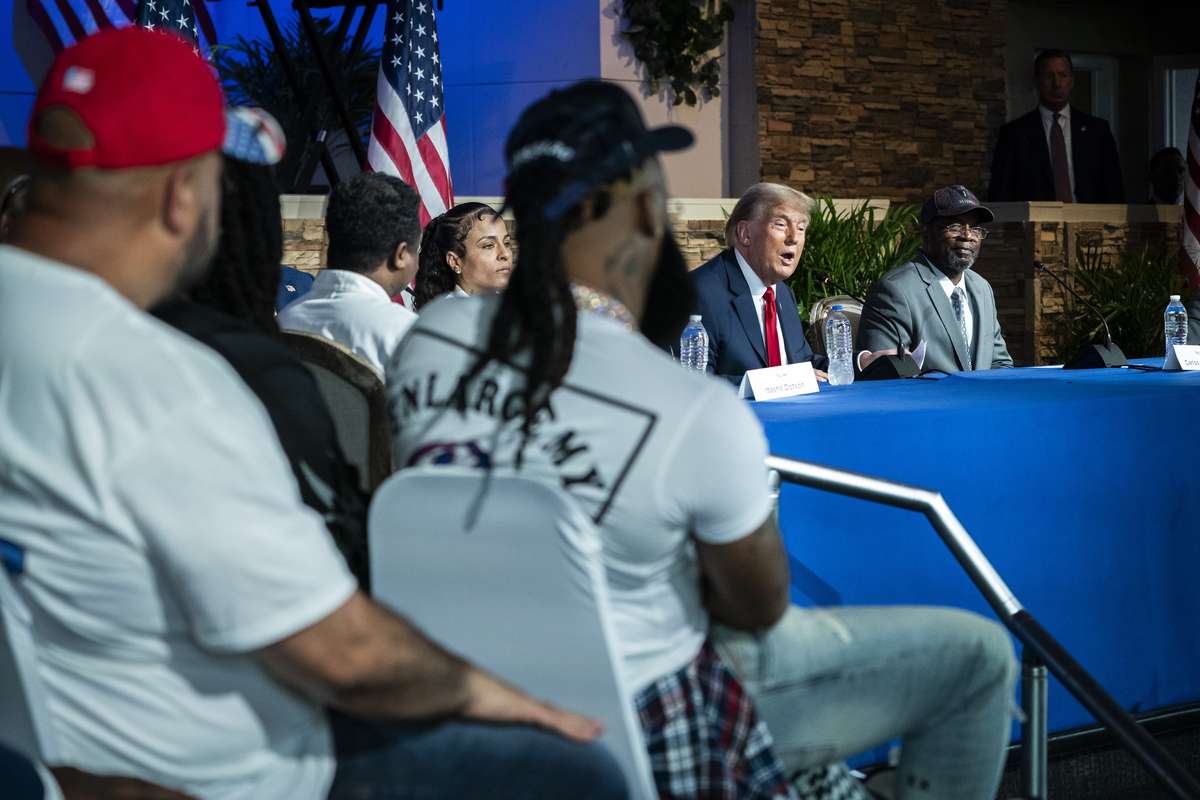
Donald Trump, the Republican presidential nominee, takes part in a roundtable at 180 Church in Detroit in June 2024. A sizable share of non-White Trump voters regret casting a ballot for him.
“This campaign has been so historic in so many ways, we’ve built the biggest, the broadest, the most unified coalition. They’ve never seen anything like it in all of American history,” Trump said in his election night victory speech. “They came from all quarters. Union, nonunion, African American, Hispanic American, Asian American, Arab American, Muslim American, we had everybody and it was beautiful. It was a historic realignment.”
But what has happened since that moment has consequences on both sides of the political aisle, with less than a year to go before voters return to the polls to determine control of Congress. A Washington Post-ABC News-Ipsos poll this fall found that 19 percent of non-White Trump voters regretted supporting him, compared with only 5 percent of White Trump voters.
Extended conversations with minority voters who cast ballots for Trump in 2024 showed mixed feelings about the president and their votes. Some still hope he will deliver on economic promises that have yet to materialize. Others have been turned off by Trump’s rhetoric and actions toward minorities. Still others say they voted more against what they saw as an out-of-touch Democratic Party than for Trump, and their future political loyalty remains up for grabs.
Here are three of their stories.
‘I’m really disappointed’

Arturo Dominguez of Laredo, Texas, has worked as a U.S. customs broker for decades. He doesn’t agree with many of Trump’s trade policies.
LAREDO, Texas – Arturo Dominguez has been a U.S. customs broker working here in one of the world’s largest trade hubs for decades. He helps his clients comply with federal regulations and ensures they’ve filed proper documentation for goods they’re trying to import.
Work has been busier than ever, but that doesn’t mean Dominguez approves of Trump’s approach to trade in his second term, which he dubbed “chaotic” and “complicated.”
He feels Trump has no plan, as officials have done some combination of threatening, imposing and lifting tariffs for months – fueling uncertainty in an industry that thrives on predictability and long-term planning. And he worries Americans have been misled about what tariffs are, saying “the consumer is the one who’s going to pay for it.”
“Estoy muy decepcionado,” he said of Trump’s trade policy. I’m really disappointed.
His disappointment runs deeper, he said, because he voted for Trump.
He wasn’t fully convinced that Trump would be a good president when he voted for him in 2024. And he had previously backed Trump’s opponents: Joe Biden in 2020 and Hillary Clinton in 2016.
But he was turned off by Biden’s last-minute decision to drop out of the race and Harris securing the nomination without an open primary. He also felt Harris was “too liberal” and hadn’t taken seriously the massive number of migrants crossing into the United States when she was vice president.
He hoped Trump had learned a lot from his four years as president and the subsequent four years out of office.
“I thought in the first term there was a learning curve, and he would come reloaded and ready to work in the second,” Dominguez, 59, said in an interview largely in Spanish over breakfast at Taco Palenque restaurant. “But he came back reloaded with vengeance for everyone who was against him, everyone he thinks wronged him.”
“You don’t do that. That’s what a little boy, an immature person, does,” he added. “What good is that going to bring for people? None.”
Dominguez’s disappointment with Trump’s trade policy tops a long list, from the government shutdown to his treatment of Ukrainian President Volodymyr Zelensky to Trump’s $20 billion bailout for Argentina.
He’s particularly angered by how the Trump administration is going after immigrants across the country – and picking up people that “look Mexican or look like they’re from another country.”
“They don’t even know if they’re American or not. It was supposed to be that they were only going after criminals. … Why are they grabbing more people off the street?” he said. “And why are they covering their faces? It isn’t right. We’ve never seen that before.”
Dominguez represents a demographic that Trump made his largest inroads with in 2024: Latino men. Trump won 54 percent of Latino men in 2024, according to exit polls, up from 36 percent four years earlier.
Carlos Odio, co-founder of Equis Research, a Democratic Latino research and polling firm, said the November gubernatorial elections in New Jersey and Virginia offered evidence that Republicans’ inroads with Latinos have stalled and their gains may not be permanent.
“Some Latinos slipped away from Republicans with potential for more to go, too, if things continue as they are,” Odio said. “Latinos haven’t taken a seat. They’re still in motion.”
Dominguez said there aren’t any Democrats who have impressed him yet as he looks to 2028. But he knows for certain that he won’t vote for anyone in Trump’s circle.
Does he regret voting for Trump?
“Mm-hmm,” he said, nodding as he swallowed a bite from his potato and egg breakfast taco. “And I don’t think I’m the only one.”
‘I will pray for him, but I’m not vouching for him’
GAINESVILLE, Georgia – Democrats spent $244 million in the purple state of Georgia in 2024 trying to get Black men like Jon Edwards to vote for Kamala Harris. Former president Barack Obama warned that lukewarm attitudes toward the Democratic nominee reeked of sexism. Harris made more than half a dozen visits to the state and unveiled an “opportunity agenda for Black men.”
It didn’t work. Edwards, a 30-year-old minister, voted for Donald Trump because of the meatier paychecks he remembers during Trump’s first term. That extra money only became more important as he and his wife have expanded their family.
And he thought Democrats spent too much time harping on issues – Edwards mentioned transgender rights and abortion access – that appealed to a concentrated segment of their base, instead of talking about how a Harris presidency would aid most Americans.
In the end, Edwards helped Georgia’s electoral votes go to Trump, just like all the other battleground states.
But Edwards doesn’t consider himself a newly-minted member of the Republican coalition that Trump has spent nearly a year touting; he’s not even a fan of Trump. And he’s not sure he’ll even vote for a Republican the next time he steps into the voting booth.
“I wouldn’t say after this last election that the Republican Party has pulled me closer to the Republican side of things,” he said during a conversation at the church where he is a youth pastor and oversees an after-school program. “It’s more accurate saying the Democratic Party has pushed me away.”
“I think that Trump is the better option,” he continued, “and that says less about Trump and more about the other options I see. I’m not a huge Trump supporter. I’m not a huge Republican. Trump did not appear to me in a dream. I will acknowledge him as my president. I will pray for him, but I’m not vouching for him. I’m not saying he’s the greatest guy or greatest president.”
How Edwards feels about Trump and Trump’s party is especially key to both parties. Georgia has become a perennially important battleground state – it went for Trump in 2024, but for Biden in 2020 – and of its senators, Jon Ossoff, is being targeted by the GOP as a potential upset in 2026.
Edwards said he plans to vote in that election, but Trump’s endorsement will not be a factor in how he decides. He picked Biden in 2020 because he was tired of the chaos inherent to Trump’s first term. But economic concerns pushed him to pick Trump again in 2024, and he worried about the social issues that Democrats centered in their platform.
“It feels like to me, politically, they were trying to grasp anything and everything and making mountains out of molehills that are not important to me,” he said. “I guess they kind of have this societal ideal that they’re pushing their agenda toward, and it’s ‘either get on the bus or get run over’ kind of mentality. Not only are they not important for me, but I disagree with some of the social issues with gender identity, sexual identity, the way immigration is handled.”
‘This is only temporary. Give Trump time.’
LAS VEGAS – Moments before her shift on the Las Vegas strip, Sache Cañete sat in front of a blinking casino game, put on chunky gold earrings and pondered her own fortunes in the months since Trump became president again.
Her mortgage payment was due soon. So was the monthly bill for the care home where her adult son lives. She hoped her tips would be better today. But they hadn’t been good in a while.
Almost one year ago, Trump’s campaign had won over her and many others in Las Vegas’s largely-minority service industry with his “no tax on tips” pledge. But for Cañete, the full effect of Trump’s promises, and his presidency, has been muddled.
Since emigrating from the Philippines nearly four decades ago, Cañete, 58, has built a life on her bounty of tips while working at one of the strip’s bustling casinos. Trump’s plan to help her keep more of her earnings simplified her decision to vote. So in November, like the majority of Nevada’s Asian Americans who make up nearly 12 percent of the battleground state’s electorate, Cañete cast her vote for Trump.
Five months after Trump took office, he delivered on that campaign promise, nestling the tips promise into his One Big Beautiful Bill. But that win has come with an asterisk.
Cañete’s tip income has gone down, not up, as tourism has dwindled under Trump’s controversial tariff policies and inflammatory rhetoric. Cañete has watched a post-pandemic flood of customers turn into an inconsistent drip and has collected fewer chips from grateful patrons.
What Cañete thought was just a slow start to the year has stretched across the seasons. She used to average $200 in tips a night. Now, she considers $100 a night lucky. Sometimes it’s as low as $80.
“It’s a struggle right now,” Cañete said. She smiled. “This is only temporary. Give Trump time.”
Her 38-year-old son has cerebral palsy, and Cañete pays $650 a month for his care. She’s pared back on shopping excursions and has only basic cable at home. And she’s increased her investment in her side gig, singing as often as she can at bars and restaurants across the city.
Las Vegas’s tourism numbers have been on a steady decline all year, first tumbling by nearly 12 percent in February compared to the same time a year earlier, and hovering in the negative ever since. Some of that dip is due to economic anxieties, experts say, though Canadians – the largest group for international travel to Las Vegas – have seen a large falloff, spurred by anger over tariffs and Trump’s talk of making the country the 51st state.
That decline has sent Cañete scrambling for other ways to make money.
One recent afternoon, Cañete stomped across a makeshift stage at the celebration of Las Vegas’s new Filipino Town Cultural District and belted out a Tina Turner number.
“Things are getting so expensive right now,” she said during a break while she picked at a plate of Laing (stewed taro leaves) and fish following a performance. She jokes – mostly – to her 28-year-old daughter to never have kids. “We’re all struggling right now.”
After emigrating from the Philippines in 1986, she enrolled in a six-week games-dealing school ahead of a mega-resort building boom on the strip and, over the next three decades, built a life one gratuity at a time.
Politics and politicians always seemed too far away to care about, but she always liked Trump’s focus on strengthening the economy and adding jobs.
She is likely to vote again, Cañete said, and probably stick with Republicans. Trump removed taxes from tips like he said he would, she said. But if the downturn in tourism and her tips persist, she isn’t so sure.
When it was time to clock in for her shift, she swept her hair over her shoulder and straightened out her uniform. She smiled wide, and then left to find her assigned table.
Her tips weren’t good that night, either.








Most Read
Popular articles in the past 24 hours
-

3,000 Accounts Posting, Spreading Content Critical of Japan on X;...
-

Milano Cortina 2026: Sakamoto Serves as Flag Bearer; Japan Earns ...
-

My Spendthrift Mother Constantly Asks Me for Money
-

A Packed Bus Plunges off a Nepal Highway, Killing 19 and Injuring...
-

Milano Cortina 2026: There Were Cheers across the Country, after ...
-

Luna Sea Drummer Shinya Dies at 56; Powerful Drummer Behind ‘Desi...
-

Milano Cortina 2026: Riku-Ryu Duo Stick Together During Closing C...
-

Emperor Receives Well-Wishes from Public on His 66th Birthday
Popular articles in the past week
-

Japan PM Takaichi’s Cabinet Resigns en Masse
-

Man Infected with Measles Reportedly Dined at Restaurant in Tokyo...
-

Sanae Takaichi Elected Prime Minister of Japan; Keeps All Cabinet...
-

Japan's Govt to Submit Road Map for Growth Strategy in March, PM ...
-

Bus Carrying 40 Passengers Catches Fire on Chuo Expressway; All E...
-

U.S. Firm to Build Training Hub in Fukushima N-plant for Debris R...
-

Japan, U.S. Name 3 Inaugural Investment Projects; Reached Agreeme...
-

Riku-Ryu Pair Wins Gold Medal: Their Strong Bond Leads to Major C...
Popular articles in the past month
-
Japan PM Takaichi’s Cabinet Resigns en Masse
-

Japan Institute to Use Domestic Commercial Optical Lattice Clock ...
-

Israeli Ambassador to Japan Speaks about Japan’s Role in the Reco...
-
Man Infected with Measles Reportedly Dined at Restaurant in Tokyo...
-

Videos Plagiarized, Reposted with False Subtitles Claiming ‘Ryuky...
-

Man Infected with Measles May Have Come in Contact with Many Peop...
-

Prudential Life Insurance Plans to Fully Compensate for Damages C...
-

Woman with Measles Visited Hospital in Tokyo Multiple Times Befor...
Top Articles in News Services
-

Survey Shows False Election Info Perceived as True
-

Prudential Life Expected to Face Inspection over Fraud
-

Hong Kong Ex-Publisher Jimmy Lai’s Sentence Raises International Outcry as China Defends It
-

Japan’s Nikkei Stock Average Touches 58,000 as Yen, Jgbs Rally on Election Fallout (UPDATE 1)
-
Japan’s Nikkei Stock Average Falls as US-Iran Tensions Unsettle Investors (UPDATE 1)
JN ACCESS RANKING
-
Japan PM Takaichi’s Cabinet Resigns en Masse
-
Japan Institute to Use Domestic Commercial Optical Lattice Clock to Set Japan Standard Time
-
Israeli Ambassador to Japan Speaks about Japan’s Role in the Reconstruction of Gaza
-
Man Infected with Measles Reportedly Dined at Restaurant in Tokyo Station
-
Videos Plagiarized, Reposted with False Subtitles Claiming ‘Ryukyu Belongs to China’; Anti-China False Information Also Posted in Japan