
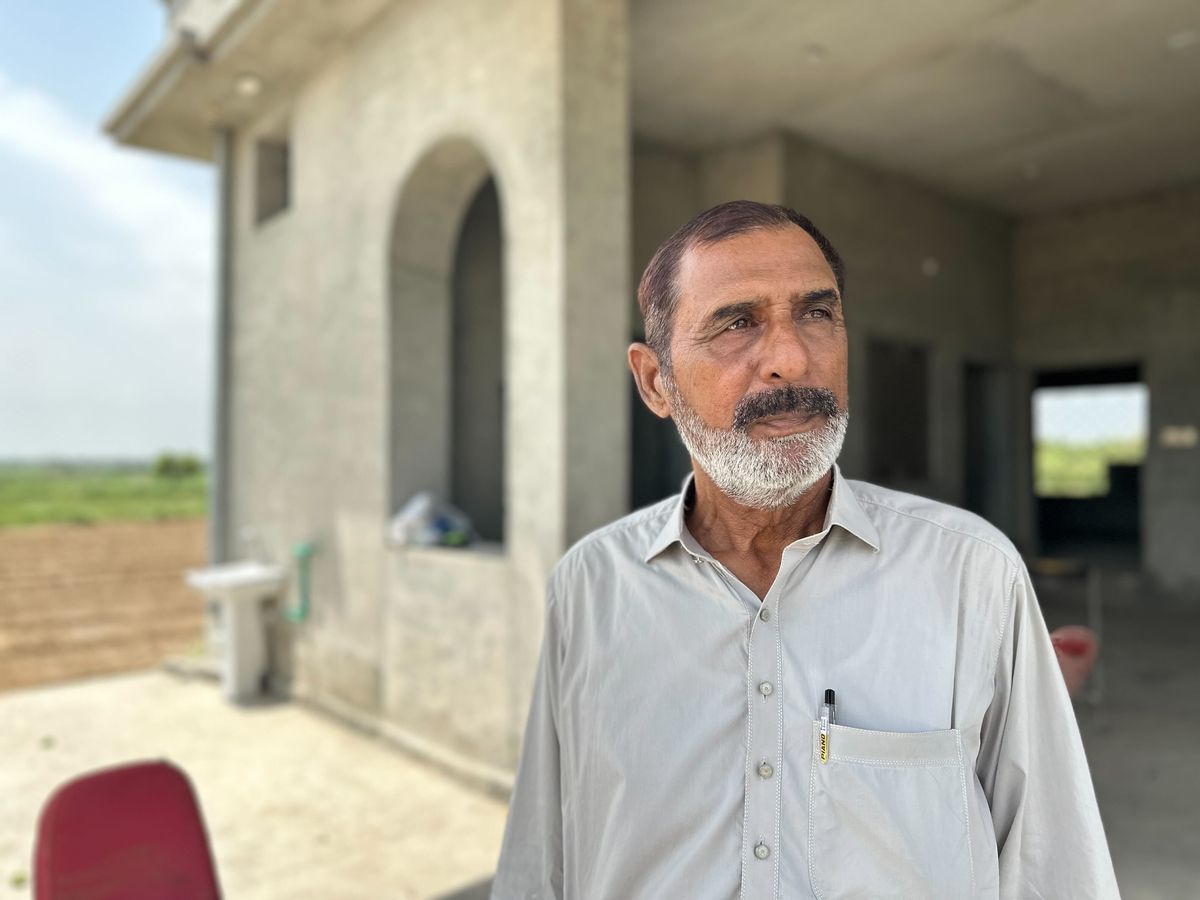
68-year-old farmer Mohammad Latif at his farm in Dhaku, Pakistan, on Aug. 6.
15:40 JST, August 25, 2025
DHAKU, Pakistan – In Pakistan’s agricultural heartland, the solar energy boom is hard to miss.
Mosques have installed solar panels to keep prayer rooms lit; some factories are now powered exclusively by the sun; farmers are using the technology to transform once-barren land into lush fields.
“Even rich people are trying to become farmers now,” said Mohammed Latif, standing in his newly built house in Dhaku, a village in the eastern Punjab region. Installing a solar-powered pump last year allowed Latif to plant thriving rows of bell peppers on his formerly arid property. He made enough money to send one of his sons to study in Britain.
Latif, 68, could recall only one other societal “revolution” in his lifetime as dramatic as this one: the construction of the country’s highway system nearly four decades ago.
Two years ago, solar energy was the fifth-largest source of electricity in Pakistan. Now, it is alone at the top, accounting for around one-fourth of the national power supply. Its rapid adoption was initially welcomed by the government, which has long struggled to provide reliable power to its 240 million people, but officials now fear it is spreading too quickly and giving the rich an unfair advantage.
The boom began in 2023, when the price of solar panels plunged globally and imports from China surged. Wealthy Pakistanis, and farmers like Latif – encouraged by government subsidies – started buying them up in bulk. Now, many have gone off the aging and overburdened national grid entirely.
“I don’t blame them,” Pakistani Power Minister Awais Leghari said in an interview with The Washington Post. “It’s the price of electricity that has led to people getting out of the grid.”
But 45 percent of Pakistanis live below the poverty line, according to the World Bank, putting solar panel systems well beyond their reach. The pool of customers for the national grid has gotten smaller and poorer, and the costs of financing old coal-powered plants have increasingly been passed on to those who can least afford it.
Electricity prices roughly doubled between 2021 and 2024, before government intervention recently stabilized them. Many families say they have had to cut back on food and other essentials to pay their power bills.
“High-income consumers go solar while nonsolar users absorb the costs,” said Hasnat Khan, senior vice chairman of the Pakistan Solar Association. “It’s a death spiral.”
Too much of a good thing?
After decades of chronic shortages, Pakistan now has an excess of power-generating capacity, analysts say, and too many power plants.
The government argues that its expensive fossil fuel plants remain necessary. Whenever solar energy production falls on cloudy days, officials say, grid consumption still surges. If coal plants weren’t constantly running, they fear rolling blackouts would quickly become a feature of life again.
The quandary, according to analysts, is rooted in a lack of foresight.
Amid widespread power outages between the 1990s and early 2010s, which frequently caused economic paralysis, Pakistani authorities rushed to massively expand coal power production. The debt-burdened nation secured billions of dollars in loans, agreeing to pay for a set amount of production capacity – even if the electricity went unused, said Muhammad Basit Ghauri, a Pakistani energy analyst, describing the approach as “inefficient and mismanaged.”
Pakistan’s power sector is saddled with around $5.6 billion of debt, according to official figures. Leghari said the government has stanched losses by cracking down on electricity theft and collecting outstanding payments. But much of the burden has been passed on to consumers, fueling energy inequality – and what critics contend is a glaring double standard.
Even as government officials urge Pakistanis not to disconnect from the national grid, many have installed solar panels atop their own mansions, which tower over tall walls topped with barbed wire and are clearly visible from the streets.
The solar divide is particularly pronounced here in Pakistan’s “martial belt,” in northern Punjab province, which has long been the army’s most fertile ground for recruits. The once humble hometowns of Pakistan’s generals, including Dhaku, have been transformed by an inflow of private funds and government energy subsidies.
Latif said connecting his now-flourishing farm to the national grid would have required him to spend thousands of dollars on his own transformer and hundreds of dollars each month in extra fees. Instead, provincial authorities paid for 60 percent of the four solar panels that power his water pump. “The farmers around here who decided to stick with the national power grid are making losses,” he said.
Muhammad Hassan Miraj, a former military officer, has retired to a luxurious estate overlooking the scenic Chakwal Canyons. He had his house built with the aim of living on solar energy – and off the power grid.
“Solar has created an economy of its own,” he said.” But “it has a darker side,” he conceded.
‘They don’t feel our pain’
Abdul Karim, 34, the owner of a small farm in Dhaku, said the solar revolution has left him behind.
“Every month, I have to pay a higher electricity bill,” he said. “I often have to choose whether to feed my family or to have power.”
In the summer months, temperatures can exceed 110 degrees. Karim says he only switches on his fan when his two young sons start feeling dizzy from the heat. He feels resentful toward the government in Islamabad.
“They sit in their comfortable houses, but over here, poor people like me are being crushed,” he said. “They don’t feel our pain.”
Leghari, the power minister, acknowledged missteps. Officials encouraged solar producers to offset their power bills by selling surplus energy to the national grid. As a result, the government wound up paying for power it didn’t need; wealthy landowners and businessmen were able to access vast amounts of electricity at low cost, or even for free, while much of the population paid higher prices.
“We need to improve,” Leghari said, so that “windfall profits do not exist for anybody on the system, and they don’t start acting as a burden on the rest.”
Solar power advocacy groups have proposed a number of potential solutions, including expanding the use of batteries so solar power-producing households can consume their excess energy rather than sell it, and limits on the size of solar systems. Real change, though, needs to come from the top, analysts say.
Ghauri said authorities should “invest in local solar panel production, modernize the national grid and divert its subsidies from fossil fuels to renewable energy.”
Haji Javed Dhakku, a 60-year-old entrepreneur in Dhaku, has so many solar panels that he can run three air-conditioning units and two water pumps – and still have leftover electricity he can sell to the national grid.
He recently started donating a portion of his revenue to poorer families in the village who can’t pay their power bills. But it shouldn’t fall on him, he said: “It should be the government’s job.”







Most Read
Popular articles in the past 24 hours
-

‘Dry Bonsai’ Gives New Life to Withered Trees, Allows Free Artist...
-

McDonald's Japan Raises Prices; Big Mac to Cost ¥500, Double Chee...
-

Nepal Bus Crash Kills 19 People, Injures 25 Including One Japanes...
-

Japan’s Nikkei Stock Average Rises as AI-Related Stocks Shine; Co...
-

Aggression against Ukraine: Malignant Precedent Must Not Be Set t...
-

Joruri Bunraku Narrative Performed in Honor of Donald Keene by La...
-

Astellas Collaborates with Vir to Develop Its Experimental Prosta...
-

Early-Blooming Kawazu Cherry Blossoms Create Sea of Pink at Park ...
Popular articles in the past week
-

Producer Behind Pop Group XG Arrested for Cocaine Possession
-

Japan PM Takaichi’s Cabinet Resigns en Masse
-

Sanae Takaichi Elected Prime Minister of Japan; Keeps All Cabinet...
-

Japan's Govt to Submit Road Map for Growth Strategy in March, PM ...
-

Bus Carrying 40 Passengers Catches Fire on Chuo Expressway; All E...
-

Japan, U.S. Name 3 Inaugural Investment Projects; Reached Agreeme...
-

Riku-Ryu Pair Wins Gold Medal: Their Strong Bond Leads to Major C...
-

Tokyo Skytree's Elevator Stops, Trapping 20 People; All Rescued (...
Popular articles in the past month
-
Producer Behind Pop Group XG Arrested for Cocaine Possession
-
Japan PM Takaichi’s Cabinet Resigns en Masse
-

Japan Institute to Use Domestic Commercial Optical Lattice Clock ...
-

Man Infected with Measles Reportedly Dined at Restaurant in Tokyo...
-

Israeli Ambassador to Japan Speaks about Japan’s Role in the Reco...
-

Videos Plagiarized, Reposted with False Subtitles Claiming ‘Ryuky...
-

Man Infected with Measles May Have Come in Contact with Many Peop...
-

Prudential Life Insurance Plans to Fully Compensate for Damages C...
Top Articles in News Services
-
Survey Shows False Election Info Perceived as True
-
Hong Kong Ex-Publisher Jimmy Lai’s Sentence Raises International Outcry as China Defends It
-
Japan’s Nikkei Stock Average Touches 58,000 as Yen, Jgbs Rally on Election Fallout (UPDATE 1)
-
Japan’s Nikkei Stock Average Falls as US-Iran Tensions Unsettle Investors (UPDATE 1)
-

Trump Names Former Federal Reserve Governor Warsh as the Next Fed Chair, Replacing Powell
JN ACCESS RANKING
-
Producer Behind Pop Group XG Arrested for Cocaine Possession
-
Japan PM Takaichi’s Cabinet Resigns en Masse
-
Japan Institute to Use Domestic Commercial Optical Lattice Clock to Set Japan Standard Time
-
Man Infected with Measles Reportedly Dined at Restaurant in Tokyo Station
-
Israeli Ambassador to Japan Speaks about Japan’s Role in the Reconstruction of Gaza