
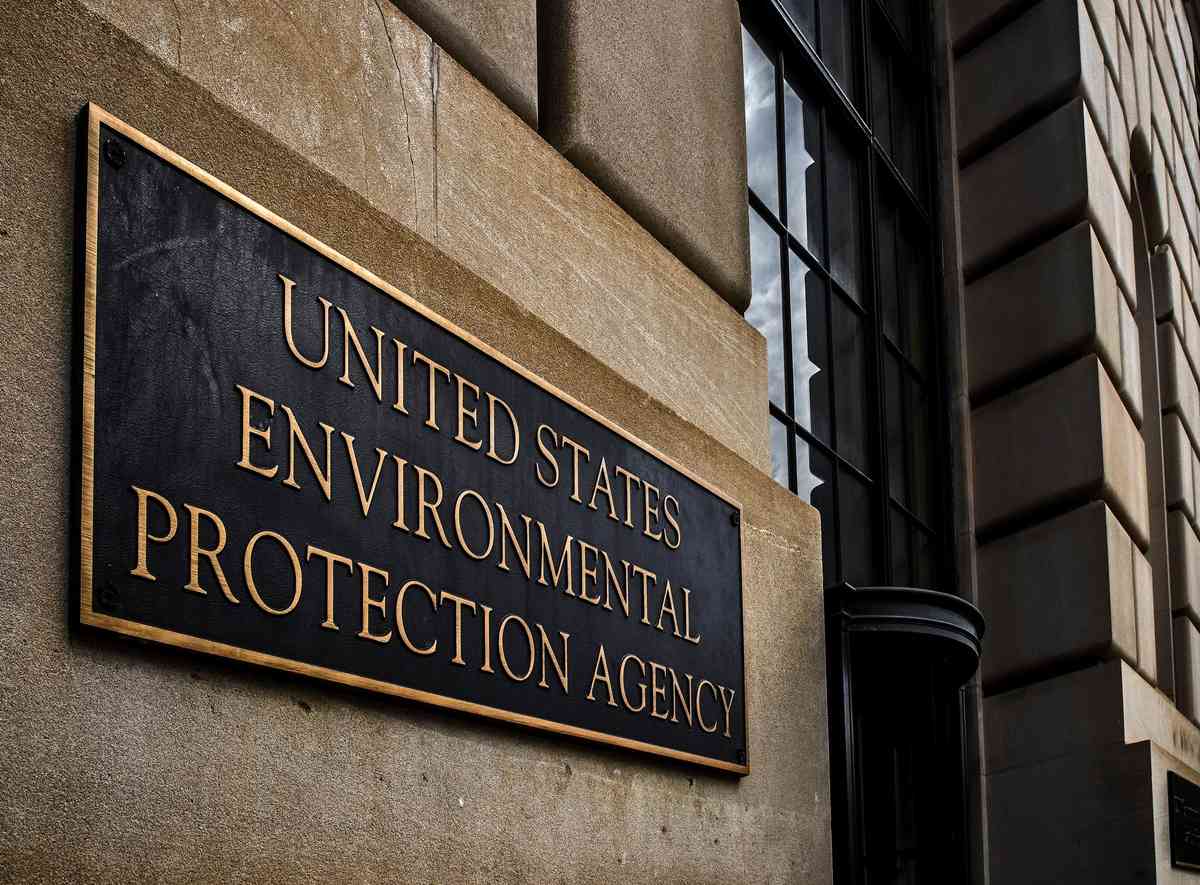
The Environmental Protection Agency in Washington, D.C.
16:03 JST, August 23, 2025
Ahead of President Donald Trump’s second term in the White House, scientists and advocates sought to tighten rules that protect climate researchers and their work from political interference. They added policies to prevent a repeat of the scandal known as “Sharpiegate” and even enshrined others in a union contract.
The Trump administration has now rolled those changes back.
Officials recently reverted scientific integrity policies at the Environmental Protection Agency and National Oceanic and Atmospheric Administration to versions as they existed at the end of the first Trump administration in January 2021.
That means government scientists still have protections to present their findings to the public or share whistleblower complaints about misconduct, for example. But it erases broader provisions scientists had pushed for, including assurance that independent arbiters – and not political appointees – would oversee enforcement of the scientific integrity policies.
Since taking control of the executive branch, the administration has thinned the government’s scientific workforce by thousands and is now taking steps to dramatically reshape the research it pursues. Trump’s budget proposals, which agencies are already preparing to follow, would eliminate many climate research centers and labs and cancel studies and data collection that could be used to inform climate-related policy.
A NOAA spokeswoman did not respond to a request for comment. In an email, EPA officials said the change was in line with a May executive order titled, “Restoring Gold Standard Science.”
“EPA is committed to upholding the principles of scientific integrity and Gold Standard Science to ensure that the EPA’s decisions and policies are informed by the most credible, reliable, and impartial scientific evidence available,” EPA spokesperson Carolyn Holran said in a statement.
Researchers quickly warned the “gold standard” tenets, which include an emphasis on transparency and reproducibility of research, could actually undermine scientific rigor and give political leaders more power over which studies get funded. Jennifer Jones, director of the Union of Concerned Scientists’ Center for Science & Democracy, said the rollbacks of the scientific integrity policies could have similar consequences.
“By reverting to these older policies, we’re going to see scientists lose protections from retaliation. We’re going to see the loss of professional or appointed scientific integrity officers,” Jones said. “They will now basically be replaced with political appointees.”
The policy changes would diminish another key tenet of scientific integrity, Jones added: Independence, which ensures scientists have authority to pursue research as they see fit, while leaving policy decisions based in that evidence up to political leaders.
“We count on federal science being there to support the public good,” she said.
During the Biden administration, EPA staff had sought to ensure that any complaints about violations of scientific integrity would be assessed by an independent investigator, rather than a political appointee, and last year enshrined that in an American Federation of Government Employees union contract.
But earlier this month, the Trump administration unilaterally canceled that contract and other collective bargaining agreements with workers at the Federal Emergency Management Agency and U.S. Citizenship and Immigration Services.
The EPA union is fighting the cancellation in court and maintains that the contract remains in full force. But the situation makes for “a very, very challenging environment” for EPA scientists, said Justin Chen, president of the AFGE Council 238, which represents about 8,000 staffers.
Amid the conflict, the EPA this week removed from its website a scientific integrity policy updated shortly before Trump returned to the White House, replacing it with a version that dates to 2012, the Substack SciLight reported. Archived versions of the website show the 2025 version had appeared as recently as July 30.
And archives of the website hosting NOAA’s scientific integrity policy show a version revised last year was replaced in June with a version from 2021.
Last year’s changes to the policy had included establishing that “interference with or undue influence on accurate public reporting of science” could result in disciplinary action and referral to the inspector general’s office. Scientists had pushed for such policies to be codified in federal law, as well, but that didn’t happen.
NOAA scientists pushed for the revisions after the incident that became known as Sharpiegate, when Trump in 2019 displayed a hurricane forecast map in the Oval Office that appeared to have been altered with a Sharpie marker to suggest Hurricane Dorian threatened Alabama, as Trump had warned on social media.
An investigation into that incident found that NOAA’s then-acting administrator, Neil Jacobs, violated the agency’s scientific integrity policy and bowed to political pressure when he oversaw the release of a statement backing Trump’s warnings about Alabama and contradicting National Weather Service meteorologists.
Jacobs is awaiting Senate confirmation to once again lead the agency.
In a confirmation hearing last month, Sen. Ben Ray Luján (D-New Mexico) asked Jacobs if he would make the same decision again.
Jacobs said he would not, and began to explain measures taken to prevent such a scenario from repeating. Before he could, Luján asked, “Would you sign off on an inaccurate statement due to political pressure in the same event, yes or no?”
“No,” Jacobs said.





Most Read
Popular articles in the past 24 hours
-

‘Dry Bonsai’ Gives New Life to Withered Trees, Allows Free Artist...
-

McDonald's Japan Raises Prices; Big Mac to Cost ¥500, Double Chee...
-

Nepal Bus Crash Kills 19 People, Injures 25 Including One Japanes...
-

Japan’s Nikkei Stock Average Rises as AI-Related Stocks Shine; Co...
-

Aggression against Ukraine: Malignant Precedent Must Not Be Set t...
-

Joruri Bunraku Narrative Performed in Honor of Donald Keene by La...
-

Astellas Collaborates with Vir to Develop Its Experimental Prosta...
-

Early-Blooming Kawazu Cherry Blossoms Create Sea of Pink at Park ...
Popular articles in the past week
-

Producer Behind Pop Group XG Arrested for Cocaine Possession
-

Japan PM Takaichi’s Cabinet Resigns en Masse
-

Sanae Takaichi Elected Prime Minister of Japan; Keeps All Cabinet...
-

Japan's Govt to Submit Road Map for Growth Strategy in March, PM ...
-

Bus Carrying 40 Passengers Catches Fire on Chuo Expressway; All E...
-

Japan, U.S. Name 3 Inaugural Investment Projects; Reached Agreeme...
-

Riku-Ryu Pair Wins Gold Medal: Their Strong Bond Leads to Major C...
-

Tokyo Skytree's Elevator Stops, Trapping 20 People; All Rescued (...
Popular articles in the past month
-
Producer Behind Pop Group XG Arrested for Cocaine Possession
-
Japan PM Takaichi’s Cabinet Resigns en Masse
-

Japan Institute to Use Domestic Commercial Optical Lattice Clock ...
-

Man Infected with Measles Reportedly Dined at Restaurant in Tokyo...
-

Israeli Ambassador to Japan Speaks about Japan’s Role in the Reco...
-

Videos Plagiarized, Reposted with False Subtitles Claiming ‘Ryuky...
-

Man Infected with Measles May Have Come in Contact with Many Peop...
-

Prudential Life Insurance Plans to Fully Compensate for Damages C...
Top Articles in News Services
-
Survey Shows False Election Info Perceived as True
-
Hong Kong Ex-Publisher Jimmy Lai’s Sentence Raises International Outcry as China Defends It
-
Japan’s Nikkei Stock Average Touches 58,000 as Yen, Jgbs Rally on Election Fallout (UPDATE 1)
-
Japan’s Nikkei Stock Average Falls as US-Iran Tensions Unsettle Investors (UPDATE 1)
-
Trump Names Former Federal Reserve Governor Warsh as the Next Fed Chair, Replacing Powell
JN ACCESS RANKING
-
Producer Behind Pop Group XG Arrested for Cocaine Possession
-
Japan PM Takaichi’s Cabinet Resigns en Masse
-
Japan Institute to Use Domestic Commercial Optical Lattice Clock to Set Japan Standard Time
-
Man Infected with Measles Reportedly Dined at Restaurant in Tokyo Station
-
Israeli Ambassador to Japan Speaks about Japan’s Role in the Reconstruction of Gaza