
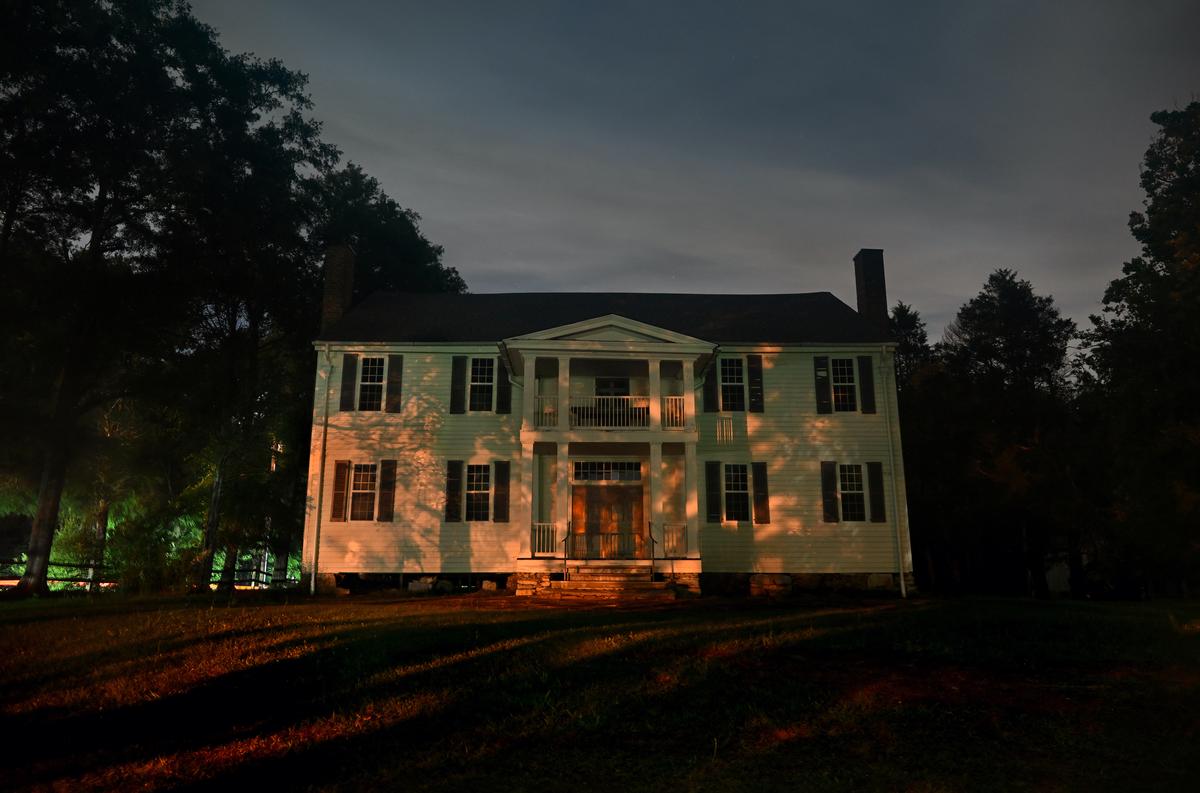
The Wallace plantation house in Harpersville, Alabama.
15:45 JST, August 18, 2025
HARPERSVILLE, Ala. – Word travels fast in this small town, so when Theoangelo Perkins heard that the family of Bill Parker was visiting his grave, he jumped in his car and raced to the old cemetery.
The burial ground is divided into two parts. Parker was laid to rest near the entrance with other members of the White family whose ancestors, named Wallace, once owned this land and were the second-largest enslavers in Shelby County. Nearby lies a much larger area, where the Black people who worked the land, as enslaved people or sharecroppers, and their descendants have been buried for more than a century.
For decades, the Black families maintained their portion of the private cemetery and the White descendants of the Wallace family took care of theirs. But in the early 2000s, Parker put up a fence that blocked access to the Black portion of the cemetery, local residents say, though none know exactly why.
With Parker’s family back in town on that day in 2018, Perkins hoped to persuade them to open the fence gate.
“My grandparents are buried at that cemetery. My great-grandparents are there. My great-great-grandparents are buried there. I have a great-great-great-grandmother who’s buried there,” said Perkins, who is Harpersville’s mayor and the pastor of a local church. “And when I was small, my dad, my granddad and I would keep the cemetery up – at least the Black section of it.”
At the cemetery, Perkins confronted Nell Gottlieb, Parker’s cousin, who inherited the Wallace plantation house and had clear memories of spending parts of her childhood there. Her views of the South had shifted dramatically since she moved away from Alabama more than 60 years ago. As Perkins told her and her relatives about the pain caused by not being able to visit the Black graves in the cemetery, she felt deeply ashamed.
The family quickly agreed to stop blocking access.
Gottlieb asked what else they could do to try to make up for the pain that had been caused.
Perkins said they would need to explore that with all the Black descendants, not just him. But he agreed to help, launching a journey that has included Gottlieb giving up her ownership of the plantation to establish a reconciliation-focused nonprofit that bears the Wallace family name.
At one time the 5,000-acre cotton plantation on the Coosa River was tended by nearly 100 enslaved people. It was built for Gottlieb’s great-great-grandfather Samuel Wallace, who moved to Alabama, then known as the “Old Southwest,” from Virginia in the 1840s.
The fertile land was perfect for growing cotton, tobacco and other cash crops. At its peak, the plantation produced nearly 50,000 pounds of cotton a year, making it one of the biggest growers in the area.
More than 100 years later, the land sits just feet from a busy intersection, behind an auto body shop. Cotton still grows in fields that stretch as far as the eye can see, but in the distance, there are steam towers from a massive power plant on the river. Tenant farmers still work the land.
When Gottlieb, 80, spent summers in the house as a child in the 1950s there was no indoor plumbing, so they had to get water from either the well or the tank that caught rainwater on the back porch.
“What I remember is the bounty of the place,” Gottlieb said. “We used to go across Highway 25 and get corn out of the cornfield and have it for dinner.”
Gottlieb got her education on Southern heritage there too, listening to her grandmother’s stories about the family’s role in the “gallant South” and the Lost Cause, a telling of American history that romanticizes the Confederacy and downplays the role of slavery in the Civil War.
“She trained me at her knee,” Gottlieb said. “I was the one that got into the Lost Cause. … I knew chapter and verse of everybody who fought in the Civil War.”
When her grandmother, a member of the United Daughters of the Confederacy, took her to the then-segregated Alabama Theatre in downtown Birmingham to see “Gone With the Wind,” Gottlieb loved the movie so much that they stayed and watched it a second time. She was too young to understand all the dynamics, she said, but thought of the Wallace house as she rooted for Scarlett O’Hara, the film’s protagonist, who fights to save her family’s cotton plantation.
The Perkins family had come to the plantation as sharecroppers after the Civil War and worked there until the 1990s. Gottlieb recalled that Perkins’s great-great-uncle, who oversaw the plantation’s cotton fields, broke the news to her as a child when her dog died. Perkins’s great-aunt had taught her to make roast beef and potato salad.
After graduating from college in Atlanta, Gottlieb moved to New York. There, she met her husband, a Jewish man, and later converted to Judaism. The family eventually settled in Austin, where she spent decades working as a professor at the University of Texas.
By then she had become one of the most liberal members of her family, she said, and tried to limit contact with relatives she believed harbored racist and antisemitic views.
When Parker, her cousin, first called about taking over the house, she declined.
“I said, ‘Oh no, Bill, you know I’m in Texas, I’m Jewish now, I haven’t lived there, my family has no relationship to it,’” Gottlieb said.
But he kept calling, and after Gottlieb thought about what her grandmother would have wanted, she relented.
For Gottlieb and many other descendants, the house was still a symbol of their family’s heritage, albeit a decaying one. She hadn’t visited often as an adult but wanted to preserve its memories.
“I did not see it as a symbol of racial terror,” Gottlieb said. “I was nostalgic.”
Until the 1960s, most of Harpersville’s Black residents still lived on the land surrounding the plantation, local residents say. It wasn’t until Congress passed the 1968 Fair Housing Act, which prohibited racial discrimination in the sale, rental or financing of housing, that many were able to spread out to other parts of town.
But it remains a community divided: Nearly a quarter of Black residents live in poverty compared with 6 percent of White residents, according to the most recent census data.
When Perkins was first elected mayor of Harpersville in 2004, he became the first Black person to lead any town in Shelby County, where 72 percent of the population is White. At the local schools, he had served as a counselor, bus driver and choir director. He also founded a church.
Once Gottlieb agreed to open up cemetery access, Perkins decided it was time for Harpersville to come to terms with the plantation that helped shape its history – and heal.
“This place has a history” and a “racist past,” Perkins said. “But how can we give it a new narrative and use it to bring people together?”
The first step was a ceremony rededicating the cemetery, which included several members of Gottlieb’s family as well as Black descendants of the plantation.
At the service, in October 2018, Gottlieb apologized on behalf of her family for slavery and closing off the cemetery to Black residents. They prayed, sang “Amazing Grace” and laid a wreath for all the Black people who were interred in unmarked graves.
“I knew what had happened was horrible,” Gottlieb said. “But I did not personally feel it until we got to the cemetery.”
Tom Hoynes, a cousin of Gottlieb’s who lives in Berkeley, California, was nervous about attending. He had been to Alabama only a handful of times. But Hoynes and his siblings still owned some of the land that made up the old plantation and received rent from the tenant farmers growing cotton on those fields.
“I’m an outsider, I’m a White man, I am a descendant of enslavers, and I’m coming into this community that is very foreign to me and that I have not had a lot of exposure to,” Hoynes said. “But I felt surprisingly welcome there, and that was remarkable.”
Also in attendance was Henry Smith, who had grown up in Harpersville and knew that his great-grandfather Anderson Wallace was born into slavery there. But he said he had no idea before the cemetery reconciliation effort that the once-grand home off Highway 25, which he passed every day on the bus ride to his segregated school, had been the plantation house of the family who enslaved his ancestors.
“I’ve seen this house all of my life, but I didn’t know what it was,” said Smith, 83.
At the cemetery rededication, a young Wallace descendant handed Smith a ceremonial key to the cemetery to mark a new age of cooperation between the White and Black families. Smith had been among the Black descendants who were barred from visiting their deceased loved ones for nearly two decades after Parker locked them out. With the fence gate now open, he visited the grave site of his son, Norman Smith, who died in 1990 at the age of 23, for the first time in years. His tombstone is the shape of a basketball.
After the ceremony, the families gathered in the plantation house and began to discuss what should come next.
Gottlieb said it was only then that she started to understand the house’s connection to the racial terror experienced by those enslaved there. It was time for the house to have a new story, she said.
Gottlieb agreed to donate the plantation to the Wallace Center for Arts and Reconciliation, a nonprofit that she would jointly run with Perkins and other descendants.
Since then, the center has raised money for college scholarships for Black descendants and hosted art exhibits seeking to reframe the history of the land around the enslaved people who worked there and their descendants. Today, it has $1.5 million in assets, much of it from the 200 acres of former plantation land that Hoynes and his siblings have donated to the organization.
They did so, Hoynes said, in part to acknowledge that the work of those enslaved at the plantation created opportunities that were passed down through the generations to the White families.
“I’ve never been much of an activist,” Hoynes said. “But I just feel like I’m in a point in life where I have the time and the energy and the motivation to participate in something that I hope will make some small corner of the world better. And this is the place that, for better or worse, I have a personal connection to.”
Other modern-day plantation owners also have reached out to the descendants of those whom their ancestors enslaved, especially during and after the 2020 racial justice protests, said Derek Alderman, a University of Tennessee professor who researches contemporary uses of Southern plantations.
But he said the Wallace descendants’ decision to give up their ownership of the house and the land was extraordinary.
Gottlieb acknowledges that it hasn’t always gone smoothly and that she is still building trust with the local Black community.
“There’s a segment of it where we are really only beginning to have trust with each other – you know, ‘What do these people want from us?’” she said.
In January, the center hired its first full-time executive director, Ebony Howard, a Black civil rights attorney from Birmingham. “I wasn’t the one to be the face of it,” Gottlieb said.
At first, the board was populated by an equal number of White and Black descendants of the families connected to the plantation. But Howard said that as some White descendants lost interest, the center, to keep the board’s racial balance, recruited White residents of Shelby County who were not related to the Wallace family.
“We get a lot of financial support from White descendants,” but the Black descendants are more engaged in the center’s operations, Howard said. “So that’s what we’re really working on, broadening the descendant engagement.”
When the center approached Peter Datcher, whose great-grandmother Lucy Baker was enslaved on the plantation, about joining the effort, he was skeptical. He didn’t fully trust that pieces of his own family’s history, and that of other Black families, would be treated with respect.
Datcher said he was only convinced once Gottlieb told him that she “realized that our wealth was on the back of your ancestors.”
Hoynes and Gottlieb say they want to provide some kind of compensation to the descendants of enslaved and sharecropper families but are still trying to figure out how much and how. They are also still grappling with how best to use the property that gave them and their ancestors the ability to leave Alabama and find success elsewhere.
The difference, Gottlieb said, is in the past, White descendants like Parker, her cousin, got to call all the shots. Now, with the creation of the Wallace Center, the Black descendants have just as much say in what happens with the plantation.
“It no longer belongs to the Wallace family,” she said. “It belongs to the community. They can sell it tomorrow, and I would have to be okay with that.”







Most Read
Popular articles in the past 24 hours
-

‘Dry Bonsai’ Gives New Life to Withered Trees, Allows Free Artist...
-

McDonald's Japan Raises Prices; Big Mac to Cost ¥500, Double Chee...
-

Nepal Bus Crash Kills 19 People, Injures 25 Including One Japanes...
-

Japan’s Nikkei Stock Average Rises as AI-Related Stocks Shine; Co...
-

Aggression against Ukraine: Malignant Precedent Must Not Be Set t...
-

Joruri Bunraku Narrative Performed in Honor of Donald Keene by La...
-

Astellas Collaborates with Vir to Develop Its Experimental Prosta...
-

Early-Blooming Kawazu Cherry Blossoms Create Sea of Pink at Park ...
Popular articles in the past week
-

Producer Behind Pop Group XG Arrested for Cocaine Possession
-

Japan PM Takaichi’s Cabinet Resigns en Masse
-

Sanae Takaichi Elected Prime Minister of Japan; Keeps All Cabinet...
-

Japan's Govt to Submit Road Map for Growth Strategy in March, PM ...
-

Bus Carrying 40 Passengers Catches Fire on Chuo Expressway; All E...
-

Japan, U.S. Name 3 Inaugural Investment Projects; Reached Agreeme...
-

Riku-Ryu Pair Wins Gold Medal: Their Strong Bond Leads to Major C...
-

Tokyo Skytree's Elevator Stops, Trapping 20 People; All Rescued (...
Popular articles in the past month
-
Producer Behind Pop Group XG Arrested for Cocaine Possession
-
Japan PM Takaichi’s Cabinet Resigns en Masse
-

Japan Institute to Use Domestic Commercial Optical Lattice Clock ...
-

Man Infected with Measles Reportedly Dined at Restaurant in Tokyo...
-

Israeli Ambassador to Japan Speaks about Japan’s Role in the Reco...
-

Videos Plagiarized, Reposted with False Subtitles Claiming ‘Ryuky...
-

Man Infected with Measles May Have Come in Contact with Many Peop...
-

Prudential Life Insurance Plans to Fully Compensate for Damages C...
Top Articles in News Services
-

Survey Shows False Election Info Perceived as True
-

Hong Kong Ex-Publisher Jimmy Lai’s Sentence Raises International Outcry as China Defends It
-
Japan’s Nikkei Stock Average Touches 58,000 as Yen, Jgbs Rally on Election Fallout (UPDATE 1)
-
Japan’s Nikkei Stock Average Falls as US-Iran Tensions Unsettle Investors (UPDATE 1)
-

Trump Names Former Federal Reserve Governor Warsh as the Next Fed Chair, Replacing Powell
JN ACCESS RANKING
-
Producer Behind Pop Group XG Arrested for Cocaine Possession
-
Japan PM Takaichi’s Cabinet Resigns en Masse
-
Japan Institute to Use Domestic Commercial Optical Lattice Clock to Set Japan Standard Time
-
Man Infected with Measles Reportedly Dined at Restaurant in Tokyo Station
-
Israeli Ambassador to Japan Speaks about Japan’s Role in the Reconstruction of Gaza