
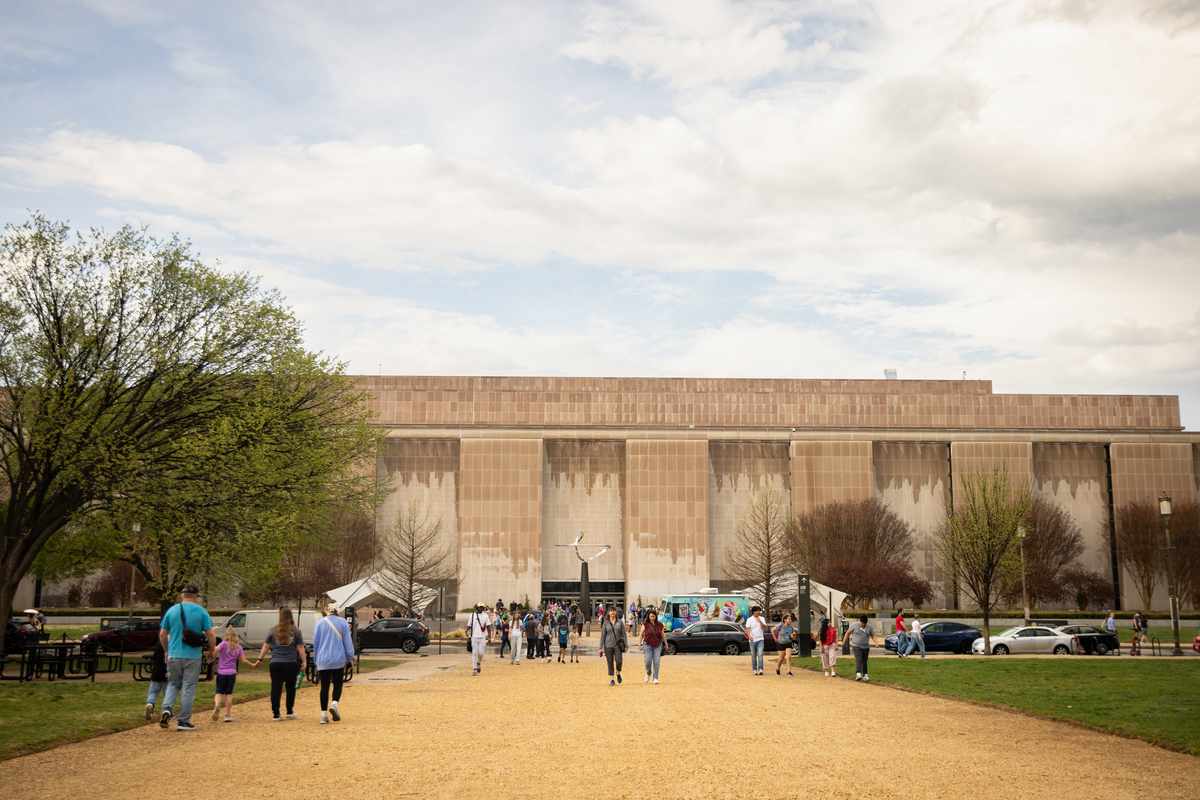
The Smithsonian National Museum of American History in Washington, D.C.
14:56 JST, August 9, 2025
The Smithsonian’s National Museum of American History on Friday unveiled an updated impeachment display that now includes context about President Donald Trump’s historic cases – a change the institution made a week after The Washington Post reported that a temporary placard containing his name had been removed from the exhibit as part of a Smithsonian content review prompted by White House pressure to oust a museum director. The new text makes minor changes to – and offers slightly fewer details than – the temporary signage.
“The National Museum of American History has completed its update to the Impeachment case within ‘The American Presidency: A Glorious Burden’ exhibition,” the Smithsonian said in a statement on Friday. “The updated display now reflects all presidential impeachments. Adhering to principles foundational to our role as the nation’s museum, we take great care to ensure that what we present to the public reflects both intellectual integrity and thoughtful design.”
The statement said that the interim sign, which had been in place from September 2021 until this July, was removed because it was not consistent with other sections of the exhibit and blocked the display case. “We removed it to make way for a more permanent update to the content inside the case,” the Smithsonian said.
The removal drew swift outcry from some members of the public as well as several Democratic leaders. The Smithsonian Institution has faced growing concerns about political interference at the education and research complex amid the Trump administration’s efforts to exert more control over its work.
Senate Minority Leader Charles E. Schumer called the removal “pathetic” during Senate floor remarks last week. “You can’t make this up,” he said. “This is a man rewriting history – or thinking he can rewrite history. He can’t, but he thinks he can.”
The Smithsonian said last week that no government official asked them to remove content from the exhibit. It also said that no other changes had been made at the museum.
In a statement, Lindsey Halligan, a White House official charged with scrutinizing “improper ideology” at the Smithsonian, reiterated that the White House wasn’t involved with the revision. “That said, it’s encouraging to see the institution taking steps that align with President Trump’s Executive Order to restore truth to American History. As part of that truth, it’s important to note that President Trump was acquitted twice by Senate, fully and on every count – a fact that belongs in the historical record.”
Some edits to the display’s text are evident, including the addition of the word “alleged” in the placard’s description of the conduct that led to Trump’s first impeachment. The display’s main panel was also updated to reflect include Trump’s name alongside Andrew Johnson, Richard M. Nixon and Bill Clinton.
Of Trump’s first impeachment, the impeachment display now reads:
“On December 18, 2019, the House impeached Donald Trump for abuse of power and obstruction of Congress. The charges focused on the president’s alleged solicitation of foreign interference in the 2020 presidential election and defiance of Congressional subpoenas. Trump was acquitted in January 2020.”
The temporary placard had read:
“On December 18, 2019, the House impeached Donald Trump for abuse of power and obstruction of Congress. The charges focused on the president’s solicitation of foreign interference in the 2020 presidential election and his defiance of Congressional subpoenas. President Trump was acquitted in January 2020.”
Trump is the only president to have been impeached twice. In 2019, he was charged by the House with abuse of power and obstruction of Congress for his attempts to withhold military aid meant for Ukraine and pressure its government to investigate his political rival Biden. He was acquitted by the Senate in 2020. Then, just over a year later, Trump was impeached again, on a charge of incitement of insurrection following the Jan. 6, 2021, Capitol attack. He was acquitted a second time, after leaving office.
Of his second impeachment, the display reads:
“On January 13, 2021, Donald Trump became the first president to be impeached twice. The charge was incitement of insurrection based on his challenge of the 2020 election results and on his speech on January 6. Because Trump’s term ended on January 20, he became the first former president tried by the Senate. He was acquitted on February 13, 2021.”
The temporary placard had read:
“On January 13, 2021, Donald Trump became the first president to be impeached twice. The charge was incitement of insurrection, based on repeated ‘false statements’ challenging the 2020 election results and his January 6 speech that ‘encouraged – and foreseeably resulted in – imminent lawless action at the Capitol.’ Because Trump’s term ended on January 20, his acquittal on February 13 made him the first former president tried by the Senate.”
Since returning to the White House in January for his second term, Trump has attempted to exert influence over prominent cultural institutions, including by taking over the John F. Kennedy Center for the Performing Arts, making drastic changes at the National Endowment for the Arts and the National Endowment for the Humanities and imposing budget cuts on the National Park Service.
In March, Trump signed an executive order to eliminate “divisive narratives” across the Smithsonian museums and “restore the Smithsonian Institution to its rightful place as a symbol of inspiration and American greatness.”
Months later, he attempted to fire Kim Sajet, the director of the Smithsonian’s National Portrait Gallery, for being a “highly partisan” person – though he had no authority to do so. The White House provided a list of 17 instances it said supported the president’s claims about her, including the caption for the museum’s presidential portrait of Trump mentioning his two impeachments and “incitement of insurrection.”
Early Friday afternoon in the “American Presidency” exhibition, visitors milled about the display case. Some had been aware of the Trump text’s removal.
“I heard it was taken out, and I came here to see it,” said Jodi Lindstrom, 49, visiting from Minneapolis. “I don’t think it’s a good idea for the president to have a say over what is history. … You can’t erase it. It’s what happened. So I’m very happy to see it back in.”
Following The Post’s reporting about the change, the Smithsonian said it would restore Trump to the impeachment display “in the coming weeks.”
“It does say four now,” said Ed Burk, 75, of Washington, D.C., leaning in to examine the display. But he wasn’t satisfied by the alterations. “Clinton gets a little more attention. Why not something as big for Donald Trump?”
Mindy Kiser, 52, visiting from Wichita, had not previously heard about the exhibition’s alterations.
“It’s disappointing to know that the museum may have caved to outside influences but also reassuring to know that they did the right thing and restored whatever they took away,” Kiser said.
Her eyes lingered on the other items in the display case, and then the Trump text, displayed low with two small artifacts: admission to the Senate gallery for impeachment proceedings.
“The fact that he’s been impeached twice, it does seem to be a little bit smaller, in my opinion,” she said. But “in these days, we should just be happy that it’s represented at all.”






Most Read
Popular articles in the past 24 hours
-

‘Dry Bonsai’ Gives New Life to Withered Trees, Allows Free Artist...
-

McDonald's Japan Raises Prices; Big Mac to Cost ¥500, Double Chee...
-

Nepal Bus Crash Kills 19 People, Injures 25 Including One Japanes...
-

Japan’s Nikkei Stock Average Rises as AI-Related Stocks Shine; Co...
-

Aggression against Ukraine: Malignant Precedent Must Not Be Set t...
-

Joruri Bunraku Narrative Performed in Honor of Donald Keene by La...
-

Astellas Collaborates with Vir to Develop Its Experimental Prosta...
-

Early-Blooming Kawazu Cherry Blossoms Create Sea of Pink at Park ...
Popular articles in the past week
-

Producer Behind Pop Group XG Arrested for Cocaine Possession
-

Japan PM Takaichi’s Cabinet Resigns en Masse
-

Sanae Takaichi Elected Prime Minister of Japan; Keeps All Cabinet...
-

Japan's Govt to Submit Road Map for Growth Strategy in March, PM ...
-

Bus Carrying 40 Passengers Catches Fire on Chuo Expressway; All E...
-

Japan, U.S. Name 3 Inaugural Investment Projects; Reached Agreeme...
-

Riku-Ryu Pair Wins Gold Medal: Their Strong Bond Leads to Major C...
-

Tokyo Skytree's Elevator Stops, Trapping 20 People; All Rescued (...
Popular articles in the past month
-
Producer Behind Pop Group XG Arrested for Cocaine Possession
-
Japan PM Takaichi’s Cabinet Resigns en Masse
-

Japan Institute to Use Domestic Commercial Optical Lattice Clock ...
-

Man Infected with Measles Reportedly Dined at Restaurant in Tokyo...
-

Israeli Ambassador to Japan Speaks about Japan’s Role in the Reco...
-

Videos Plagiarized, Reposted with False Subtitles Claiming ‘Ryuky...
-

Man Infected with Measles May Have Come in Contact with Many Peop...
-

Prudential Life Insurance Plans to Fully Compensate for Damages C...
Top Articles in News Services
-
Survey Shows False Election Info Perceived as True
-

Hong Kong Ex-Publisher Jimmy Lai’s Sentence Raises International Outcry as China Defends It
-
Japan’s Nikkei Stock Average Touches 58,000 as Yen, Jgbs Rally on Election Fallout (UPDATE 1)
-
Japan’s Nikkei Stock Average Falls as US-Iran Tensions Unsettle Investors (UPDATE 1)
-
Trump Names Former Federal Reserve Governor Warsh as the Next Fed Chair, Replacing Powell
JN ACCESS RANKING
-
Producer Behind Pop Group XG Arrested for Cocaine Possession
-
Japan PM Takaichi’s Cabinet Resigns en Masse
-
Japan Institute to Use Domestic Commercial Optical Lattice Clock to Set Japan Standard Time
-
Man Infected with Measles Reportedly Dined at Restaurant in Tokyo Station
-
Israeli Ambassador to Japan Speaks about Japan’s Role in the Reconstruction of Gaza