
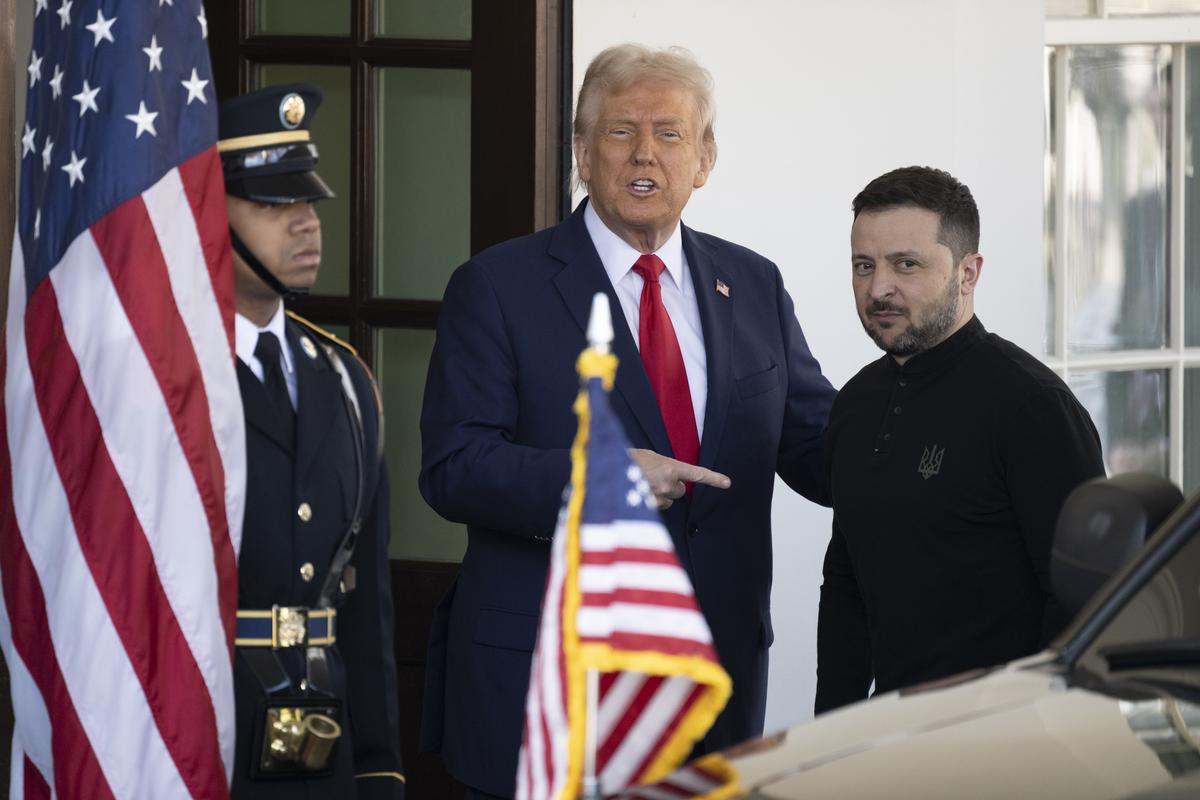
President Donald Trump greets Ukrainian President Volodymyr Zelensky outside the White House in February.
17:10 JST, August 6, 2025
The Trump administration’s neglect toward Biden-era sanctions targeting Russia’s economy has allowed the Kremlin to revive its military and prolong the war in Ukraine, Senate Democrats argue in a report published Tuesday in anticipation of the president’s deadline for Moscow to end the conflict or face severe financial penalties.
The report accuses the administration of having failed to advance the extensive sanctions regime built over the first three years of Russia’s full-scale invasion. That lapse, the authors argue, undercuts any future U.S. threats to tighten the screws on Russia’s war machine.
Senate Democrats have undertaken a broad campaign to pressure President Donald Trump into following through on his ultimatum to Russian President Vladimir Putin. Their report also represents an attempt to reframe Trump’s Friday deadline as a referendum on his Russia policy. The president has cast himself as a peacemaker doing all he can to end the fighting in Ukraine. The report’s authors say that, in those negotiations, Trump has ceded crucial leverage to bring the conflict to a close.
“If Trump is serious about ending the war in Ukraine, he should start using the tools he already has,” Sen. Elizabeth Warren, the top Democrat on the Senate Banking, Housing and Urban Affairs Committee, whose staff co-wrote the report, said in a statement.
White House spokeswoman Anna Kelly disputed the Democrats’ argument, pointing to Trump’s efforts this year to negotiate a ceasefire in Ukraine.
Unlike Trump’s predecessor, President Joe Biden, “this President is taking real action to stop the killing – prompting the two countries to hold talks for the first time in years,” Kelly said in a statement. “He is selling American-made weapons to NATO members and threatening Putin with biting sanctions if he does not agree to a ceasefire because he wants to bring peace to this conflict that has gone on for far too long.”
The Russian Embassy in Washington did not respond to a request for comment.
Warren oversaw the report along with Sen. Jeanne Shaheen (New Hampshire), the highest-ranking Democrat on the Senate Foreign Relations Committee, who called Trump’s sanctions pledge “a welcome step.”
“But every month he’s spent in office without action has strengthened Putin’s hand, weakened ours and undermined Ukraine’s own efforts to bring an end to the war,” Shaheen said in a joint statement with Warren.
No Republicans joined their effort, though GOP lawmakers who support Ukraine have pushed for bipartisan legislation to tighten sanctions on Russia’s economy and target Chinese entities who Western countries say have helped sustain the Kremlin’s war machine.
Trump entered office pledging to end the war within a day and quickly deferred to Putin while baselessly claiming Ukraine, not Russia, was responsible for prolonging the fighting. Since then, Trump has reversed his stance, having grown increasingly frustrated with Putin’s refusal to make a deal, and promised to continue selling weapons to Kyiv.
Trump spoke on Tuesday with Ukraine’s president, Volodymyr Zelensky, who in a readout of their call said they discussed Russia’s ongoing attacks on Kyiv and other Ukrainian cities and Trump’s sanctions threat. “This can change a lot,” Zelensky’s statement said. The two leaders had an acrimonious meeting in the Oval Office over the winter but have since repaired their relationship.
The White House confirmed the call but declined to provide additional details. Trump also dispatched U.S. special envoy Steve Witkoff to Moscow for meetings with Russian leaders on Wednesday, said a person familiar with the matter who spoke on the condition of anonymity because they were not authorized to discuss it publicly.
Without progress by Friday, Trump has warned he would impose “secondary sanctions” on countries that buy Russian gas, which has helped pay for an enormous increase in the Kremlin’s defense budget over the past three years of war. On Monday, the president announced on social media that he would raise tariffs on India in part because of how much Russian oil it buys.
The Biden administration avoided similar targeted measures against India to avoid alienating a core partner in U.S. competition with China.
The Democrats’ report says that additional U.S. sanctions should not be the administration’s only priority. The Biden administration spent three years building a sanctions regime designed to squeeze Russia’s main sources of income while also cutting off materials critical to the country’s defense industry. Those sanctions need constant updating, though, as the Kremlin learns how to dodge them, the report says.
From February 2022, when Putin directed his full-scale invasion, to January 2025, when Biden left office, the last administration issued more than 140 new rounds of sanctions to keep pace with Russia’s evasion, the report states. Over six months in office, the Trump administration hasn’t issued any, the report says.
The Trump administration has rolled out new sanctions against Iran, which has aided Russia throughout the war along with China and North Korea, including penalties put in place last week that will also target Russia’s oil sales. But the pause on Biden-era measures, Senate aides involved with the report said, has allowed Russia to access money and materials far more easily than before.
“Sanctions [are] not the entire solution, but it’s certainly giving away a huge lever that Trump could be using,” one aide said, speaking like some others on the condition of anonymity to discuss the report.
Lawmakers from both parties have urged the administration to tighten economic pressure on Russia. A bill introduced by Sens. Lindsey Graham (R-South Carolina) and Richard Blumenthal (D-Connecticut) would impose 500 percent tariffs on countries that continue to buy Russian uranium and gas. The bill has 84 co-sponsors, nearly the entire Senate.
Shaheen on Friday introduced a narrower bill, joined by Sen. John Cornyn (R-Texas), that would target Chinese companies that have supported Russia’s defense industry. Treasury Secretary Scott Bessent, who called for a more “muscular” sanctions regime against Russia in his January confirmation hearing, raised the issue during trade negotiations with China last week.
The Chinese government has denied Western accusations, saying it hasn’t supplied Russia with lethal aid and applies “strict” controls on exports that have civilian and military uses.
The Trump administration initially avoided issuing new sanctions as a deliberate change in U.S. policy to entice Russia to negotiate, top officials said at the time.
The Democrats’ report argues, too, that another reason for the sanctions enforcement lapse can be traced to vast staff cuts across the U.S. government under Trump despite efforts to exempt national security personnel. A hiring freeze at the Treasury Department and firings at the State Department, among other federal agencies, have led to employees otherwise focused on sanctions to be reassigned or cut altogether, the report says.
The Treasury Department pushed back on the reports’ argument, saying in a statement that the department was “committed to fully enforcing our current sanctions against Russia” and since January had “issued over $200 million in civil monetary penalties against illicit actors who sought to evade Russian-related sanctions.”
The State Department said the agency is “ready to work” with other parts of the U.S. government on any future sanctions.






Most Read
Popular articles in the past 24 hours
-

‘Dry Bonsai’ Gives New Life to Withered Trees, Allows Free Artist...
-

McDonald's Japan Raises Prices; Big Mac to Cost ¥500, Double Chee...
-

Nepal Bus Crash Kills 19 People, Injures 25 Including One Japanes...
-

Japan’s Nikkei Stock Average Rises as AI-Related Stocks Shine; Co...
-

Aggression against Ukraine: Malignant Precedent Must Not Be Set t...
-

Joruri Bunraku Narrative Performed in Honor of Donald Keene by La...
-

Astellas Collaborates with Vir to Develop Its Experimental Prosta...
-

Early-Blooming Kawazu Cherry Blossoms Create Sea of Pink at Park ...
Popular articles in the past week
-

Producer Behind Pop Group XG Arrested for Cocaine Possession
-

Japan PM Takaichi’s Cabinet Resigns en Masse
-

Sanae Takaichi Elected Prime Minister of Japan; Keeps All Cabinet...
-

Japan's Govt to Submit Road Map for Growth Strategy in March, PM ...
-

Bus Carrying 40 Passengers Catches Fire on Chuo Expressway; All E...
-

Japan, U.S. Name 3 Inaugural Investment Projects; Reached Agreeme...
-

Riku-Ryu Pair Wins Gold Medal: Their Strong Bond Leads to Major C...
-

Tokyo Skytree's Elevator Stops, Trapping 20 People; All Rescued (...
Popular articles in the past month
-
Producer Behind Pop Group XG Arrested for Cocaine Possession
-
Japan PM Takaichi’s Cabinet Resigns en Masse
-

Japan Institute to Use Domestic Commercial Optical Lattice Clock ...
-

Man Infected with Measles Reportedly Dined at Restaurant in Tokyo...
-

Israeli Ambassador to Japan Speaks about Japan’s Role in the Reco...
-

Videos Plagiarized, Reposted with False Subtitles Claiming ‘Ryuky...
-

Man Infected with Measles May Have Come in Contact with Many Peop...
-

Prudential Life Insurance Plans to Fully Compensate for Damages C...
Top Articles in News Services
-
Survey Shows False Election Info Perceived as True
-
Hong Kong Ex-Publisher Jimmy Lai’s Sentence Raises International Outcry as China Defends It
-
Japan’s Nikkei Stock Average Touches 58,000 as Yen, Jgbs Rally on Election Fallout (UPDATE 1)
-
Japan’s Nikkei Stock Average Falls as US-Iran Tensions Unsettle Investors (UPDATE 1)
-
Trump Names Former Federal Reserve Governor Warsh as the Next Fed Chair, Replacing Powell
JN ACCESS RANKING
-
Producer Behind Pop Group XG Arrested for Cocaine Possession
-
Japan PM Takaichi’s Cabinet Resigns en Masse
-
Japan Institute to Use Domestic Commercial Optical Lattice Clock to Set Japan Standard Time
-
Man Infected with Measles Reportedly Dined at Restaurant in Tokyo Station
-
Israeli Ambassador to Japan Speaks about Japan’s Role in the Reconstruction of Gaza