
11:50 JST, August 2, 2025
Bipartisan legislation introduced in the Senate on Friday would force the Trump administration to impose economic penalties on China for supporting Russia’s war machine, targeting Moscow’s most important sponsor as the president intensifies efforts to end the war in Ukraine.
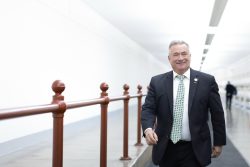
The bill introduced by Sens. Jeanne Shaheen (D-New Hampshire) and John Cornyn (R-Texas) would require the administration to target Chinese “entities and individuals” that have helped sustain the Russian defense industry despite enormous battlefield losses and widespread Western sanctions imposed since the start of the war.
“To finally bring Putin to the negotiating table and end this war, the United States must hold Chinese companies, CEOs, and banks accountable for this activity,” Shaheen, the Senate Foreign Relations Committee’s top Democrat, said in a statement singling out the Russian president, Vladimir Putin.
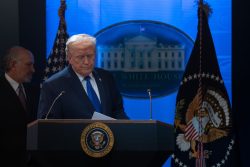
The bill is among the efforts by Ukraine’s supporters in Congress seeking to take advantage of President Donald Trump’s recent pivot away from Moscow, where the Russian leader has spurned his efforts to broker a peace deal. Trump has grown increasingly frustrated with Putin and on Tuesday set a 10-day deadline for the Kremlin to stop the fighting, warning that a failure to comply would invite punishing new sanctions.
On Friday, Trump said on social media that he had directed the Pentagon to dispatch two nuclear submarines to “the appropriate regions.” The president’s Truth Social post was aimed at Dmitry Medvedev, the deputy chair of Russia’s security council, who has ridiculed Trump’s ultimatum.
In a statement, the White House said: “The Constitution vests the president with the authority to conduct diplomacy with foreign nations. Any sanction package must provide complete flexibility for the president to continue to pursue his desired foreign policy.”
The Chinese Embassy in Washington did not immediately respond to a request for comment. Neither did the Russian Embassy.
While courting Putin earlier this year, Trump complained publicly about Ukraine’s president, Volodymyr Zelensky, while baselessly accusing the government in Kyiv of perpetuating the war. The president’s change in tone has provided cover for Republican defense hawks, such as Cornyn, to push more aggressively against Russia.
“By imposing sanctions on Chinese companies and individuals who advance Putin’s aggression, this legislation would deliver a significant blow to bad actors in Beijing and Moscow alike and bring us one step closer to President Trump’s goal of ending the war in Ukraine,” Cornyn said in a separate statement.
China has been one of Russia’s closest backers in the conflict following a summit between the two countries’ leaders, who promised a “no limits” partnership shortly before the Kremlin launched its full-scale invasion of Ukraine three years ago. Chinese firms have supplied an estimated 70 percent of the equipment Russia has needed to refill its supply of missiles, drones and other munitions throughout the war, said a Democratic congressional aide, speaking on the condition of anonymity to describe the sensitive matter.
China has avoided sending direct lethal support, in part out of concern that the U.S. and its allies would impose financial penalties on Beijing, the aide said. Still, in July, the European Commission levied its first sanctions on Chinese firms “for supplying goods used on the battlefield.”
North Korea and Iran also have come to Putin’s aid, allowing the Russian military to replenish its substantial combat losses.
While unlikely itself to pass, the bill presents a more tailored option next to a severe sanctions package on Russia introduced by Sens. Lindsey Graham (R-South Carolina) and Richard Blumenthal (D-Connecticut). That bill, which has 84 co-sponsors, would impose 500 percent tariffs on countries that continue to buy Russian uranium and gas, all but cleaving them from the U.S. economy.
The legislation introduced Friday would also direct the administration to work with U.S. allies on further sanctions to limit China’s support for Russia and to assess whether to target Chinese defense firms.
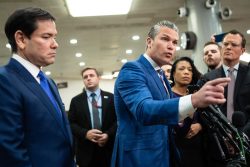
While the Trump administration has made concessions to China while negotiating a trade deal and a potential summit between Trump and Chinese President Xi Jinping, Treasury Secretary Scott Bessent told reporters he raised the issue of Beijing’s support for Russia’s war in trade talks this week.
“The Chinese take their sovereignty very seriously,” Bessent said. “We don’t want to impede on their sovereignty, so if they’d like to pay a 100 percent tariff, pay it,” Bessent said of the possible penalty.




Most Read
Popular articles in the past 24 hours
-

‘Dry Bonsai’ Gives New Life to Withered Trees, Allows Free Artist...
-

McDonald's Japan Raises Prices; Big Mac to Cost ¥500, Double Chee...
-

Nepal Bus Crash Kills 19 People, Injures 25 Including One Japanes...
-

Japan’s Nikkei Stock Average Rises as AI-Related Stocks Shine; Co...
-

Aggression against Ukraine: Malignant Precedent Must Not Be Set t...
-

Joruri Bunraku Narrative Performed in Honor of Donald Keene by La...
-

Astellas Collaborates with Vir to Develop Its Experimental Prosta...
-

Early-Blooming Kawazu Cherry Blossoms Create Sea of Pink at Park ...
Popular articles in the past week
-

Producer Behind Pop Group XG Arrested for Cocaine Possession
-

Japan PM Takaichi’s Cabinet Resigns en Masse
-

Sanae Takaichi Elected Prime Minister of Japan; Keeps All Cabinet...
-

Japan's Govt to Submit Road Map for Growth Strategy in March, PM ...
-

Bus Carrying 40 Passengers Catches Fire on Chuo Expressway; All E...
-

Japan, U.S. Name 3 Inaugural Investment Projects; Reached Agreeme...
-

Riku-Ryu Pair Wins Gold Medal: Their Strong Bond Leads to Major C...
-

Tokyo Skytree's Elevator Stops, Trapping 20 People; All Rescued (...
Popular articles in the past month
-
Producer Behind Pop Group XG Arrested for Cocaine Possession
-
Japan PM Takaichi’s Cabinet Resigns en Masse
-

Japan Institute to Use Domestic Commercial Optical Lattice Clock ...
-

Man Infected with Measles Reportedly Dined at Restaurant in Tokyo...
-

Israeli Ambassador to Japan Speaks about Japan’s Role in the Reco...
-

Videos Plagiarized, Reposted with False Subtitles Claiming ‘Ryuky...
-

Man Infected with Measles May Have Come in Contact with Many Peop...
-

Prudential Life Insurance Plans to Fully Compensate for Damages C...
Top Articles in News Services
-
Survey Shows False Election Info Perceived as True
-
Hong Kong Ex-Publisher Jimmy Lai’s Sentence Raises International Outcry as China Defends It
-
Japan’s Nikkei Stock Average Touches 58,000 as Yen, Jgbs Rally on Election Fallout (UPDATE 1)
-
Japan’s Nikkei Stock Average Falls as US-Iran Tensions Unsettle Investors (UPDATE 1)
-
Trump Names Former Federal Reserve Governor Warsh as the Next Fed Chair, Replacing Powell
JN ACCESS RANKING
-
Producer Behind Pop Group XG Arrested for Cocaine Possession
-
Japan PM Takaichi’s Cabinet Resigns en Masse
-
Japan Institute to Use Domestic Commercial Optical Lattice Clock to Set Japan Standard Time
-
Man Infected with Measles Reportedly Dined at Restaurant in Tokyo Station
-
Israeli Ambassador to Japan Speaks about Japan’s Role in the Reconstruction of Gaza