
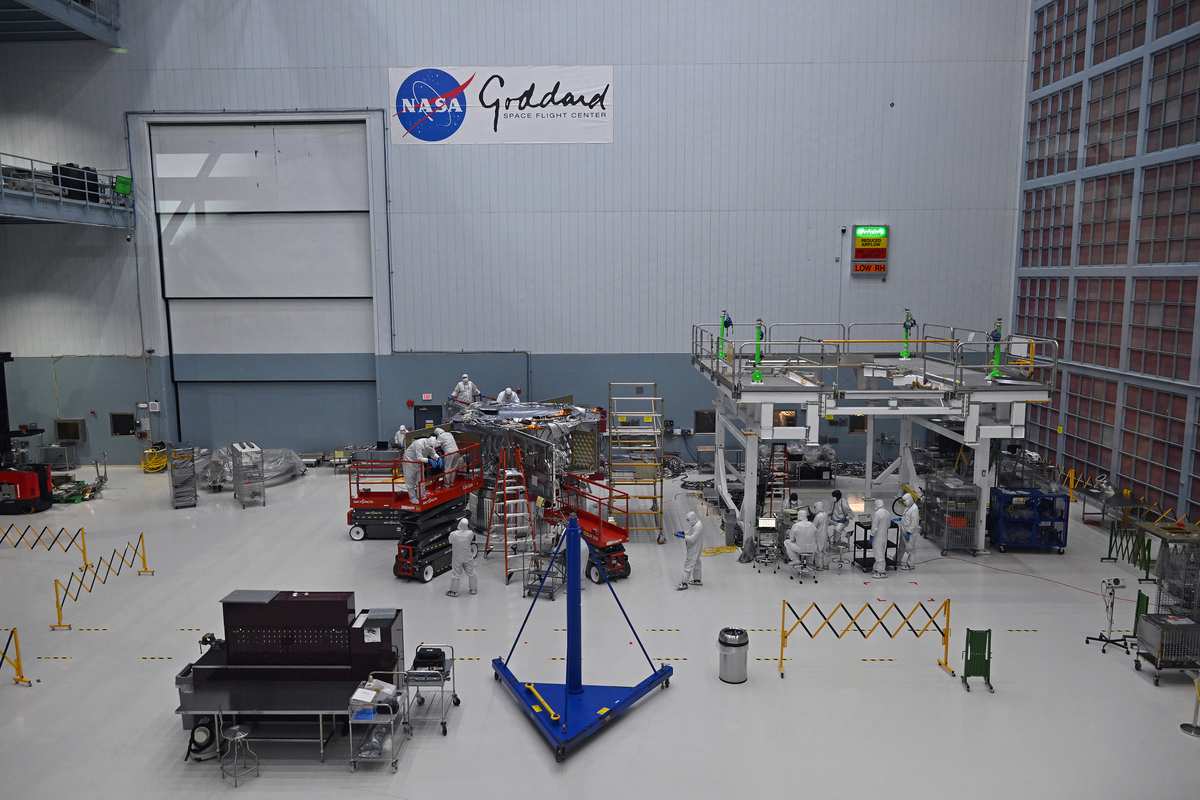
Employees do work related to the Nancy Grace Roman Space Telescope at the NASA Goddard Space Flight Center in Maryland.
11:43 JST, April 13, 2025
NASA’s science budget could be cut nearly in half under an early version of President Donald Trump’s budget proposal to Congress, a move that would terminate billions of dollars’ worth of ongoing and future missions, according to two individuals with direct knowledge of the administration’s plan.
The budget plan, sent to NASA by the Office of Management and Budget, would give NASA’s Science Mission Directorate $3.9 billion, down from its current budget of about $7.3 billion, according to the individuals, who spoke on the condition of anonymity because they were not authorized to publicly discuss the details.
The White House did not immediately respond to a request for comment. NASA press secretary Bethany Stevens issued a brief statement: “NASA has received the fiscal year 2026 budget passback from the Office of Management and Budget, and has begun the deliberative process.”
The budget proposal, though not yet formally submitted to Congress, would eviscerate a long list of planetary and astronomical missions, including the next major NASA space telescope and the agency’s goal of bringing samples of Mars back to Earth to search for signs of ancient life.
NASA’s astrophysics budget would take a huge hit, dropping from about $1.5 billion to $487 million. Planetary science would see a drop from $2.7 billion to $1.9 billion. Earth science would drop from about $2.2 billion to $1.033 billion.
“This is an extinction-level event for NASA science,” said Casey Dreier, chief of space policy for the Planetary Society, a space advocacy group. “It needlessly terminates functional, productive science missions and cancels new missions currently being built, wasting billions of taxpayer dollars in the process. This is neither efficient nor smart budgeting.”
The Hubble and Webb space telescopes – celebrated for their long list of discoveries as well as stunning images of the universe – would remain supported under the proposal. However, no other telescope would be funded.
That includes the Nancy Grace Roman Space Telescope, which has been designed to study distant galaxies and faraway planets from an orbital outpost about a million miles from Earth. The hardware of the Roman is in place and being integrated and tested at NASA’s Goddard Space Flight Center in Greenbelt, Maryland. The Roman is scheduled to launch as early as September 2026.
The budget draft, known as a “passback,” is one step in the process by which the president sends Congress a 2026 fiscal year budget request. Congress has the power of the purse and can rescue programs targeted for termination by the White House.
“They’re going to run NASA into a very deep ditch if they proceed with this kind of savagery,” Bill Nelson, the NASA administrator under President Joe Biden, said in an interview. “If you savage NASA science, you have savaged our entire exploration program, and that will affect the human exploration program as well.”
Ars Technica reported last month that NASA’s science budget could be cut by as much as 50 percent.
Massive science cuts would put NASA Goddard in a perilous position.
“It’d be a huge loss to our country, because what the men and women at Goddard do is the foundation for everything else that we do in space,” Sen. Chris Van Hollen (D-Maryland) told The Washington Post. He said the Maryland delegation will fight back.
“I think there’ll be very strong bipartisan resistance in Congress to cutting missions that are the foundation of our space program,” he said. “This is like eating your seed corn, and it will have very damaging impacts on our space program, on national security programs, and it will undermine our leadership in the area of technical innovation and scientific research.”
NASA does not yet have a confirmed administrator. Trump’s nominee, billionaire entrepreneur Jared Isaacman, appeared Wednesday before the Senate Commerce, Space and Transportation committee in what was at times a testy nomination hearing.
Most of the questions from committee members focused on NASA’s human spaceflight ambitions and whether Isaacman would support the Artemis moon mission as currently envisioned, which includes multiple landings and a permanent human presence using NASA rockets and spacecraft as well as landers built by SpaceX and Jeff Bezos’s Blue Origin. (Bezos owns The Post.)
Isaacman said he supported the moon mission and vowed that it could be done in parallel with Mars missions. At one point, he said Mars should be the priority but after being pressed by Sen. Ted Cruz (R-Texas), he said, “we don’t have to make a binary decision of Moon versus Mars, or the moon has to come first versus Mars.” Mars is the destination preferred by Trump and Elon Musk, the SpaceX founder who has long dreamed of creating a human civilization on Mars.
But Isaacman did not show any interest in cutting science programs to boost funding to human spaceflight. He called himself “an advocate for science.”
If confirmed, he said, “NASA will be a force multiplier for science. We will leverage NASA’s scientific talent and capabilities to enable academic institutions and industry to increase the rate of world-changing discoveries. We will launch more telescopes, more probes, more rovers, and endeavor to better understand our planet and the universe beyond.”









Most Read
Popular articles in the past 24 hours
-
Japan Seeks to Counter China's Expanding Influence in Pacific by ...
-

Japan's Diet Begins Debate on Takaichi's Budget Plans, ‘Proactive...
-

Exhibition Featuring Yoshiharu Tsuge’s Manga World Underway in Ch...
-

Tokyo Skytree Observation Deck Remains Closed for Inspection afte...
-

Impact on Japanese Economy Unclear with Trump’s New Tariffs, Shif...
-

Hanzomon Line Service Suspended between Kudanshita, Oshiage Stati...
-

Nikkei Rises Over 700 Points to Hit New Intraday High
-

Japan's Services Inflation Steady, Signals Wage-Driven Price Pres...
Popular articles in the past week
-

Producer Behind Pop Group XG Arrested for Cocaine Possession
-

Japan, U.S. Name 3 Inaugural Investment Projects; Reached Agreeme...
-

iPS Treatments Pass Key Milestone, but Broader Applications Far f...
-

Tokyo Skytree's Elevator Stops, Trapping 20 People; All Rescued (...
-

Director Naomi Kawase's New Film Explores Heart Transplants in Ja...
-

Japan’s Major Real Estate Firms Expanding Overseas Businesses to ...
-

Milano Cortina 2026: Japan’s Mari Fukada Wins Gold in Women’s Sno...
-

Milano Cortina 2026: Japanese Figure Skater Kaori Sakamoto’...
Popular articles in the past month
-
Producer Behind Pop Group XG Arrested for Cocaine Possession
-

Japan PM Takaichi’s Cabinet Resigns en Masse
-

Japan Institute to Use Domestic Commercial Optical Lattice Clock ...
-

Man Infected with Measles Reportedly Dined at Restaurant in Tokyo...
-

Israeli Ambassador to Japan Speaks about Japan’s Role in the Reco...
-

Videos Plagiarized, Reposted with False Subtitles Claiming ‘Ryuky...
-

Man Infected with Measles May Have Come in Contact with Many Peop...
-

Prudential Life Insurance Plans to Fully Compensate for Damages C...
Top Articles in News Services
-

Survey Shows False Election Info Perceived as True
-

Hong Kong Ex-Publisher Jimmy Lai’s Sentence Raises International Outcry as China Defends It
-

Japan’s Nikkei Stock Average Touches 58,000 as Yen, Jgbs Rally on Election Fallout (UPDATE 1)
-
Japan’s Nikkei Stock Average Falls as US-Iran Tensions Unsettle Investors (UPDATE 1)
-

Trump Names Former Federal Reserve Governor Warsh as the Next Fed Chair, Replacing Powell
JN ACCESS RANKING
-
Producer Behind Pop Group XG Arrested for Cocaine Possession
-
Japan PM Takaichi’s Cabinet Resigns en Masse
-
Man Infected with Measles Reportedly Dined at Restaurant in Tokyo Station
-
Israeli Ambassador to Japan Speaks about Japan’s Role in the Reconstruction of Gaza
-
Videos Plagiarized, Reposted with False Subtitles Claiming ‘Ryukyu Belongs to China’; Anti-China False Information Also Posted in Japan