
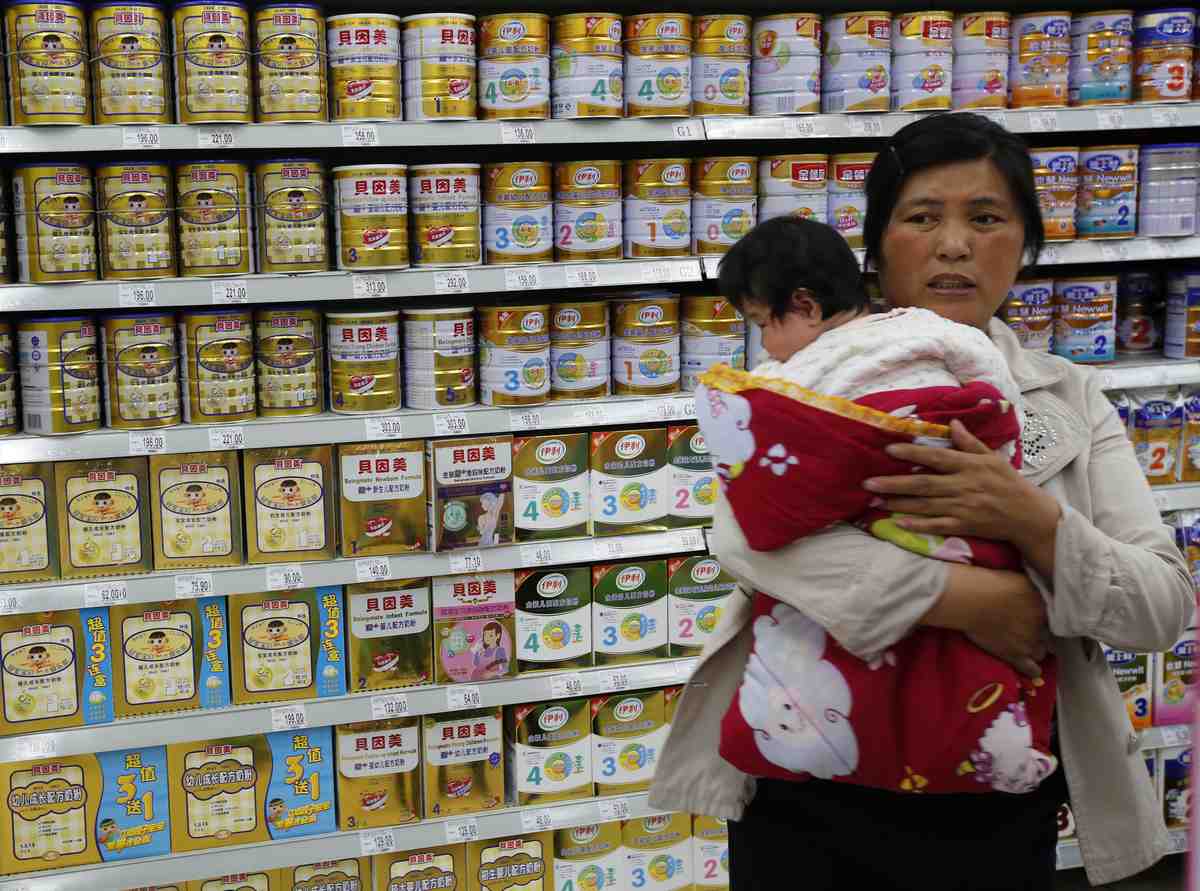
A woman holding a baby stands in front of a shelf displaying milk powder products at a supermarket in Beijing May 20, 2013.
11:55 JST, March 6, 2025
A diverse diet that introduced 13 or 14 foods to 9-month-old babies was associated with a 45 percent lower risk of food allergy compared with the introduction of fewer foods at that age, according to a study in the journal Pediatric Allergy and Immunology.
Researchers used data from 2,060 infants and their families – recruited between May 2016 and December 2022 – in the NorthPop Birth Cohort Study, a population-based study in Northern Sweden that seeks to identify factors influencing allergies and asthma.
The new research also said infants with the most diverse diet had a 61 percent lower risk of having a food allergy by 18 months than those with the least diverse diet. A diverse diet was particularly effective in preventing a food allergy for those without a family history of food allergies or history of eczema. But earlier introduction of a diverse diet, at 6 months, did not show the same reduction in food allergy risk.
Parents filled out food consumption questionnaires when their children reached about 9 months of age. Diet diversity was measured by the frequency of the infants’ consumption of 14 foods at 6 and 9 months, as well as how often the infants consumed six allergenic foods (wheat, egg, fish, dairy, nuts and peanuts, and soy).
At 18 months, 100 children participating in the study were diagnosed with a food allergy. The most commonly occurring were cow’s milk allergy (69 cases) and egg allergy (35 cases). Additionally, 30 of the 100 had allergies to multiple foods.
Food allergies are generally inherited, the researchers said, but infant diet can have an impact on the adaptive immune system and allergic disease development.
“Repeated exposure to foods in infancy is important both for tolerance development and maintenance,” the authors write. “One could assume that frequent consumption of plant-based foods including fruit, vegetables, and legumes which are rich in fiber and vitamins are especially important for reducing food allergy risk, in line with existing guidelines.”







Most Read
Popular articles in the past 24 hours
-
Japan Seeks to Counter China's Expanding Influence in Pacific by ...
-

Exhibition Featuring Yoshiharu Tsuge’s Manga World Underway in Ch...
-

Tokyo Skytree Observation Deck Remains Closed for Inspection afte...
-

Impact on Japanese Economy Unclear with Trump’s New Tariffs, Shif...
-
Japanese Watermelon Shipments Starts in Leading Production Distri...
-

Hanzomon Line Service Suspended between Kudanshita, Oshiage Stati...
-

Takeshima Day: Persistently Demanding Resolution from South Korea...
-

Japan's Services Inflation Steady, Signals Wage-Driven Price Pres...
Popular articles in the past week
-

Producer Behind Pop Group XG Arrested for Cocaine Possession
-

Japan, U.S. Name 3 Inaugural Investment Projects; Reached Agreeme...
-

iPS Treatments Pass Key Milestone, but Broader Applications Far f...
-

Tokyo Skytree's Elevator Stops, Trapping 20 People; All Rescued (...
-

Director Naomi Kawase's New Film Explores Heart Transplants in Ja...
-

Japan’s Major Real Estate Firms Expanding Overseas Businesses to ...
-

Milano Cortina 2026: Japan’s Mari Fukada Wins Gold in Women’s Sno...
-

Milano Cortina 2026: Japanese Figure Skater Kaori Sakamoto’...
Popular articles in the past month
-
Producer Behind Pop Group XG Arrested for Cocaine Possession
-

Japan PM Takaichi’s Cabinet Resigns en Masse
-

Japan Institute to Use Domestic Commercial Optical Lattice Clock ...
-

Man Infected with Measles Reportedly Dined at Restaurant in Tokyo...
-

Israeli Ambassador to Japan Speaks about Japan’s Role in the Reco...
-

Videos Plagiarized, Reposted with False Subtitles Claiming ‘Ryuky...
-

Man Infected with Measles May Have Come in Contact with Many Peop...
-

Prudential Life Insurance Plans to Fully Compensate for Damages C...
Top Articles in News Services
-
Survey Shows False Election Info Perceived as True
-
Hong Kong Ex-Publisher Jimmy Lai’s Sentence Raises International Outcry as China Defends It
-

Japan’s Nikkei Stock Average Touches 58,000 as Yen, Jgbs Rally on Election Fallout (UPDATE 1)
-
Japan’s Nikkei Stock Average Falls as US-Iran Tensions Unsettle Investors (UPDATE 1)
-

Trump Names Former Federal Reserve Governor Warsh as the Next Fed Chair, Replacing Powell
JN ACCESS RANKING
-
Producer Behind Pop Group XG Arrested for Cocaine Possession
-
Japan PM Takaichi’s Cabinet Resigns en Masse
-
Man Infected with Measles Reportedly Dined at Restaurant in Tokyo Station
-
Israeli Ambassador to Japan Speaks about Japan’s Role in the Reconstruction of Gaza
-
Videos Plagiarized, Reposted with False Subtitles Claiming ‘Ryukyu Belongs to China’; Anti-China False Information Also Posted in Japan