
Under Ukraine Security Guarantees, Western Troops Could Repel Russian Forces Post-Ceasefire, Says Germany’s Merz
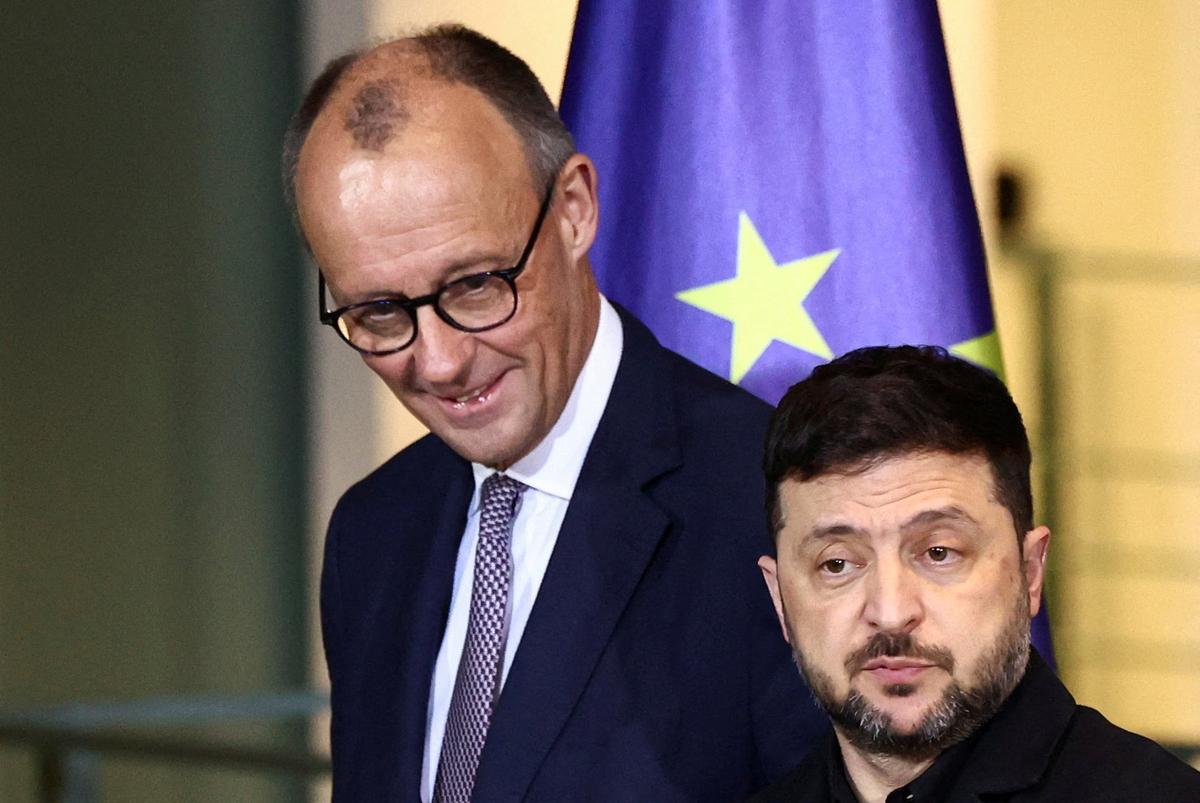
Ukrainian President Volodymyr Zelenskiy and German Chancellor Friedrich Merz attend a press conference at the Chancellery in Berlin, Germany December 15, 2025.
12:35 JST, December 17, 2025
BERLIN, Dec 16 (Reuters) – Under post-ceasefire guarantees provided by the United States and Europe to Ukraine, peacekeepers could in certain circumstances repel Russian forces, German Chancellor Friedrich Merz told ZDF public television in an interview, adding that this remained a far-off prospect.
Pressed by interviewers for details on the possible security guarantees floated by the United States in Monday’s Berlin talks with Ukrainian President Volodymyr Zelenskiy, Merz said the guarantors would need to repel Russian forces should there be a violation of any ceasefire terms.
“We would secure a demilitarized zone between the warring parties and, to be very specific, we would also act against corresponding Russian incursions and attacks. We’re not there yet,” he said.
“The fact that the Americans have made such a commitment – to protect Ukraine in the event of a ceasefire as if it were NATO territory – I think that’s a remarkable new position for the United States of America.”
Russia has yet to agree to the ceasefire that both the U.S. and Europe have said would be a prerequisite for any security guarantees, or to the presence of Western troops on the ground in Ukraine to help end the full-scale war begun when President Vladimir Putin ordered Russia’s invasion of Ukraine in February 2022.
’50:50′ CHANCE OF GIVING UKRAINE RUSSIA’S ASSETS
Merz said he believed there was a “50:50” chance of securing a European agreement on using immobilized Russian assets to fund Ukraine’s continuing defence. It was essential to do so, he added, since Ukraine would need funding for at least two more years after the current round of European funding runs out in the first quarter of 2026.
“There are reservations throughout Europe, and I can well understand these reservations,” he said. “But … if we don’t act now and make the decision we could make to halt this advance of the Russian army, when will we?”
The hostile tone towards Europe in the new U.S. National Security Strategy had not surprised him, he said, since it mirrored many of the criticisms Vice President JD Vance made of Europe in his speech to the Munich Security Conference at the start of the year.
But Merz said any isolationist drift on the part of the U.S. was unlikely to be sustained.
“America first is all well and good, but America alone would not be good for America either,” he said. “And taking a look at the economic data in America, I can imagine that the Americans will eventually approach us and say, ‘Don’t we want to talk about some issues that benefit us both?'”




Most Read
Popular articles in the past 24 hours
-

Japanese Shipping Giants Halt Strait of Hormuz Transit as Iran Co...
-

U.S. Launches Attacks on Iran: Avoid Escalation of Conflict by An...
-

Japan Shares and Yen Fall, Jgbs Rise as Iran Strikes Continue
-
Takaichi: Japan Striving to Ensure Safety of Japanese Nationals; ...
-

Sawtooth Roof Factory Stands as Monument to Ashikaga Textile Hist...
-
Kyoto Animation President Hideaki Hatta Dies of Illness at 76; Co...
-

Parents of Japanese Teen Shot in U.S. Strive for Gun Control
-

Disinformation Spreads About Team Mirai, Ballot Readers; Online P...
Popular articles in the past week
-

Nepal Bus Crash Kills 19 People, Injures 25 Including One Japanes...
-
Milano Cortina 2026: Japanese Gold Medalist Figure Skater Miura S...
-
Tokyo Spends Big on Children, Wins Over Parents
-

McDonald's Japan Raises Prices; Big Mac to Cost ¥500, Double Chee...
-
Japan’s Miura, Kihara Announce Withdrawal from Figure Skating Wor...
-

Exhibition Featuring Yoshiharu Tsuge’s Manga World Underway in Ch...
-

Yokohama to Test Out Renewable-Powered Offshore Floating Data Cen...
-

BOJ Keeping Eye on Economy and Takaichi's ‘Proactive Fiscal Polic...
Popular articles in the past month
-

Producer Behind Pop Group XG Arrested for Cocaine Possession
-

Japan PM Takaichi’s Cabinet Resigns en Masse
-

Man Infected with Measles Reportedly Dined at Restaurant in Tokyo...
-

Israeli Ambassador to Japan Speaks about Japan’s Role in the Reco...
-

Videos Plagiarized, Reposted with False Subtitles Claiming ‘Ryuky...
-

Man Infected with Measles May Have Come in Contact with Many Peop...
-

Prudential Life Insurance Plans to Fully Compensate for Damages C...
-

Woman with Measles Visited Hospital in Tokyo Multiple Times Befor...
Top Articles in News Services
-
Survey Shows False Election Info Perceived as True
-
Hong Kong Ex-Publisher Jimmy Lai’s Sentence Raises International Outcry as China Defends It
-
Japan’s Nikkei Stock Average Touches 58,000 as Yen, Jgbs Rally on Election Fallout (UPDATE 1)
-
Japan’s Nikkei Stock Average Falls as US-Iran Tensions Unsettle Investors (UPDATE 1)
-
Japan’s Nikkei Stock Average Rises on Tech Rally and Takaichi’s Spending Hopes (UPDATE 1)
JN ACCESS RANKING
-
Producer Behind Pop Group XG Arrested for Cocaine Possession
-
Japan PM Takaichi’s Cabinet Resigns en Masse
-
Man Infected with Measles Reportedly Dined at Restaurant in Tokyo Station
-
Israeli Ambassador to Japan Speaks about Japan’s Role in the Reconstruction of Gaza
-
Videos Plagiarized, Reposted with False Subtitles Claiming ‘Ryukyu Belongs to China’; Anti-China False Information Also Posted in Japan