
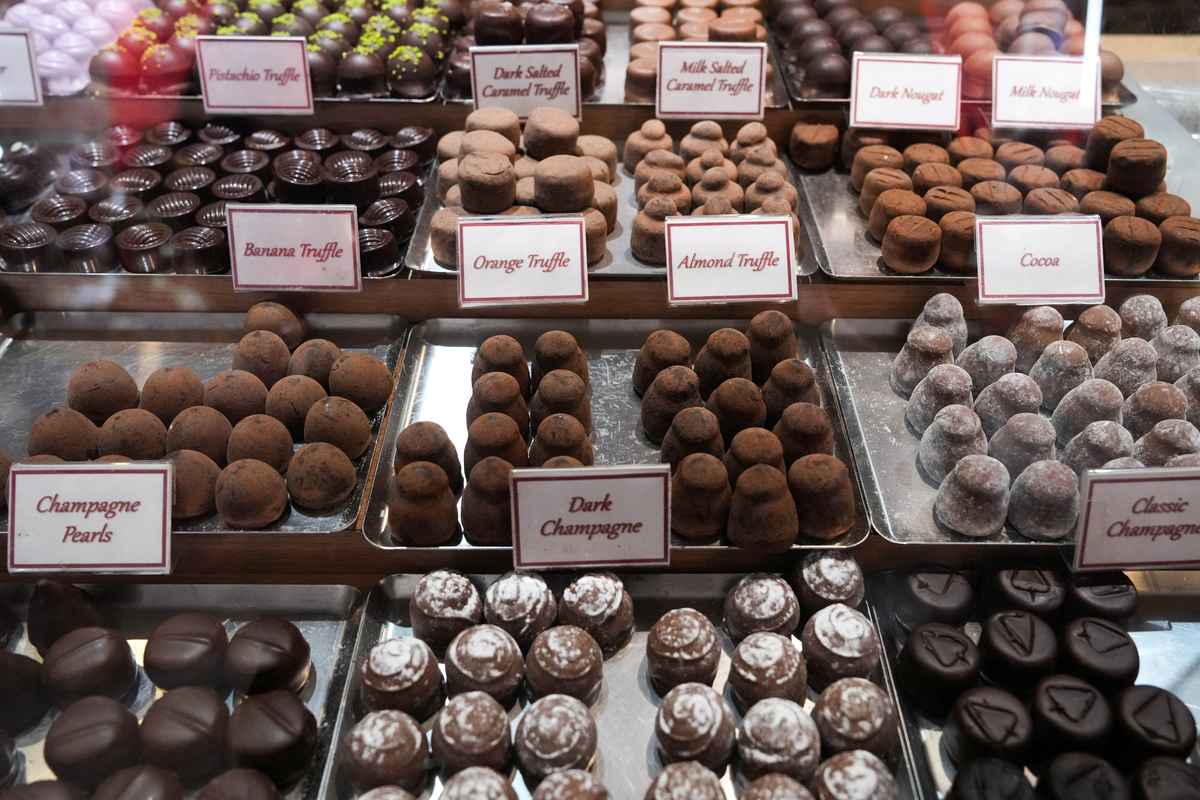
Chocolates are displayed in a Teuscher Chocolates of Switzerland store on Fifth Avenue as President Trump’s new tariffs are imposed, in New York City, U.S., August 7, 2025.
16:00 JST, October 10, 2025
NEW YORK, Oct 9 (Reuters) – U.S. chocolate consumers will face elevated chocolate prices this coming Halloween period as cocoa costs have more than doubled since early 2024, according to a report released on Thursday by Wells Fargo’s Agri-Food Institute.
While wholesale cocoa prices CCc1 have eased from late 2024 peaks, manufacturers are still passing on to consumers their increased costs. Companies are also reducing seasonal product lines and implementing “shrinkflation” – reducing portion sizes while maintaining prices, the report said.
The surge in cocoa costs was caused by severe supply disruptions in West Africa, which accounts for approximately 70% of global cocoa production. Heavy rains in late 2023 triggered black pod disease and crop rot, while subsequent El Nino-induced droughts in 2024 increased the prevalence of cocoa swollen shoot virus disease.
Global cocoa production fell 12.9% year-over-year to 4.37 million metric tons in the last crop season, creating a supply deficit of 494,000 metric tons, the largest in over 60 years, according to the International Cocoa Organization (ICO). Production in Ivory Coast, the world’s largest producer, dropped 25.3%, while Ghana’s output declined 31.3%.
The outlook remains challenging, Wells Fargo said, citing preliminary assessments by cocoa exporters that point to a 10% decline in output for the 2025/26 crop year beginning in October across four West African producers.
“It is likely that cocoa prices will remain high at least through the next crop year ending September 2026 given the current record cocoa supply deficit,” the report stated.
Recently imposed tariffs on major suppliers of cocoa and cocoa products to the U.S. States are an added cost factor.
The main U.S. suppliers are Ecuador, Ivory Coast, Dominican Republic and Ghana. All of them received so-called “reciprocal” tariffs, ranging from 15% to 25%.
U.S. importers and chocolate makers need to pay that additional amount when the beans or byproducts such as cocoa butter or cocoa powder arrive in the country. Cocoa is only produced in tropical regions.
Wells Fargo analysts said consumers should shop for treats with less cocoa content, compare prices across retailers, and consider generic alternatives, which can offer savings compared to branded products.





Most Read
Popular articles in the past 24 hours
-
McDonald's Japan Raises Prices; Big Mac to Cost ¥500, Double Chee...
-

Nepal Bus Crash Kills 19 People, Injures 25 Including One Japanes...
-
Japan’s Nikkei Stock Average Rises as AI-Related Stocks Shine; Co...
-

Aggression against Ukraine: Malignant Precedent Must Not Be Set t...
-

Joruri Bunraku Narrative Performed in Honor of Donald Keene by La...
-

Early-Blooming Kawazu Cherry Blossoms Create Sea of Pink at Park ...
-
Astellas Collaborates with Vir to Develop Its Experimental Prosta...
-
Kanto's 1st Spring Wind Blows as Tokyo Sees Unseasonably High Tem...
Popular articles in the past week
-

Producer Behind Pop Group XG Arrested for Cocaine Possession
-

Japan PM Takaichi’s Cabinet Resigns en Masse
-

Sanae Takaichi Elected Prime Minister of Japan; Keeps All Cabinet...
-

Japan's Govt to Submit Road Map for Growth Strategy in March, PM ...
-

Bus Carrying 40 Passengers Catches Fire on Chuo Expressway; All E...
-

Japan, U.S. Name 3 Inaugural Investment Projects; Reached Agreeme...
-

Riku-Ryu Pair Wins Gold Medal: Their Strong Bond Leads to Major C...
-

iPS Treatments Pass Key Milestone, but Broader Applications Far f...
Popular articles in the past month
-
Producer Behind Pop Group XG Arrested for Cocaine Possession
-
Japan PM Takaichi’s Cabinet Resigns en Masse
-

Japan Institute to Use Domestic Commercial Optical Lattice Clock ...
-

Man Infected with Measles Reportedly Dined at Restaurant in Tokyo...
-

Israeli Ambassador to Japan Speaks about Japan’s Role in the Reco...
-

Videos Plagiarized, Reposted with False Subtitles Claiming ‘Ryuky...
-

Man Infected with Measles May Have Come in Contact with Many Peop...
-

Prudential Life Insurance Plans to Fully Compensate for Damages C...
Top Articles in News Services
-
Survey Shows False Election Info Perceived as True
-
Hong Kong Ex-Publisher Jimmy Lai’s Sentence Raises International Outcry as China Defends It
-
Japan’s Nikkei Stock Average Touches 58,000 as Yen, Jgbs Rally on Election Fallout (UPDATE 1)
-
Japan’s Nikkei Stock Average Falls as US-Iran Tensions Unsettle Investors (UPDATE 1)
-
Trump Names Former Federal Reserve Governor Warsh as the Next Fed Chair, Replacing Powell
JN ACCESS RANKING
-
Producer Behind Pop Group XG Arrested for Cocaine Possession
-
Japan PM Takaichi’s Cabinet Resigns en Masse
-
Man Infected with Measles Reportedly Dined at Restaurant in Tokyo Station
-
Israeli Ambassador to Japan Speaks about Japan’s Role in the Reconstruction of Gaza
-
Videos Plagiarized, Reposted with False Subtitles Claiming ‘Ryukyu Belongs to China’; Anti-China False Information Also Posted in Japan