
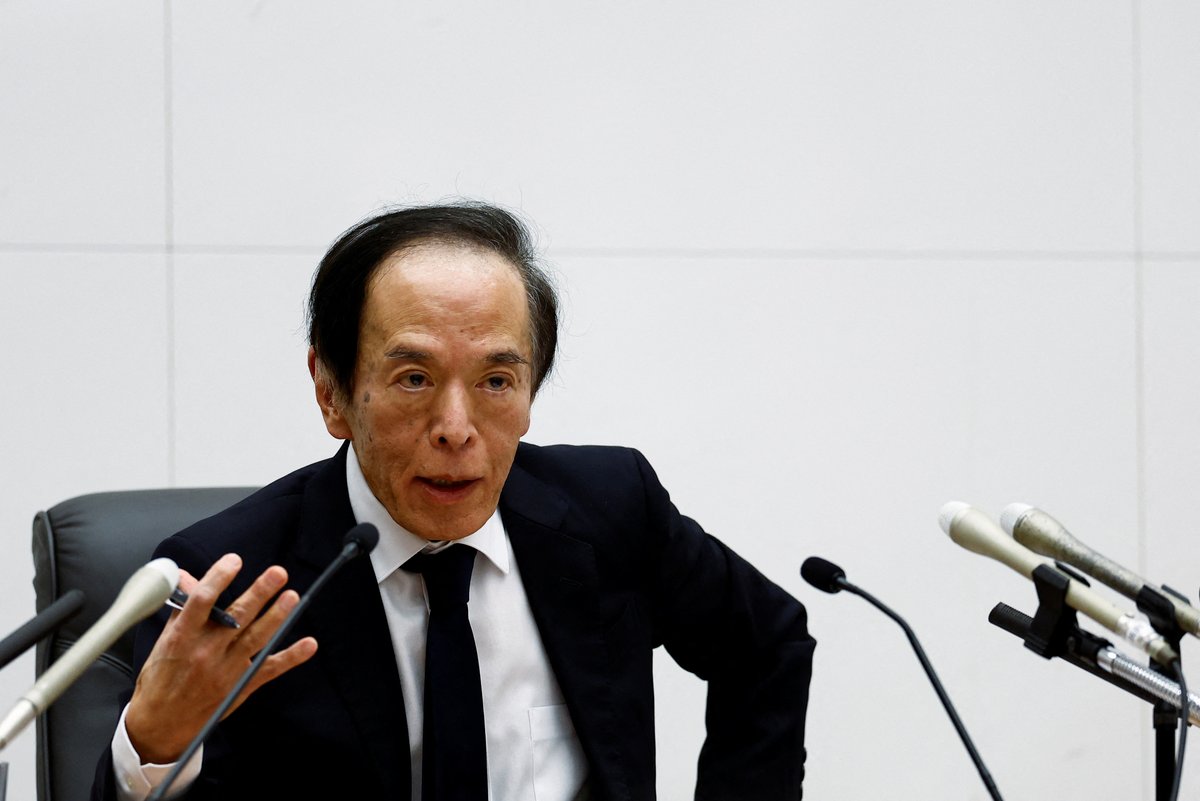
Bank of Japan (BOJ) Governor Kazuo Ueda speaks at a press conference after the central bank’s policy meeting at BOJ headquarters in Tokyo, Japan January 24, 2025.
15:31 JST, February 12, 2025
TOKYO, Feb 12 (Reuters) – Bank of Japan Governor Kazuo Ueda said on Wednesday the central bank will conduct monetary policy bearing in mind there are risks that food prices may continue to be high and affect people’s inflation expectations.
“We’re deeply aware that a rise of more than 2% in prices of fresh foods and other commonly purchased products are negatively impacting people’s lives,” Ueda told parliament.
“Rises in the prices of food, including fresh food, won’t necessarily be temporary and there’s the chance that this will impact people’s mindsets and price expectations,” he said.
Ueda’s remarks followed the BOJ’s decision last month to raise short-term interest rates to 0.5%, a level unseen in Japan for 17 years, underscoring policymakers’ conviction the economy is on course to achieve wage-driven, durable price rises.
The overall consumer price index (CPI) rose 3.6% in December from a year earlier, much faster than a 3.0% gain in the core index that strips away the effect of volatile fresh food prices, driven by price spikes in fresh vegetables and the cost of rice.
Ueda has said such cost-push inflationary pressure is likely to dissipate toward the mid-year.
In gauging whether inflation will sustainably hit its 2% inflation target, the BOJ focuses on underlying inflation, or the broad trend of price moves that strips away one-off factors such as fuel and volatile fresh food costs.
Ueda reiterated at the parliament session that the pace of the central bank’s interest rate hikes will depend on economic, price and financial situations.
He also confirmed that the central bank will in June conduct a mid-term review of the its current plan to taper government bond purchases and come up with a new one for April 2026 onwards.
Last July, the bank said it plans to halve its monthly Japanese government bond purchases to 3 trillion yen ($19.52 billion) as of January-March 2026.
“We’ve formulated and are implementing our bond-taper plan based on the view that tapering should be done in a predictable manner with a certain degree of flexibility to ensure the stability of bond markets,” Ueda told parliament.
($1 = 153.7100 yen)





Most Read
Popular articles in the past 24 hours
-

‘Dry Bonsai’ Gives New Life to Withered Trees, Allows Free Artist...
-

McDonald's Japan Raises Prices; Big Mac to Cost ¥500, Double Chee...
-

Nepal Bus Crash Kills 19 People, Injures 25 Including One Japanes...
-

Japan’s Nikkei Stock Average Rises as AI-Related Stocks Shine; Co...
-

Aggression against Ukraine: Malignant Precedent Must Not Be Set t...
-

Joruri Bunraku Narrative Performed in Honor of Donald Keene by La...
-

Astellas Collaborates with Vir to Develop Its Experimental Prosta...
-

Early-Blooming Kawazu Cherry Blossoms Create Sea of Pink at Park ...
Popular articles in the past week
-

Producer Behind Pop Group XG Arrested for Cocaine Possession
-

Japan PM Takaichi’s Cabinet Resigns en Masse
-

Sanae Takaichi Elected Prime Minister of Japan; Keeps All Cabinet...
-

Japan's Govt to Submit Road Map for Growth Strategy in March, PM ...
-

Bus Carrying 40 Passengers Catches Fire on Chuo Expressway; All E...
-

Japan, U.S. Name 3 Inaugural Investment Projects; Reached Agreeme...
-

Riku-Ryu Pair Wins Gold Medal: Their Strong Bond Leads to Major C...
-

Tokyo Skytree's Elevator Stops, Trapping 20 People; All Rescued (...
Popular articles in the past month
-
Producer Behind Pop Group XG Arrested for Cocaine Possession
-
Japan PM Takaichi’s Cabinet Resigns en Masse
-

Japan Institute to Use Domestic Commercial Optical Lattice Clock ...
-

Man Infected with Measles Reportedly Dined at Restaurant in Tokyo...
-

Israeli Ambassador to Japan Speaks about Japan’s Role in the Reco...
-

Videos Plagiarized, Reposted with False Subtitles Claiming ‘Ryuky...
-

Man Infected with Measles May Have Come in Contact with Many Peop...
-

Prudential Life Insurance Plans to Fully Compensate for Damages C...
Top Articles in News Services
-
Survey Shows False Election Info Perceived as True
-
Hong Kong Ex-Publisher Jimmy Lai’s Sentence Raises International Outcry as China Defends It
-
Japan’s Nikkei Stock Average Touches 58,000 as Yen, Jgbs Rally on Election Fallout (UPDATE 1)
-
Japan’s Nikkei Stock Average Falls as US-Iran Tensions Unsettle Investors (UPDATE 1)
-

Trump Names Former Federal Reserve Governor Warsh as the Next Fed Chair, Replacing Powell
JN ACCESS RANKING
-
Producer Behind Pop Group XG Arrested for Cocaine Possession
-
Japan PM Takaichi’s Cabinet Resigns en Masse
-
Japan Institute to Use Domestic Commercial Optical Lattice Clock to Set Japan Standard Time
-
Man Infected with Measles Reportedly Dined at Restaurant in Tokyo Station
-
Israeli Ambassador to Japan Speaks about Japan’s Role in the Reconstruction of Gaza