
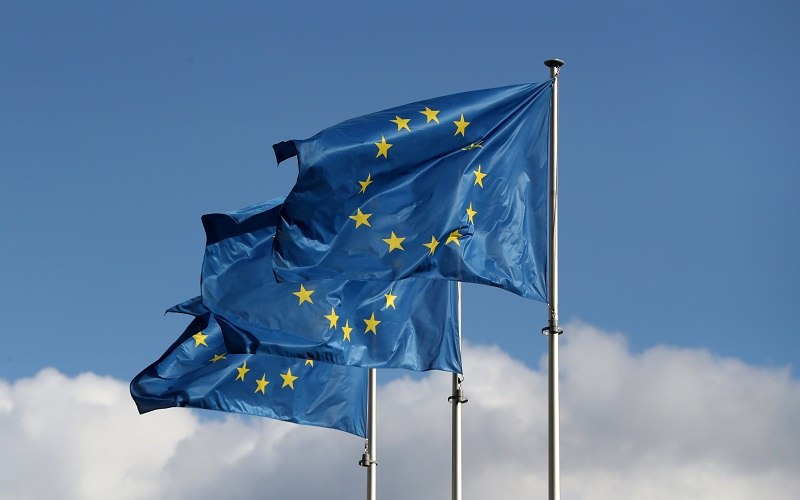
European Union flags fly outside the EU Commission headquarters in Brussels, Belgium September 19, 2019.
15:00 JST, March 28, 2023
BRUSSELS, March 28 (Reuters) – The European Union on Tuesday reached a provisional deal on the deployment of more service stations for cars running on electricity and alternative fuels as the bloc seeks to reduce the carbon footprint of its transport sector.
“The agreement will send a clear signal to citizens and other stakeholders that user-friendly recharging infrastructure and refueling stations for alternative fuels, such as hydrogen, will be installed throughout the EU,” Andreas Carlson, the Swedish minister for infrastructure and housing, said in a EU statement.
Sweden currently holds the bloc’s presidency.
Further commenting on what he called a “provisional political agreement” between the Council and the European Parliament, Carlson added: “Citizens will no longer have a reason to feel anxious about finding charging and refueling stations to their electric or fuel-cell car.”
He added it was the bloc’s aim to make more recharging capacity available on the streets in urban areas as well along the motorways.
EU energy ministers are set to give final approval later on Tuesday to end sales of new CO2-emitting cars in 2035, after Germany won an exemption for cars running on e-fuels.







Most Read
Popular articles in the past 24 hours
-

Exhibition Featuring Yoshiharu Tsuge’s Manga World Underway in Ch...
-

Tokyo Skytree Observation Deck Remains Closed for Inspection afte...
-
Japanese Watermelon Shipments Starts in Leading Production Distri...
-

Impact on Japanese Economy Unclear with Trump’s New Tariffs, Shif...
-

Takeshima Day: Persistently Demanding Resolution from South Korea...
-

Hanzomon Line Service Suspended between Kudanshita, Oshiage Stati...
-

CARTOON OF THE DAY (February 25)
-
Hanzomon Line Service Resumes
Popular articles in the past week
-

Producer Behind Pop Group XG Arrested for Cocaine Possession
-

iPS Treatments Pass Key Milestone, but Broader Applications Far f...
-

Japan, U.S. Name 3 Inaugural Investment Projects; Reached Agreeme...
-

Tokyo Skytree's Elevator Stops, Trapping 20 People; All Rescued (...
-

Director Naomi Kawase's New Film Explores Heart Transplants in Ja...
-

Japan’s Major Real Estate Firms Expanding Overseas Businesses to ...
-

Milano Cortina 2026: Japanese Figure Skater Kaori Sakamoto’...
-

Baby Monkey Punch Captures Hearts at Chiba Pref. Zoo, on Social M...
Popular articles in the past month
-
Producer Behind Pop Group XG Arrested for Cocaine Possession
-

Japan PM Takaichi’s Cabinet Resigns en Masse
-

Japan Institute to Use Domestic Commercial Optical Lattice Clock ...
-

Man Infected with Measles Reportedly Dined at Restaurant in Tokyo...
-

Israeli Ambassador to Japan Speaks about Japan’s Role in the Reco...
-

Videos Plagiarized, Reposted with False Subtitles Claiming ‘Ryuky...
-

Man Infected with Measles May Have Come in Contact with Many Peop...
-

Prudential Life Insurance Plans to Fully Compensate for Damages C...
Top Articles in News Services
-
Survey Shows False Election Info Perceived as True
-
Hong Kong Ex-Publisher Jimmy Lai’s Sentence Raises International Outcry as China Defends It
-

Japan’s Nikkei Stock Average Touches 58,000 as Yen, Jgbs Rally on Election Fallout (UPDATE 1)
-
Japan’s Nikkei Stock Average Falls as US-Iran Tensions Unsettle Investors (UPDATE 1)
-

Trump Names Former Federal Reserve Governor Warsh as the Next Fed Chair, Replacing Powell
JN ACCESS RANKING
-
Producer Behind Pop Group XG Arrested for Cocaine Possession
-
Japan PM Takaichi’s Cabinet Resigns en Masse
-
Man Infected with Measles Reportedly Dined at Restaurant in Tokyo Station
-
Israeli Ambassador to Japan Speaks about Japan’s Role in the Reconstruction of Gaza
-
Videos Plagiarized, Reposted with False Subtitles Claiming ‘Ryukyu Belongs to China’; Anti-China False Information Also Posted in Japan