
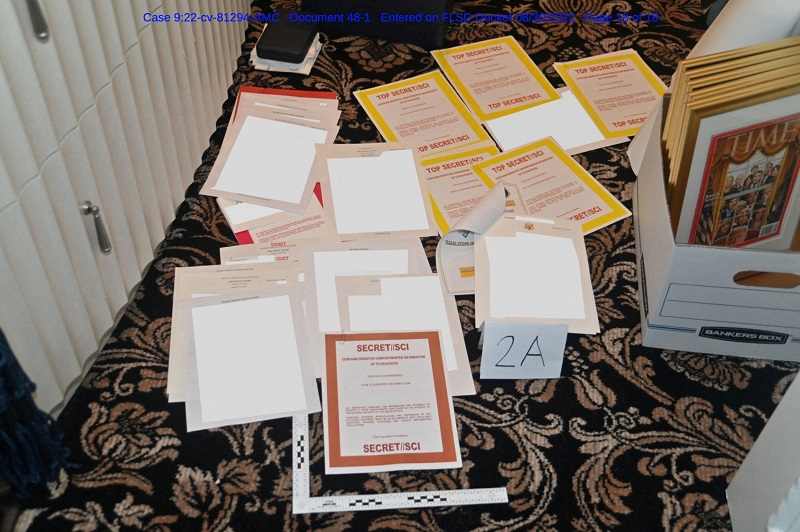
A redacted FBI photograph of documents and classified cover sheets recovered from a container stored in former U.S. president Donald Trump’s Florida estate, and which was included in a U.S. Department of Justice filing and released August 30, 2022.
12:22 JST, December 2, 2022
WASHINGTON (Reuters) – A U.S. appeals court on Thursday dealt a blow to Donald Trump, reversing a judge’s appointment of an independent arbiter to vet documents seized by the FBI from his Florida home and allowing all of the records to be used in a criminal investigation of the former president.
The Atlanta-based 11th Circuit U.S. Court of Appeals ruled in favor of the Justice Department in its challenge to Florida-based U.S. District Judge Aileen Cannon’s September decision to name a “special master” to review the records to decide if some should be kept from investigators.
The three-judge 11th Circuit panel said Cannon lacked the authority to grant Trump’s request for a special master made in a lawsuit he filed two weeks after FBI agents carried out a court-approved Aug. 8 search at his Mar-a-Lago estate in Palm Beach. It also overturned Cannon’s decision to bar investigators from accessing most of the records pending the review and threw out Trump’s suit.
Trump faces a federal criminal investigation into his retention of sensitive government records after leaving office in January 2021, including whether he violated a 1917 law called the Espionage Act that makes it a crime to release information harmful to national security. Investigators also are looking into potential unlawful obstruction of the probe.
FBI agents seized about 11,000 records, including about 100 marked as classified, during the search.
The 11th Circuit said that while a search warrant for a former president’s property is “extraordinary,” it did not give “the judiciary license to interfere in an ongoing investigation.” The court also said Trump did not prove there was a “callous disregard” for his constitutional rights in the search of his property, one of the few reasons a court can intervene in an ongoing investigation.
“The law is clear. We cannot write a rule that allows any subject of a search warrant to block government investigations after the execution of the warrant,” the panel wrote. “Nor can we write a rule that allows only former presidents to do so.”
The 11th Circuit panel consisted of Judge William Pryor, appointed by Republican former President George W. Bush, as well as two of Trump’s own appointees, Judges Andrew Brasher and Britt Grant.
Trump is likely to appeal the 11th Circuit’s action to the conservative-majority U.S. Supreme Court. The 11th Circuit said its order will not take effect for seven days, during which Trump could seek to challenge it.
A Trump spokesperson called the decision “purely procedural and based only on jurisdiction,” and said it did not address the merits of the case.
“President Donald J. Trump will continue to fight against the weaponized Department of ‘Justice,’ while standing for America and Americans,” the spokesperson added.
The news came as top Justice Department officials were gathered for an annual holiday party in Washington. They learned they had won the case from reporters who were also in attendance.
A Justice Department spokesperson declined to comment.
Three days after Trump announced a run for the 2024 Republican presidential nomination, U.S. Attorney General Merrick Garland on Nov. 18 appointed a special counsel, Jack Smith, to oversee the documents criminal investigation and another one also relating to Trump.
Cannon, who was appointed to her judgeship by Trump, named Raymond Dearie, another federal judge, to review the records to consider whether any should be walled off from the criminal investigation.
Cannon also halted prosecutors from using the documents taken in the search as part of their criminal investigation until the conclusion of Dearie’s review, although a separate 11th Circuit panel later gave the government access to the materials marked as classified.
Trump’s lawyers had asked Dearie to find that some documents are protected by executive privilege, a legal doctrine that permits presidents to keep certain communications secret, or meet the definition of “personal” papers that should be kept private. Trump’s lawyers argued that he designated certain records as his personal papers, a claim that the Justice Department disputes.






Most Read
Popular articles in the past 24 hours
-

McDonald's Japan Raises Prices; Big Mac to Cost ¥500, Double Chee...
-

Nepal Bus Crash Kills 19 People, Injures 25 Including One Japanes...
-

Japan’s Nikkei Stock Average Rises as AI-Related Stocks Shine; Co...
-

Aggression against Ukraine: Malignant Precedent Must Not Be Set t...
-

Joruri Bunraku Narrative Performed in Honor of Donald Keene by La...
-

Kanto's 1st Spring Wind Blows as Tokyo Sees Unseasonably High Tem...
-

How Keri Russell's Suede Coach Boots Ended up in My Closet
-

Early-Blooming Kawazu Cherry Blossoms Create Sea of Pink at Park ...
Popular articles in the past week
-

Producer Behind Pop Group XG Arrested for Cocaine Possession
-

Japan PM Takaichi’s Cabinet Resigns en Masse
-

Sanae Takaichi Elected Prime Minister of Japan; Keeps All Cabinet...
-

Japan's Govt to Submit Road Map for Growth Strategy in March, PM ...
-

Bus Carrying 40 Passengers Catches Fire on Chuo Expressway; All E...
-

Japan, U.S. Name 3 Inaugural Investment Projects; Reached Agreeme...
-

Riku-Ryu Pair Wins Gold Medal: Their Strong Bond Leads to Major C...
-

iPS Treatments Pass Key Milestone, but Broader Applications Far f...
Popular articles in the past month
-
Producer Behind Pop Group XG Arrested for Cocaine Possession
-
Japan PM Takaichi’s Cabinet Resigns en Masse
-

Japan Institute to Use Domestic Commercial Optical Lattice Clock ...
-

Man Infected with Measles Reportedly Dined at Restaurant in Tokyo...
-

Israeli Ambassador to Japan Speaks about Japan’s Role in the Reco...
-

Videos Plagiarized, Reposted with False Subtitles Claiming ‘Ryuky...
-

Man Infected with Measles May Have Come in Contact with Many Peop...
-

Prudential Life Insurance Plans to Fully Compensate for Damages C...
Top Articles in News Services
-
Survey Shows False Election Info Perceived as True
-
Hong Kong Ex-Publisher Jimmy Lai’s Sentence Raises International Outcry as China Defends It
-
Japan’s Nikkei Stock Average Touches 58,000 as Yen, Jgbs Rally on Election Fallout (UPDATE 1)
-
Japan’s Nikkei Stock Average Falls as US-Iran Tensions Unsettle Investors (UPDATE 1)
-
Trump Names Former Federal Reserve Governor Warsh as the Next Fed Chair, Replacing Powell
JN ACCESS RANKING
-
Producer Behind Pop Group XG Arrested for Cocaine Possession
-
Japan PM Takaichi’s Cabinet Resigns en Masse
-
Man Infected with Measles Reportedly Dined at Restaurant in Tokyo Station
-
Israeli Ambassador to Japan Speaks about Japan’s Role in the Reconstruction of Gaza
-
Videos Plagiarized, Reposted with False Subtitles Claiming ‘Ryukyu Belongs to China’; Anti-China False Information Also Posted in Japan