
Flamingos Are Stirring up Trouble and Ravaging Rice for Risotto in Italy’s Northeast
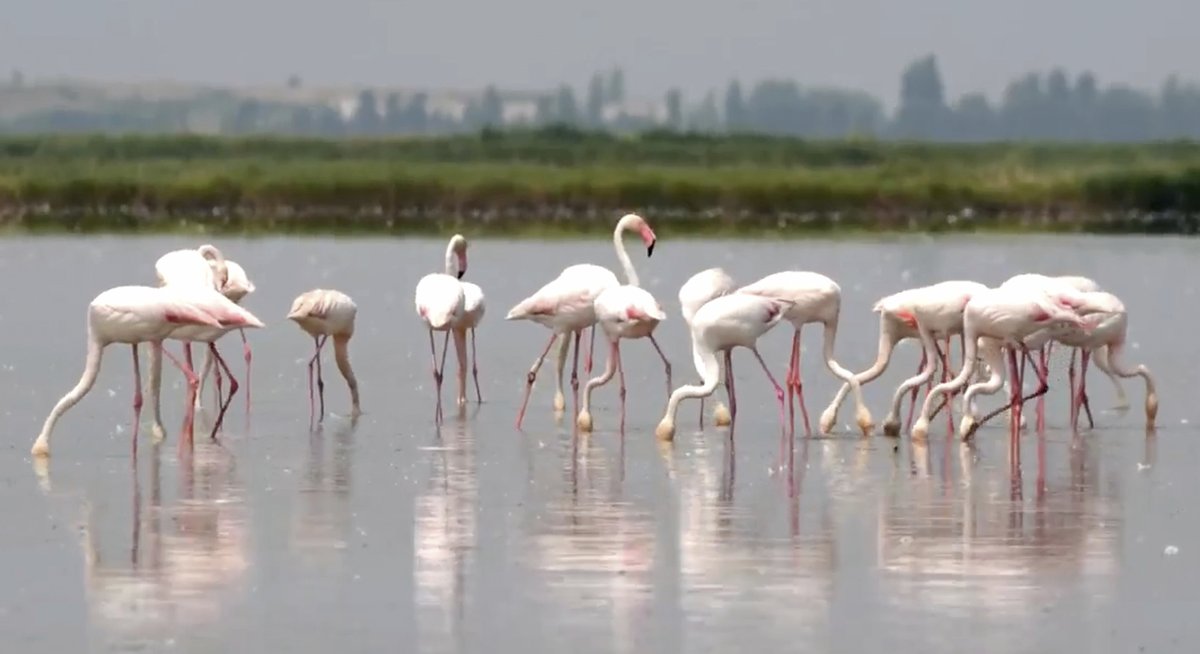
A flock of Flamingos is seen in a flooded field that produce rice for risotto, in Jolanda Di Savoia, Italy, June 11, 2025.
13:41 JST, July 11, 2025
JOLANDA DI SAVOIA, Italy (AP) — An unusual pest is ravaging crops and irking farmers in northeastern Italy: the flamingo.
Flocks of these relatively recent immigrants have set their hungry sights on the flooded fields that produce rice for risotto in Ferrara province, between Venice and Ravenna. The long-legged birds aren’t interested in the seedlings; rather, flamingos use their webbed feet to stir up the soil and snatch mollusks, algae or insects from the shallow water.
Rice is collateral damage.
Farmers have started patroling day and night in a bid to scare the birds away. They honk their trucks’ horns, bang barrels and even fire small gas cannons that make thunderous booms. Mostly, the noise just sends them flying to another nearby rice paddy to be trampled underfoot.
Enrico Fabbri, a local grower, said he is discouraged after seeing production losses of as much as 90% in some of his planted areas.
“These are new things that have never happened before. You invest so much time and care into preparing everything,” Fabbri, 63, said beside one of his paddies on the outskirts of Jolanda di Savoia. “Then, just as the crop begins to grow, it’s like having a newborn child taken away. That’s what it feels like.”
The flamingos appear to have come from their prior nesting grounds in the nearby Comacchio Valleys within a reserve on the coast, just south of where the Po River, Italy’s longest, flows into the Adriatic Sea.
The birds have been there since 2000, after drought in southern Spain sent them searching for nesting grounds further east, according to Roberto Tinarelli, ornithologist and president of the Emilia-Romagna Ornithologists Association.
Previously, they had been confined to lakes in North Africa, parts of Spain and a bit of France’s Camargue region, Tinarelli, 61, said beside a pond in Bentivolgio, a town near Bologna.
There have been no studies yet to determine why these flamingos started seeking food further inland, where farmers flood their fields from late spring to early summer as a means of germinating newly planted rice seeds. Until the paddies are drained after a few weeks, the flamingos are a threat.
“Obviously, we are looking for answers from those who have to deal with the problem. From an environmental point of view, all this is beautiful, but we must keep in mind that rice cultivation is among the most expensive, extensive crops,” said Massimo Piva, a 57-year-old rice grower and vice-president of the local farmers’ confederation.
“They are beautiful animals, it’s their way of moving and behaving, but the problem is trying to limit their presence as much as possible,” Piva said.
Tinarelli, the ornithologist, suggested several solutions to fend off flamingos that are more humane and effective than the clamorous efforts currently employed: surrounding paddies with tall trees or hedges and, even better, reducing water levels of freshly planted paddies to between 2 and 4 inches (5 and 10 centimeters), instead of 12 inches (30 centimeters).
“This is sufficient for the rice to grow, but decidedly less attractive to flamingos, which must splash around in the water,” he said.








Most Read
Popular articles in the past 24 hours
-

McDonald's Japan Raises Prices; Big Mac to Cost ¥500, Double Chee...
-

Nepal Bus Crash Kills 19 People, Injures 25 Including One Japanes...
-

Japan’s Nikkei Stock Average Rises as AI-Related Stocks Shine; Co...
-

Aggression against Ukraine: Malignant Precedent Must Not Be Set t...
-

Joruri Bunraku Narrative Performed in Honor of Donald Keene by La...
-

Milano Cortina 2026: Gold Medal Olympic Figure Skaters Riku Miura...
-

Kanto's 1st Spring Wind Blows as Tokyo Sees Unseasonably High Tem...
-

How Keri Russell's Suede Coach Boots Ended up in My Closet
Popular articles in the past week
-

Producer Behind Pop Group XG Arrested for Cocaine Possession
-

Japan PM Takaichi’s Cabinet Resigns en Masse
-

Sanae Takaichi Elected Prime Minister of Japan; Keeps All Cabinet...
-

Japan's Govt to Submit Road Map for Growth Strategy in March, PM ...
-

Bus Carrying 40 Passengers Catches Fire on Chuo Expressway; All E...
-

Japan, U.S. Name 3 Inaugural Investment Projects; Reached Agreeme...
-

Riku-Ryu Pair Wins Gold Medal: Their Strong Bond Leads to Major C...
-

iPS Treatments Pass Key Milestone, but Broader Applications Far f...
Popular articles in the past month
-
Producer Behind Pop Group XG Arrested for Cocaine Possession
-
Japan PM Takaichi’s Cabinet Resigns en Masse
-

Japan Institute to Use Domestic Commercial Optical Lattice Clock ...
-

Man Infected with Measles Reportedly Dined at Restaurant in Tokyo...
-

Israeli Ambassador to Japan Speaks about Japan’s Role in the Reco...
-

Videos Plagiarized, Reposted with False Subtitles Claiming ‘Ryuky...
-

Man Infected with Measles May Have Come in Contact with Many Peop...
-

Prudential Life Insurance Plans to Fully Compensate for Damages C...
Top Articles in News Services
-

Survey Shows False Election Info Perceived as True
-

Hong Kong Ex-Publisher Jimmy Lai’s Sentence Raises International Outcry as China Defends It
-
Japan’s Nikkei Stock Average Touches 58,000 as Yen, Jgbs Rally on Election Fallout (UPDATE 1)
-
Japan’s Nikkei Stock Average Falls as US-Iran Tensions Unsettle Investors (UPDATE 1)
-

Trump Names Former Federal Reserve Governor Warsh as the Next Fed Chair, Replacing Powell
JN ACCESS RANKING
-
Producer Behind Pop Group XG Arrested for Cocaine Possession
-
Japan PM Takaichi’s Cabinet Resigns en Masse
-
Man Infected with Measles Reportedly Dined at Restaurant in Tokyo Station
-
Israeli Ambassador to Japan Speaks about Japan’s Role in the Reconstruction of Gaza
-
Videos Plagiarized, Reposted with False Subtitles Claiming ‘Ryukyu Belongs to China’; Anti-China False Information Also Posted in Japan