
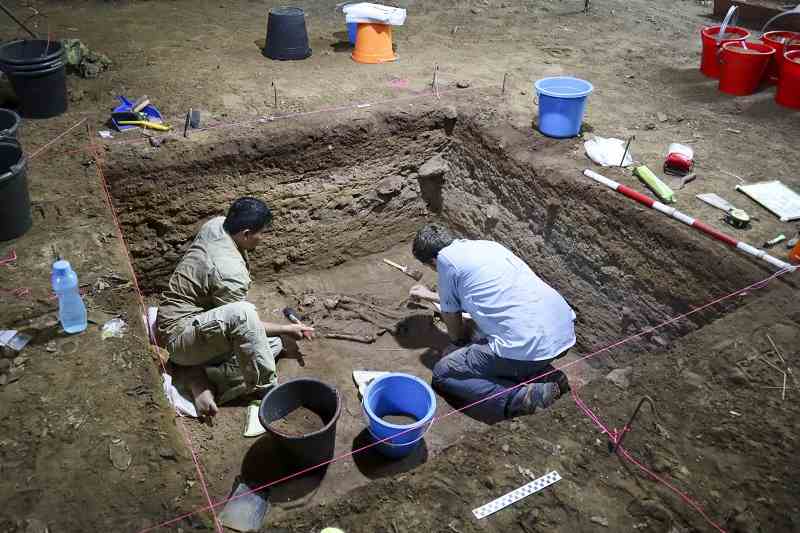
Dr Tim Maloney and Andika Priyatno work at the site in a cave in East Kalimantan, Borneo, Indonesia, March 2, 2020.
12:19 JST, September 8, 2022
NEW YORK (AP) — The 31,000-year-old skeleton of a young adult found in a cave in Indonesia that is missing its left foot and part of its left leg reveal the oldest known evidence of an amputation, according to a new study.
Scientists say the amputation was performed when the person was a child — and that the “patient” went on to live for years as an amputee. The prehistoric surgery could show that humans were making medical advances much earlier than previously thought, according to the study published Wednesday in the journal Nature.
Researchers were exploring a cave in Borneo, in a rainforest region known for having some of the earliest rock art in the world, when they came across the grave, said Tim Maloney, an archaeologist at Griffith University in Australia and the study’s lead researcher.
Though much of the skeleton was intact, it was missing its left foot and the lower part of its left leg, he explained. After examining the remains, the researchers concluded the foot bones weren’t missing from the grave, or lost in an accident — they were carefully removed.
The remaining leg bone showed a clean, slanted cut that healed over, Maloney said. There were no signs of infection, which would be expected if the child had gotten its leg bitten off by a creature like a crocodile. And there were also no signs of a crushing fracture, which would have been expected if the leg had snapped off in an accident.
The person appears to have lived for around six to nine more years after losing the limb, eventually dying from unknown causes as a young adult, researchers say.
This shows that the prehistoric foragers knew enough about medicine to perform the surgery without fatal blood loss or infection, the authors concluded. Researchers don’t know what kind of tool was used to amputate the limb, or how infection was prevented — but they speculate that a sharp stone tool may have made the cut, and point out that some of the rich plant life in the region has medicinal properties.
Also, the community would have had to care for the child for years afterward, since surviving the rugged terrain as an amputee wouldn’t have been easy.
This early surgery “rewrites the history of human medical knowledge and developments,” Maloney said at a press briefing.
Before this find, the earliest example of amputation had been in a French farmer from 7,000 years ago, who had part of his forearm removed. Scientists had thought that advanced medical practices developed around 10,000 years ago, as humans settled down into agricultural societies, the study authors said.
But this study adds to growing evidence that humans started caring for each other’s health much earlier in their history, said Alecia Schrenk, an anthropologist at the University of Nevada, Las Vegas, who was not involved with the study.
“It had long been assumed healthcare is a newer invention,” Schrenk said in an email. “Research like this article demonstrates that prehistoric peoples were not just left to fend for themselves.”








Most Read
Popular articles in the past 24 hours
-

Japan Seeks to Counter China's Expanding Influence in Pacific by ...
-

Exhibition Featuring Yoshiharu Tsuge’s Manga World Underway in Ch...
-

Tokyo Skytree Observation Deck Remains Closed for Inspection afte...
-

Impact on Japanese Economy Unclear with Trump’s New Tariffs, Shif...
-

Japanese Watermelon Shipments Starts in Leading Production Distri...
-

Takeshima Day: Persistently Demanding Resolution from South Korea...
-

Hanzomon Line Service Suspended between Kudanshita, Oshiage Stati...
-

Japan's Services Inflation Steady, Signals Wage-Driven Price Pres...
Popular articles in the past week
-

Producer Behind Pop Group XG Arrested for Cocaine Possession
-

Japan, U.S. Name 3 Inaugural Investment Projects; Reached Agreeme...
-

iPS Treatments Pass Key Milestone, but Broader Applications Far f...
-

Tokyo Skytree's Elevator Stops, Trapping 20 People; All Rescued (...
-

Director Naomi Kawase's New Film Explores Heart Transplants in Ja...
-

Japan’s Major Real Estate Firms Expanding Overseas Businesses to ...
-

Milano Cortina 2026: Japan’s Mari Fukada Wins Gold in Women’s Sno...
-

Milano Cortina 2026: Japanese Figure Skater Kaori Sakamoto’...
Popular articles in the past month
-
Producer Behind Pop Group XG Arrested for Cocaine Possession
-

Japan PM Takaichi’s Cabinet Resigns en Masse
-

Japan Institute to Use Domestic Commercial Optical Lattice Clock ...
-

Man Infected with Measles Reportedly Dined at Restaurant in Tokyo...
-

Israeli Ambassador to Japan Speaks about Japan’s Role in the Reco...
-

Videos Plagiarized, Reposted with False Subtitles Claiming ‘Ryuky...
-

Man Infected with Measles May Have Come in Contact with Many Peop...
-

Prudential Life Insurance Plans to Fully Compensate for Damages C...
Top Articles in News Services
-

Survey Shows False Election Info Perceived as True
-

Hong Kong Ex-Publisher Jimmy Lai’s Sentence Raises International Outcry as China Defends It
-

Japan’s Nikkei Stock Average Touches 58,000 as Yen, Jgbs Rally on Election Fallout (UPDATE 1)
-
Japan’s Nikkei Stock Average Falls as US-Iran Tensions Unsettle Investors (UPDATE 1)
-

Trump Names Former Federal Reserve Governor Warsh as the Next Fed Chair, Replacing Powell
JN ACCESS RANKING
-
Producer Behind Pop Group XG Arrested for Cocaine Possession
-
Japan PM Takaichi’s Cabinet Resigns en Masse
-
Man Infected with Measles Reportedly Dined at Restaurant in Tokyo Station
-
Israeli Ambassador to Japan Speaks about Japan’s Role in the Reconstruction of Gaza
-
Videos Plagiarized, Reposted with False Subtitles Claiming ‘Ryukyu Belongs to China’; Anti-China False Information Also Posted in Japan