
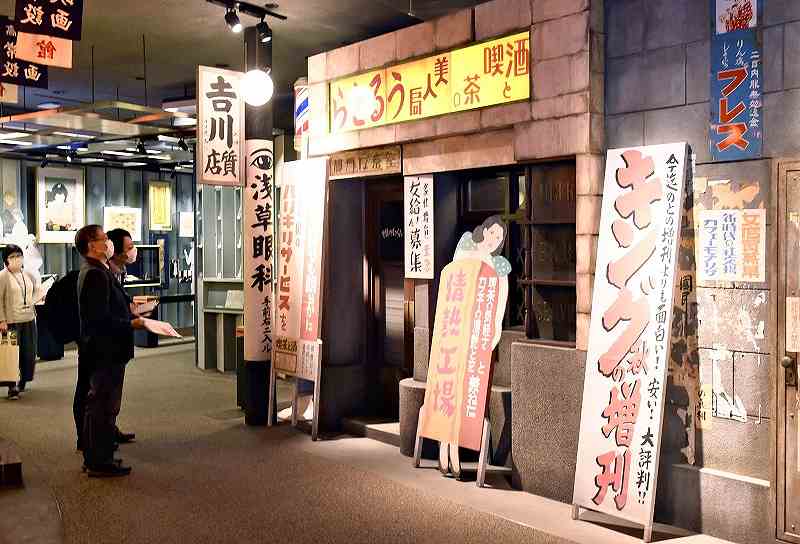
Reproduced street views of what is said to be Tokyo’s Asakusa district in the 1920s can give visitors a glimpse into the past.
9:00 JST, January 1, 2023
SAKURA, Chiba — Life-size replicas of a retro theater counter, a barbershop and a cafe await visitors to the National Museum of Japanese History in Sakura, Chiba Prefecture. Apparently, the nostalgia-packed scenes are reproductions of street views in and around Tokyo’s Asakusa district in the 1920s.
In Gallery 5 of the museum, lifestyles of the Japanese between the latter half of the 19th century and the 1920s are introduced in three corners based on themes of “Civilization and Enlightenment,” “Industrialization and Development of Hokkaido” and “A New Urban Lifestyle.”
Hiroshi Yokoo, assistant chief of the museum’s publicity service section, said, “The main feature is relatively large diorama replicas.”
Many efforts are made so that visitors can appreciate how people lived in those years. The displays are so popular that some visitors take selfies standing in front of the dioramas.
One popular display is the entrance of a bygone movie theater. For the people living in those years, watching stage dramas and movies was the most attractive kind of entertainment. Hearing that, visitors should imagine a scene where a large number of people are enthusiastically gathered around the movie theater to see talked-about movies.
I was guided to Gallery 6, which is based on two themes — “War and Peace” and “The Postwar Lifestyle Revolution.”
Another highly popular spot in this museum is a full-size reconstruction of a “danchi” housing complex unit. The real ones were built by the now-defunct Japan Housing Corporation.
In this display, visitors will find a washing machine that was manufactured in 1962, a refrigerator and an electric rice cooker, among other things. They are all positioned in harmony with the atmosphere of the housing unit, giving visitors a vivid representation of how people lived in those years.
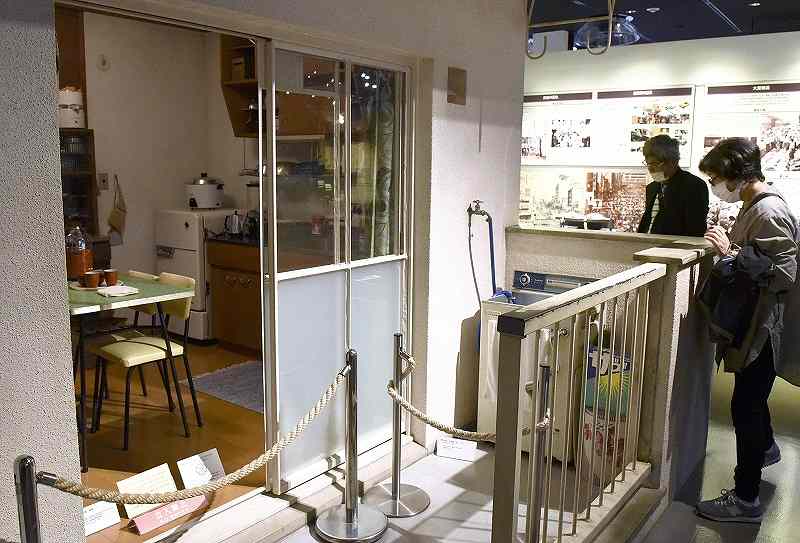
A reconstruction of a “danchi” housing complex unit built by the now-defunct Japan Housing Corporation. The replica apartment includes a washing machine made in 1962.
There are a total of six permanent exhibition galleries in the museum. A point of pride for the museum is that it houses a wide range of collections not only from modern years.
What is very impressive is the replica of a Naumann elephant in Gallery 1 that stands about 3.5 meters tall. It was produced using part of a skull excavated in Narita, Chiba Prefecture, and other items as references.
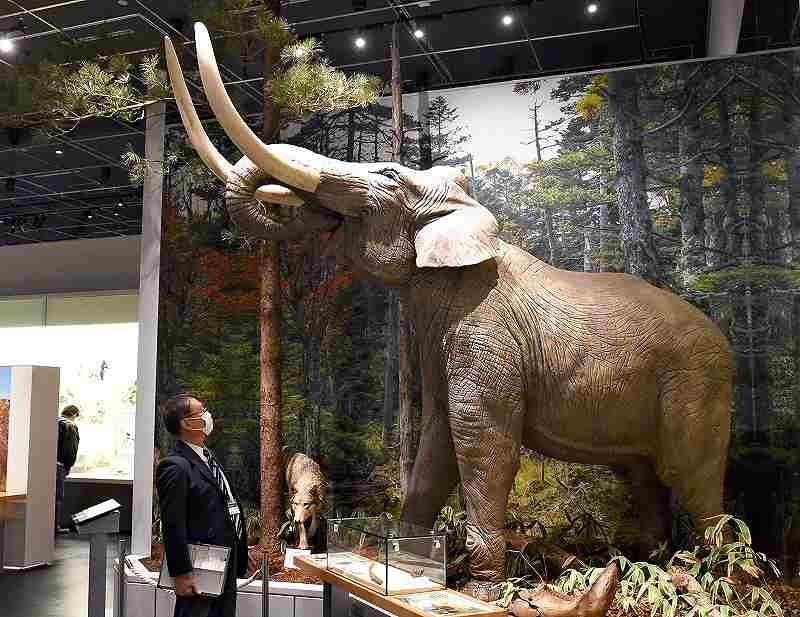
A replica of a Naumann elephant, which debuted in 2019 after the museum was refurbished
In Gallery 3 is a very tall road sign about 4 meters high. The road sign is a replica of one that stood at a crossing of the Tokaido and Nakasendo roads. The real one is in a former post station in Kusatsu, Shiga Prefecture.
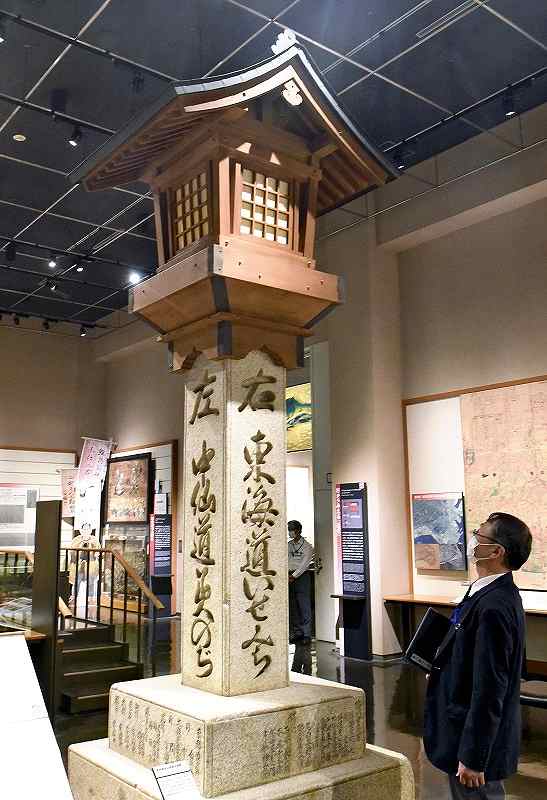
A replica of a road sign at a crossing of the Tokaido and Nakasendo roads
The total floor space of the galleries is about 8,900 square meters. Viewing all of the items on display at the museum involves walking more than 3 kilometers.
Yokoo said: “It’s impossible to sufficiently view all of them in a single day. I want people to visit here two or three times.”
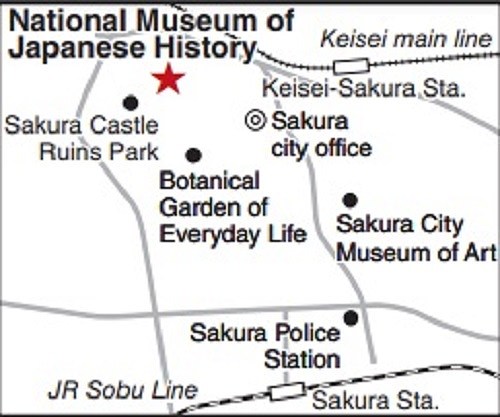
National Museum of Japanese History
The museum opened in 1983. It is next to the Sakura Castle Ruins Park, which is famous as a location for viewing cherry blossoms.
Address: 117 Jonaicho, Sakura, Chiba Prefecture
Hours: 9:30 a.m. to 5 p.m. from March to September. 9:30 a.m. to 4:30 p.m. from October to February. Closed on Mondays (the following day if Monday is a national holiday) and during the year-end and New Year periods.
Admission: ¥600 for adults, ¥250 for university students and free for high school students or younger.


Related Tags


Most Read
Popular articles in the past 24 hours
-

Japan Figure Skating Legend Yuzuru Hanyu Is Proud Disaster Surviv...
-
Hawaii Museum on Tsunami Including Japan's 2011 Disaster at Risk ...
-

Japan Train Company to Increase Fares, Including in Tokyo Metropo...
-

Struggling Onosato Pulls out of Spring Tourney
-

Japan’s Mitsui O.S.K. Lines Container Ship Anchored in Persian Gu...
-

Tail of ANA Plane Struck Runway During Landing in Houston; No Inj...
-

Iran Targets Busiest International Airport as Top UN Body Demands...
-

Samurai Japan Holds First Practice in Miami; Team Will Play again...
Popular articles in the past week
-
Japan Figure Skating Legend Yuzuru Hanyu Is Proud Disaster Surviv...
-

Nippon Life Insurance's U.S. Arm Sues OpenAI Over Legal Assistanc...
-

Ibaraki Pref.'s 1st Foreign Bus Driver Hired in Tsukuba
-
Govt to Utilize ODA for Ensuring Economic Security; Securing Ener...
-
Massive Sewer Pipe Found Jutting Out of Highway in Osaka
-

Amid Strait of Hormuz Blockade, Shipping Companies Scramble to Ge...
-
Beckoning Cats Get Makeover to Fit Modern Lifestyles with Sleek D...
-
Japan Govt Survey Finds Just 10% of Workers Want Working Hours to...
Popular articles in the past month
-

Producer Behind Pop Group XG Arrested for Cocaine Possession
-

Japan PM Takaichi’s Cabinet Resigns en Masse
-

Man Infected with Measles Reportedly Dined at Restaurant in Tokyo...
-

Videos Plagiarized, Reposted with False Subtitles Claiming ‘Ryuky...
-

iPS Treatments Pass Key Milestone, but Broader Applications Far f...
-

Sanae Takaichi Elected Prime Minister of Japan; Keeps All Cabinet...
-

Nepal Bus Crash Kills 19 People, Injures 25 Including One Japanes...
-
South Korea Tightens Rules on Foreigners Buying Homes in Seoul Me...
Top Articles in Features
-
Tokyo’s New Record-Breaking Fountain Named ‘Tokyo Aqua Symphony’
-
High-Hydration Bread on the Rise, Seeing Increase in Specialty Shops, Recipe Searches
-
Japanese Students Use Traditional Pickle to Create Novel Wagashi Confectionery
-
Heirs to Kyoto Talent: Craftsman Works to Keep Tradition of ‘Kinran’ Brocade Alive Through Initiatives, New Creations
-

My Spendthrift Mother Constantly Asks Me for Money
JN ACCESS RANKING
-
Producer Behind Pop Group XG Arrested for Cocaine Possession
-
Japan PM Takaichi’s Cabinet Resigns en Masse
-
Man Infected with Measles Reportedly Dined at Restaurant in Tokyo Station
-
Videos Plagiarized, Reposted with False Subtitles Claiming ‘Ryukyu Belongs to China’; Anti-China False Information Also Posted in Japan
-
iPS Treatments Pass Key Milestone, but Broader Applications Far from Guaranteed