
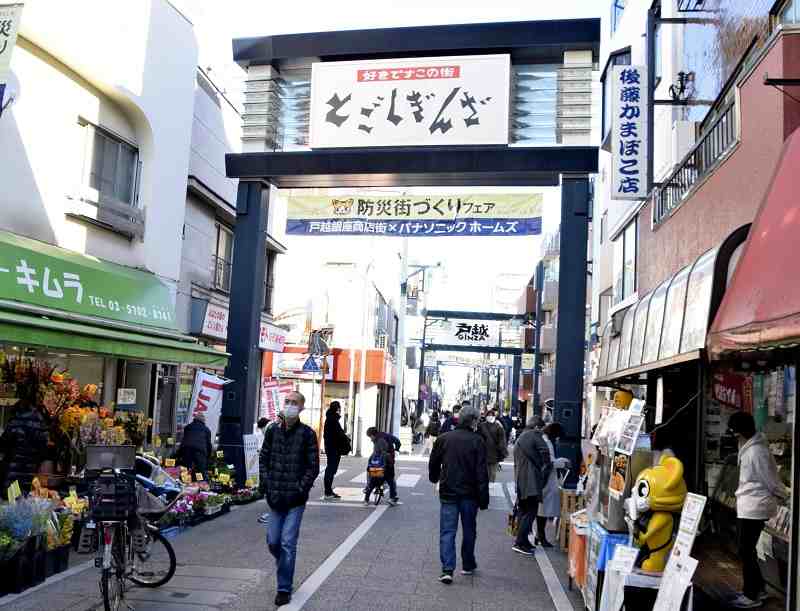
The Togoshi-Ginza shopping street in Shinagawa Ward, Tokyo, which is 1.3 kilometers long
16:36 JST, March 9, 2021
Tokyo has quite a few shopping streets named after Ginza — the foremost commercial district in the capital’s Chuo Ward — such as Jujo-Ginza, Sunamachi-Ginza and Chofu-Ginza, to name but a few. Togoshi-Ginza is another example and looking into the history of the shopping street in Togoshi, Shinagawa Ward, reveals the connection between this place and the original Ginza.
The train station closest to Togoshi-Ginza is Togoshi-Ginza Station on the Tokyu Ikegami Line, which is operated by Tokyu Railway Co. A chronicle of the first 50 years of the company published in 1973 explains the history of the station’s name, saying, “[The station] was named after the busy shopping street, Togoshi-Ginza.” It is not clear when the area began to be called Togoshi-Ginza, but descriptions in the chronicle indicate that the name was already recognized by the 1920s.
The current Togoshi-Ginza shopping district is managed by three local shopping center promotion associations. The 1.3-kilometer-long street is lined by about 350 shops, including greengrocers, butchers, stationery shops and laundries, many of them with a somewhat nostalgic aesthetic. A monument on the street displays two bricks in faded reddish brown, sealed in glass.
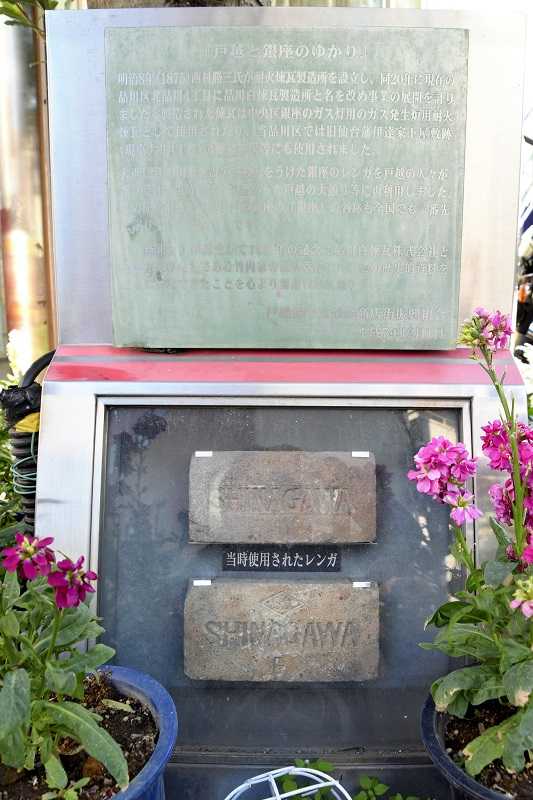
Two bricks on display along Togoshi-Ginza shopping street tell of its historical connection with Ginza in Chuo Ward, Tokyo.
“These bricks are a testament to the street’s connection with Ginza,” said Toshio Yamamura, 72, the chairman of the Togoshi-Ginza Shotengai Rengokai association, which was formed by the three shopping center promotion associations.
Geographically, the town of Togoshi is a basin. Many of its streets rise at both ends.
“This place did not drain well back then, and the residents apparently found it difficult walk on pebbled streets whenever it rained,” said Tetsuro Kamei, 57, who runs a jewelry and watch shop along Togoshi-Ginza street, speaking of the 1920s when his grandfather started a business there.
Having learned of this problem, a brick company came to the rescue. Shinagawa Shirorenga was the supplier of bricks for Ginza, where the townscape of brick buildings was destroyed in the 1923 Great Kanto Earthquake. The company suggested to Togoshi that the streets in its shopping district be paved with bricks, using a large amount from their stock as well as brick debris from the quake. The bricks donated to the town by the company were used to pave the shopping street. Based on this whole process, the name of the town was combined with Ginza to name the street Togoshi-Ginza, or so it is said.
The bricks used for the pavement are all gone now because they were removed during roadwork. The two bricks on display, which have been there since 1995, are believed to be of the same type. They were offered to the town by Shinagawa Refractories Co., the successor of Shinagawa Shirorenga, which found a few of them in the company’s storage facility in Fukushima Prefecture.
The 1923 earthquake affected the circumstances surrounding the shopping street as well. According to the 2014 edition of Shinagawa Ward’s official history book, the area around Togoshi at the time of the quake did not suffer much serious damage from the disaster. Therefore, many people who lost their homes in the catastrophe moved in, increasing the population of the area, which subsequently thrived.
In 2003, the National Federation of Shopping Center Promotion Associations carried out a survey on 13,259 shopping streets and districts across the country. It found that there were 345 shopping streets that included the word “Ginza.” Togoshi-Ginza is believed to be the first, although there is no official record.


Related Tags


Most Read
Popular articles in the past 24 hours
-
Japan Govt to Tighten Requirements to Receive Permanent Residency...
-
‘King Kazu’ Discusses His Connection to Fukushima
-
JR Tokai Breaks Ground on Yamanashi Maglev Station; Will Be Part ...
-

Tail of ANA Plane Struck Runway During Landing in Houston; No Inj...
-

Medical Care at Home and Disasters: Ensure Systems to Provide Con...
-

Samurai Japan Holds First Practice in Miami; Team Will Play again...
-

CARTOON OF THE DAY (March 12)
-

White House Takes First Step toward Permanent Fix for Illegal Tar...
Popular articles in the past week
-

Japan Figure Skating Legend Yuzuru Hanyu Is Proud Disaster Surviv...
-

Nippon Life Insurance's U.S. Arm Sues OpenAI Over Legal Assistanc...
-
Govt to Utilize ODA for Ensuring Economic Security; Securing Ener...
-
Massive Sewer Pipe Found Jutting Out of Highway in Osaka
-
Beckoning Cats Get Makeover to Fit Modern Lifestyles with Sleek D...
-
Japan Govt Survey Finds Just 10% of Workers Want Working Hours to...
-
Japan's 2nd Round of U.S. Investments May Be Worth Over $100 Bill...
-

Imperial Family Watches World Baseball Classic Game Against Austr...
Popular articles in the past month
-

Producer Behind Pop Group XG Arrested for Cocaine Possession
-

Japan PM Takaichi’s Cabinet Resigns en Masse
-

Man Infected with Measles Reportedly Dined at Restaurant in Tokyo...
-

Videos Plagiarized, Reposted with False Subtitles Claiming ‘Ryuky...
-
Japan Figure Skating Legend Yuzuru Hanyu Is Proud Disaster Surviv...
-

iPS Treatments Pass Key Milestone, but Broader Applications Far f...
-

Sanae Takaichi Elected Prime Minister of Japan; Keeps All Cabinet...
-

Nepal Bus Crash Kills 19 People, Injures 25 Including One Japanes...
Top Articles in Features
-
Tokyo’s New Record-Breaking Fountain Named ‘Tokyo Aqua Symphony’
-

High-Hydration Bread on the Rise, Seeing Increase in Specialty Shops, Recipe Searches
-
Japanese Students Use Traditional Pickle to Create Novel Wagashi Confectionery
-

My Spendthrift Mother Constantly Asks Me for Money
-
Heirs to Kyoto Talent: Craftsman Works to Keep Tradition of ‘Kinran’ Brocade Alive Through Initiatives, New Creations
JN ACCESS RANKING
-
Producer Behind Pop Group XG Arrested for Cocaine Possession
-
Japan PM Takaichi’s Cabinet Resigns en Masse
-
Man Infected with Measles Reportedly Dined at Restaurant in Tokyo Station
-
Videos Plagiarized, Reposted with False Subtitles Claiming ‘Ryukyu Belongs to China’; Anti-China False Information Also Posted in Japan
-
Japan Figure Skating Legend Yuzuru Hanyu Is Proud Disaster Survivor and Gold Medalist, Vows to Continue Support Efforts