
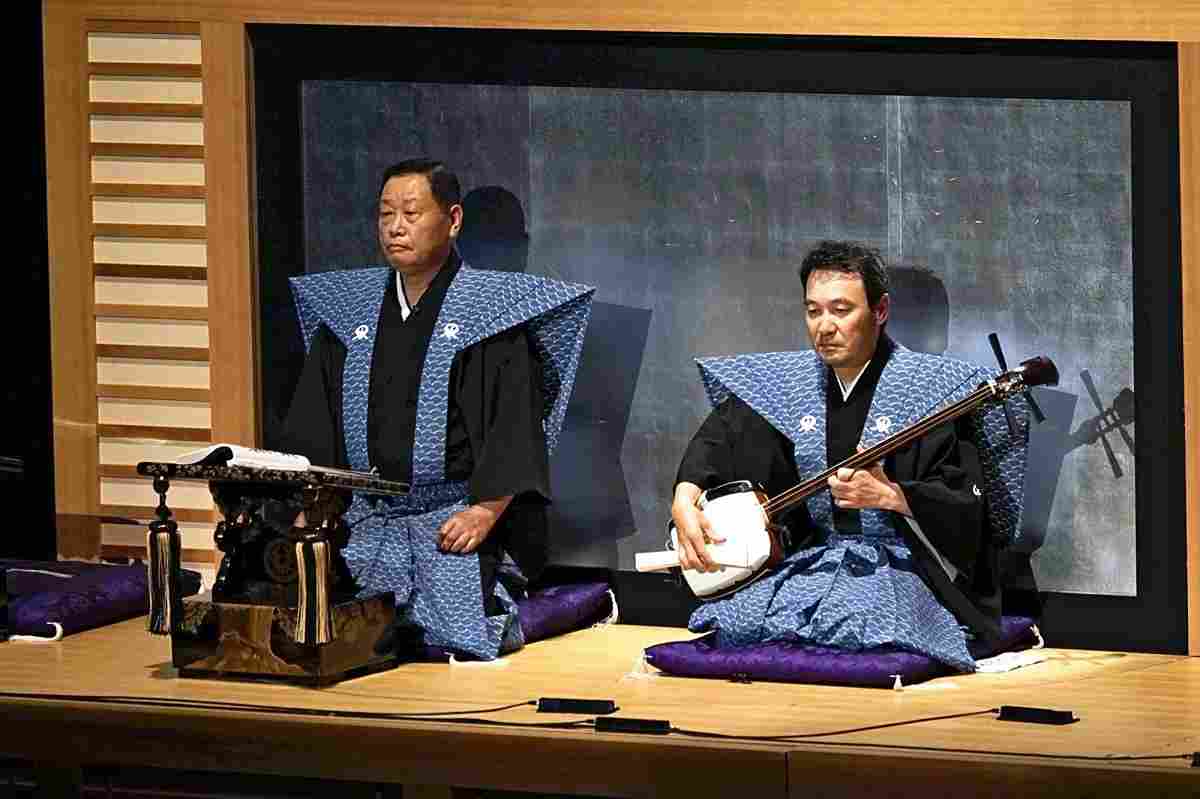
A tayu narrator and a shamisen player perform a scene from a traditional Nose joruri piece in June 2019.
18:28 JST, March 5, 2021
OSAKA — Long a prosperous economic and cultural hub, Osaka is home to many traditional folk performing arts. The skills necessary to perform these arts need to be taught to younger generations to keep the tradition alive. In recent years, however, the lack of successors has placed groups that work to preserve such arts in a difficult position.
Practitioners of joruri shamisen-accompanied narrative ballads have been searching for new ways in which to carry on the art form, especially as the opportunities to practice and perform have become fewer amid the novel coronavirus pandemic.
The National Bunraku Theater in Chuo Ward, Osaka, is famous throughout the country for its puppet theater joruri performances. This art form has spread throughout Osaka Prefecture to the remote town of Nose in the north.
Traditional Nose joruri was known as su-joruri — joruri without puppets — and featured stories told by a tayu narrator accompanied by a shamisen player. The people of Nose started their joruri more than 200 years ago, when a villager who had trained in storytelling in central Osaka brought the art form back to his hometown.
Today, Nose joruri has four separate schools, each run by an oyaji, or father figure, who looks after his successors.
According to Isao Okamoto, 74, who served as the Takemoto Izutsudayu School’s oyaji, joruri was so popular in the town up until the beginning of the Showa period (1926-1989) that almost all the local young people belonged to one of the four schools.
“If you can’t discuss joruri, I’m not letting you marry my daughter,” was a common phrase at the time, he said.
However, finding successors to carry on the tradition isn’t easy now because the youth of today are busy with either work or school.
The Nose town government has made efforts to promote the art form’s appeal. The Joruri Theater, established in 1993, began holding not only su-joruri performances but also ningyo joruri puppet theater in 1998 in an attempt to boost its acclaim.
Okamoto serves as the head of the Ningyo-Joruri Rokkaku-za theater company that has been established and bases its operations in the theater, performing there annually. The troupe is also invited to perform at events in various places outside the prefecture about 20 times a year.
“I want to hand down the joruri spirit to the next generation by blending the old with the new to keep up with the times,” Okamoto said.

Mascot characters Ojyo, left, and Ruririn were created to promote Nose joruri.
Two mascot characters, Ojyo and Ruririn, were created prior to the coronavirus outbreak as a way of getting the younger generation interested in Nose joruri. Puppets made in the image of these high school student characters who love Nose joruri have been used in performances. Key chains and other merchandise featuring the duo are also available.
“Although joruri has quite a rigid image as a classical art form, there are also original performances that incorporate the names of famous spots and scenery that can be found in Nose, making it even more enjoyable,” said Motoko Mizohata, 27, a member of the theater company, who has been playing the shamisen since she was in the fourth grade of elementary school. She is now a homemaker in Fukuoka Prefecture, but intends to perform again should she return to the Kansai region.
The troupe’s performance in June last year was canceled amid the pandemic. Even though the troupe members have been unable to adequately rehearse together, the theater is looking to publicize the troupe by streaming online videos of past performances.


Related Tags




Most Read
Popular articles in the past 24 hours
-

Japan Govt to Tighten Requirements to Receive Permanent Residency...
-

‘King Kazu’ Discusses His Connection to Fukushima
-
JR Tokai Breaks Ground on Yamanashi Maglev Station; Will Be Part ...
-

Tail of ANA Plane Struck Runway During Landing in Houston; No Inj...
-

Medical Care at Home and Disasters: Ensure Systems to Provide Con...
-

Samurai Japan Holds First Practice in Miami; Team Will Play again...
-

CARTOON OF THE DAY (March 12)
-

White House Takes First Step toward Permanent Fix for Illegal Tar...
Popular articles in the past week
-
Japan Figure Skating Legend Yuzuru Hanyu Is Proud Disaster Surviv...
-

Nippon Life Insurance's U.S. Arm Sues OpenAI Over Legal Assistanc...
-
Govt to Utilize ODA for Ensuring Economic Security; Securing Ener...
-

Massive Sewer Pipe Found Jutting Out of Highway in Osaka
-
Beckoning Cats Get Makeover to Fit Modern Lifestyles with Sleek D...
-
Japan Govt Survey Finds Just 10% of Workers Want Working Hours to...
-
Japan's 2nd Round of U.S. Investments May Be Worth Over $100 Bill...
-

Imperial Family Watches World Baseball Classic Game Against Austr...
Popular articles in the past month
-

Producer Behind Pop Group XG Arrested for Cocaine Possession
-

Japan PM Takaichi’s Cabinet Resigns en Masse
-

Man Infected with Measles Reportedly Dined at Restaurant in Tokyo...
-

Videos Plagiarized, Reposted with False Subtitles Claiming ‘Ryuky...
-
Japan Figure Skating Legend Yuzuru Hanyu Is Proud Disaster Surviv...
-

iPS Treatments Pass Key Milestone, but Broader Applications Far f...
-

Sanae Takaichi Elected Prime Minister of Japan; Keeps All Cabinet...
-

Nepal Bus Crash Kills 19 People, Injures 25 Including One Japanes...
Top Articles in Features
-

Tokyo’s New Record-Breaking Fountain Named ‘Tokyo Aqua Symphony’
-

High-Hydration Bread on the Rise, Seeing Increase in Specialty Shops, Recipe Searches
-
Japanese Students Use Traditional Pickle to Create Novel Wagashi Confectionery
-

My Spendthrift Mother Constantly Asks Me for Money
-
Heirs to Kyoto Talent: Craftsman Works to Keep Tradition of ‘Kinran’ Brocade Alive Through Initiatives, New Creations
JN ACCESS RANKING
-
Producer Behind Pop Group XG Arrested for Cocaine Possession
-
Japan PM Takaichi’s Cabinet Resigns en Masse
-
Man Infected with Measles Reportedly Dined at Restaurant in Tokyo Station
-
Videos Plagiarized, Reposted with False Subtitles Claiming ‘Ryukyu Belongs to China’; Anti-China False Information Also Posted in Japan
-
Japan Figure Skating Legend Yuzuru Hanyu Is Proud Disaster Survivor and Gold Medalist, Vows to Continue Support Efforts