
Director Naomi Kawase’s New Film Explores Heart Transplants in Japan, Production Involved Real Patients, Families

The protagonist played by Vicky Krieps, right, talks with children awaiting organ transplants.
7:00 JST, February 19, 2026
A film about the current state of heart transplant surgeries in Japan has been completed in cooperation with actual patients. Director Naomi Kawase’s new work, “Yakushima’s Illusion,” pursued realism through extensive interviews with patients, their families and doctors, who also appeared in the film.
The film was released nationwide in Japan on Feb. 6.
With a shortage of organ donors in Japan, a supporting organization involved in its production has expressed hope the movie will raise awareness about the importance of transplants.
In heart transplants, the heart is removed from a donor who is brain-dead and transplanted into a patient with heart disease. The average waiting period for a transplant in Japan is about four years and one month. Many patients die while waiting, and some opt for transplants overseas.
One catalyst for Kawase’s film project was a series of articles on organ transplantation published by The Yomiuri Shimbun starting in August 2022.
Among the articles, one covered the arrest of an NPO director suspected of arranging unauthorized organ transplants overseas in violation of the Organ Transplant Law; another told the story of a young boy who died while waiting for a heart transplant due to donor shortages and conveyed his family’s feelings. Kawase pasted the articles into her notebook and began drafting the film.
Kawase personally interviewed children awaiting heart transplants, their families and transplant surgeons. She learned that when a donor’s wishes are unknown, the family makes the decision. Kawase reflected, “Transplantation and donation are matters of life and death, and the burden on families is immense. Some people grasp at straws and seek transplants overseas. There are human emotions there, and I wanted to depict that.”
Based on real stories
In the film, actress Vicky Krieps from Luxembourg plays the protagonist, Corry. Arriving from France as a transplant coordinator at a hospital in Kobe, Corry grapples with challenges in reforming hospital attitudes and addressing staff shortages while working with children awaiting transplants, their families and doctors. During that time, a young girl’s condition suddenly deteriorates as she waits for a transplant.
This girl was modeled after a real child from Hokkaido, who was hospitalized in Osaka Prefecture to receive a transplant. She waited for two years and three months but died in 2022 at age 10. Kawase interviewed the girl’s family and gathered details about her daily life in the hospital.
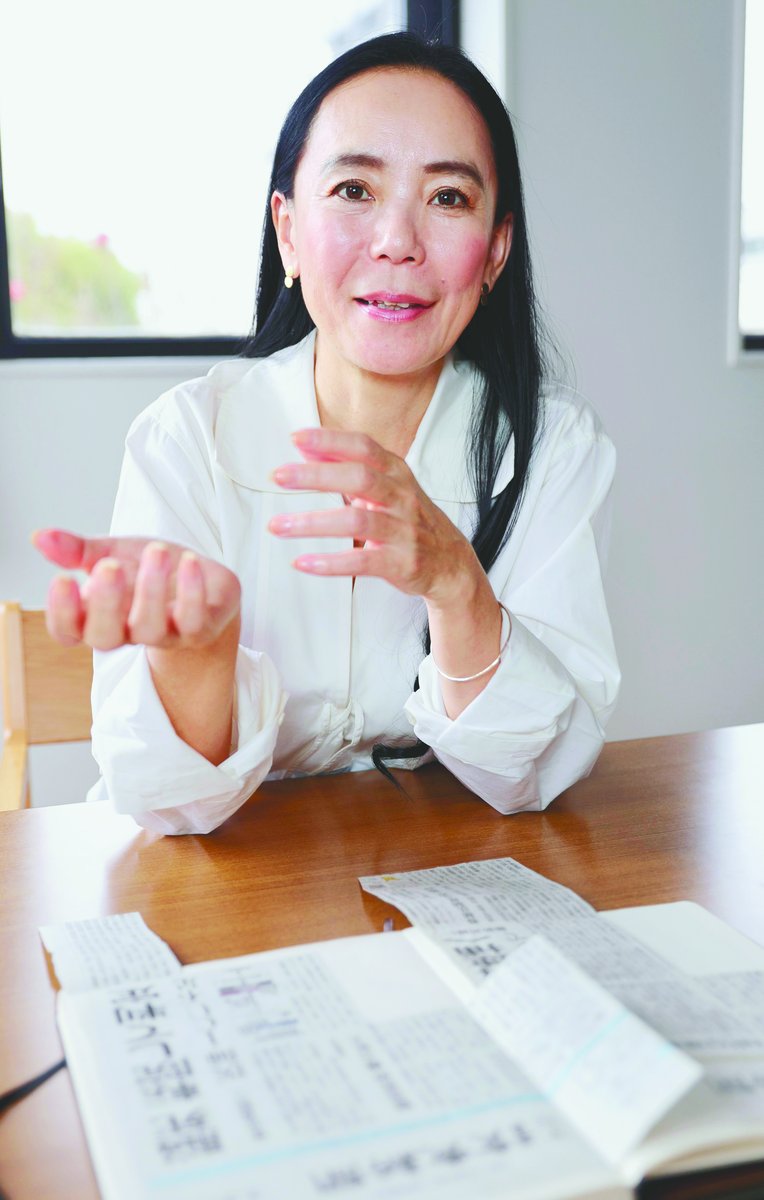
Director Naomi Kawase talks about her new film “Yakushima’s Illusion” in Ashiya, Hyogo Prefecture.
Never giving up hope
Ryoma Aoyama, 45, a company employee from Suita, Osaka Prefecture, whose second daughter Tamaki received a heart transplant in Seattle in 2016, appears in the film as the father of a patient. He serves as the representative of the NPO “Trio Japan” in Tokyo, which supports children awaiting transplants.
He said, “The film carries a message of never giving up hope. I hope it raises awareness about organ donation and transplantation and encourages people to think about it.”
The film also depicts “accompanying hospitalization,” where family members stay overnight with the patient. Actress Machiko Ono plays a supporter who delivers homemade bento boxed meals to these families.
The model for Ono’s character is Tomoko Hata, 49, who runs a bento shop in Suita. She accompanied her eldest son, Shinnosuke, during his hospitalization for a brain tumor before he died in 2022 at age 17. She now delivers bento boxes to families of children awaiting heart transplants.
“Ms. Ono listened to my story with tears in her eyes. I’d be happy if the film helps advance support for these families,” said Hata who had visited the filming location.
“The essence of this film lies in the ‘connection of life’ — how one person’s death connects to another’s life.” Kawase said. “Transplantation isn’t about wishing for someone’s death or taking their organs. I hope more people understand that it’s simply a choice made by potential donors or their families.”




Most Read
Popular articles in the past 24 hours
-
Kesennuma, Miyagi Pref., Locals Raise Carp Streamers as Symbol of...
-

Iran Situation: Significance of Rule of Law Must Be Conveyed
-

Toyota Advancing Plant-Based Biofuel Development in Fukushima Tow...
-

Trump Says Iran Had a New Site for Developing Nuclear Weapons
-

2 People Reportedly Found on Mt. Fuji; Hiking Trail Currently Clo...
-

CARTOON OF THE DAY (March 10)
-
Rapeseed Flowers Reach Peak Viewing Period at Tokyo's Showa Kinen...
-

Memorial Service Marks 81st Anniversary of Tokyo Air Raid; Crown ...
Popular articles in the past week
-

Ibaraki Pref.'s 1st Foreign Bus Driver Hired in Tsukuba
-

Amid Strait of Hormuz Blockade, Shipping Companies Scramble to Ge...
-

Govt to Utilize ODA for Ensuring Economic Security; Securing Ener...
-
Japan Govt Survey Finds Just 10% of Workers Want Working Hours to...
-

Japan's 2nd Round of U.S. Investments May Be Worth Over $100 Bill...
-

Nippon Life Insurance's U.S. Arm Sues OpenAI Over Legal Assistanc...
-

Imperial Family Watches World Baseball Classic Game Against Austr...
-

Beckoning Cats Get Makeover to Fit Modern Lifestyles with Sleek D...
Popular articles in the past month
-

Producer Behind Pop Group XG Arrested for Cocaine Possession
-

Japan PM Takaichi’s Cabinet Resigns en Masse
-

Man Infected with Measles Reportedly Dined at Restaurant in Tokyo...
-

Videos Plagiarized, Reposted with False Subtitles Claiming ‘Ryuky...
-

iPS Treatments Pass Key Milestone, but Broader Applications Far f...
-

Sanae Takaichi Elected Prime Minister of Japan; Keeps All Cabinet...
-

Nepal Bus Crash Kills 19 People, Injures 25 Including One Japanes...
-

South Korea Tightens Rules on Foreigners Buying Homes in Seoul Me...
Top Articles in Culture
-
Traditional Japanese Silk Hakama Tradition Preserved by Sole Weaver in Sendai
-

Exhibition Featuring Yoshiharu Tsuge’s Manga World Underway in Chofu, Tokyo; Unique, Surreal Works Draw Steady Crowds
-
2 Unpublished Early Novellas by Japan’s Kenzaburo Oe Discovered, Show Budding Promise of Future Nobel Prize-Winning Author
-
Japanese Film, Anymart, Wins Critics’ Award at International Film Festival in Berlin, Director’s Debut Feature Film Shocks Audiences
-

New Japanese Animated Film ‘A New Dawn’ Applauded at Berlin International Film Festival; Director Yoshitoshi Shinomiya Also Helped Produce “Your Name.”
JN ACCESS RANKING
-
Producer Behind Pop Group XG Arrested for Cocaine Possession
-
Japan PM Takaichi’s Cabinet Resigns en Masse
-
Man Infected with Measles Reportedly Dined at Restaurant in Tokyo Station
-
Videos Plagiarized, Reposted with False Subtitles Claiming ‘Ryukyu Belongs to China’; Anti-China False Information Also Posted in Japan
-
iPS Treatments Pass Key Milestone, but Broader Applications Far from Guaranteed