
Japan’s Waseda Univ. Awards 2 Writers Who ‘Crossed Border’ between Genres, Languages
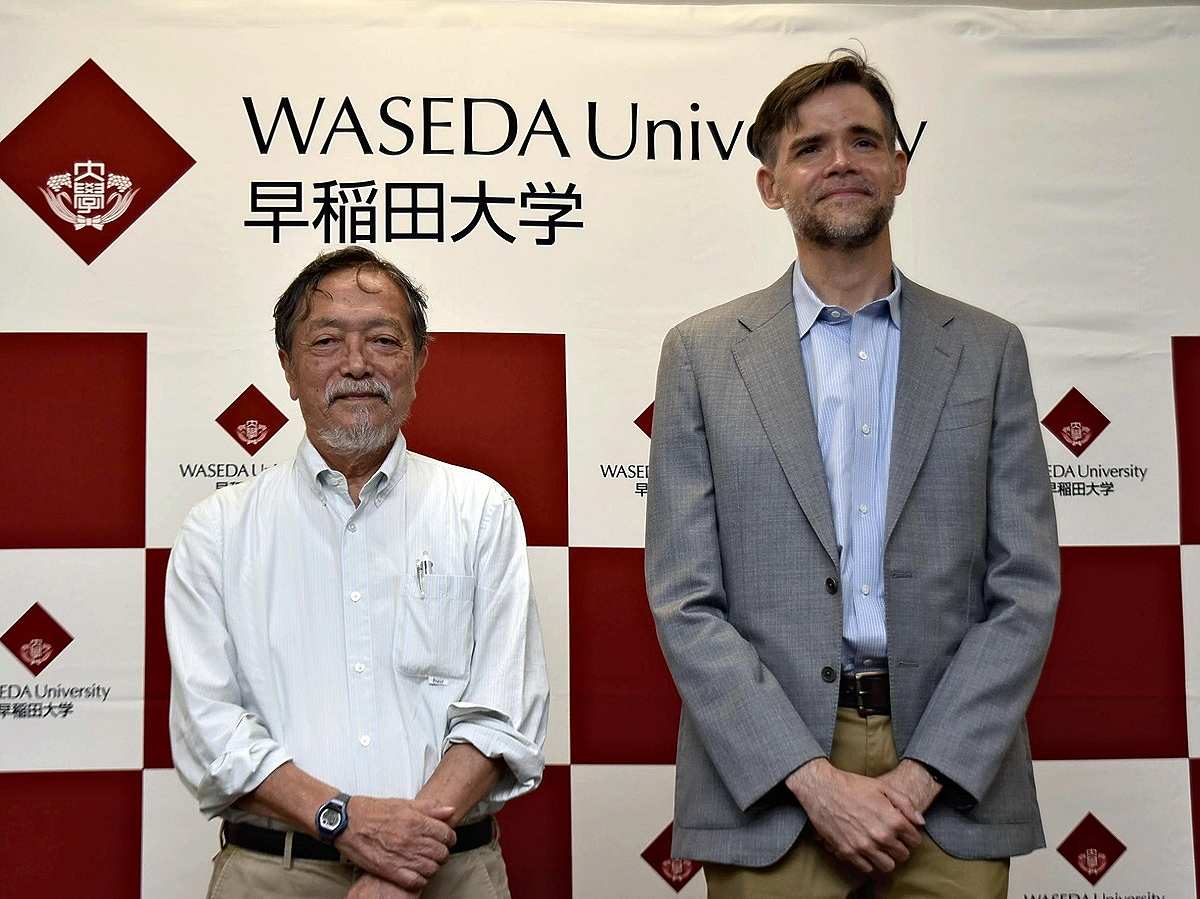
Natsuki Ikezawa, left, winner of the Tsubouchi Shoyo Award, and Gregory Khezrnejat, who received an honorable mention, pose for a photo at Waseda University in Shinjuku Ward, Tokyo, on Sept. 29.
17:00 JST, November 26, 2023
Waseda University announced that this year’s Tsubouchi Shoyo Award went to writer Natsuki Ikezawa, who has written various works, including novels and poems, and has even worked on translations while living in Japan and overseas.
Gregory Khezrnejat, who was born in the United States and writes novels in Japanese, received an honorable mention.
The two were recognized as writers who have “crossed the borders” of genres and languages.
“Receiving [this award] is a surprise, but it also gives me anxiety,” Ikezawa, 78, said at a press conference on Sept. 29. “I have been thinking that I could do something else by changing the form of my works to novels, poems, translating and editing. I think I can continue to write in good health for a while longer.”
In March, Ikezawa released the historical novel “Mata auhimade” (Until we meet again). The book depicts World War II and the postwar era through the perspective of his great-uncle, who was a naval officer.

The cover of “Mata auhimade” (Until we meet again) written by Natsuki Ikezawa
“I wanted to think about the war through the lens of what we know today,” he said. “I thought I could write it like I wrote other historical novels, such as ‘Shizukana Daichi’ (The quiet land).”
Khezrnejat’s second Japanese-language novel, “Kaikonchi” (The land under cultivation), was nominated for the Akutagawa Prize last winter.
“I’m very honored,” Khezrnejat said at the press conference. “Mr. Ikezawa has a huge collection of works, so I don’t think I should sit idle.”
At the press conference, the two spoke about the connection between language and literature.
“I think the future of the Japanese language lies in the fact that another language will be incorporated into Japanese and the language will change,” Ikezawa said. “I hope [Khezrnejat] will change [the literary world] with words that are not simply smooth and beautiful like in [typical] Japanese words.”
Khezrnejat writes while being surrounded by the Persian language spoken by his Iranian father, his native language of English, as well as the Japanese he was taught in school. He said he was influenced by multiple languages and cultures and expressed his desire to “write something new from a different angle than the dichotomy of Japan versus non-Japan.”




Most Read
Popular articles in the past 24 hours
-

Improvement of Japanese Language Schools Lags Rise in Foreigners
-

Japan's Test-Takers in Sapporo Offered Special Accommodation Arra...
-

Japanese Shipping Giants Halt Strait of Hormuz Transit as Iran Co...
-

Rental Lab Space in Tokyo Area More Than Doubles Since 2010, Offe...
-

U.S. Launches Attacks on Iran: Avoid Escalation of Conflict by An...
-
Parents of Japanese Teen Shot in U.S. Strive for Gun Control
-

Sawtooth Roof Factory Stands as Monument to Ashikaga Textile Hist...
-

Disinformation Spreads About Team Mirai, Ballot Readers; Online P...
Popular articles in the past week
-

Nepal Bus Crash Kills 19 People, Injures 25 Including One Japanes...
-
Milano Cortina 2026: Japanese Gold Medalist Figure Skater Miura S...
-

Tokyo Spends Big on Children, Wins Over Parents
-

McDonald's Japan Raises Prices; Big Mac to Cost ¥500, Double Chee...
-
‘Dry Bonsai’ Gives New Life to Withered Trees, Allows Free Artist...
-
Japan’s Miura, Kihara Announce Withdrawal from Figure Skating Wor...
-

Exhibition Featuring Yoshiharu Tsuge’s Manga World Underway in Ch...
-

Yokohama to Test Out Renewable-Powered Offshore Floating Data Cen...
Popular articles in the past month
-

Producer Behind Pop Group XG Arrested for Cocaine Possession
-

Japan PM Takaichi’s Cabinet Resigns en Masse
-

Man Infected with Measles Reportedly Dined at Restaurant in Tokyo...
-

Israeli Ambassador to Japan Speaks about Japan’s Role in the Reco...
-

Videos Plagiarized, Reposted with False Subtitles Claiming ‘Ryuky...
-

Man Infected with Measles May Have Come in Contact with Many Peop...
-

Prudential Life Insurance Plans to Fully Compensate for Damages C...
-

Woman with Measles Visited Hospital in Tokyo Multiple Times Befor...
Top Articles in Culture
-

BTS to Hold Comeback Concert in Seoul on March 21; Popular Boy Band Releases New Album to Signal Return
-

Director Naomi Kawase’s New Film Explores Heart Transplants in Japan, Production Involved Real Patients, Families
-

Tokyo Exhibition Offers Inside Look at Impressionism; 70 of 100 Works on ‘Interiors’ by Monet, Others on Loan from Paris
-
Traditional Japanese Silk Hakama Tradition Preserved by Sole Weaver in Sendai
-
Exhibition Featuring Yoshiharu Tsuge’s Manga World Underway in Chofu, Tokyo; Unique, Surreal Works Draw Steady Crowds
JN ACCESS RANKING
-
Producer Behind Pop Group XG Arrested for Cocaine Possession
-
Japan PM Takaichi’s Cabinet Resigns en Masse
-
Man Infected with Measles Reportedly Dined at Restaurant in Tokyo Station
-
Israeli Ambassador to Japan Speaks about Japan’s Role in the Reconstruction of Gaza
-
Videos Plagiarized, Reposted with False Subtitles Claiming ‘Ryukyu Belongs to China’; Anti-China False Information Also Posted in Japan