
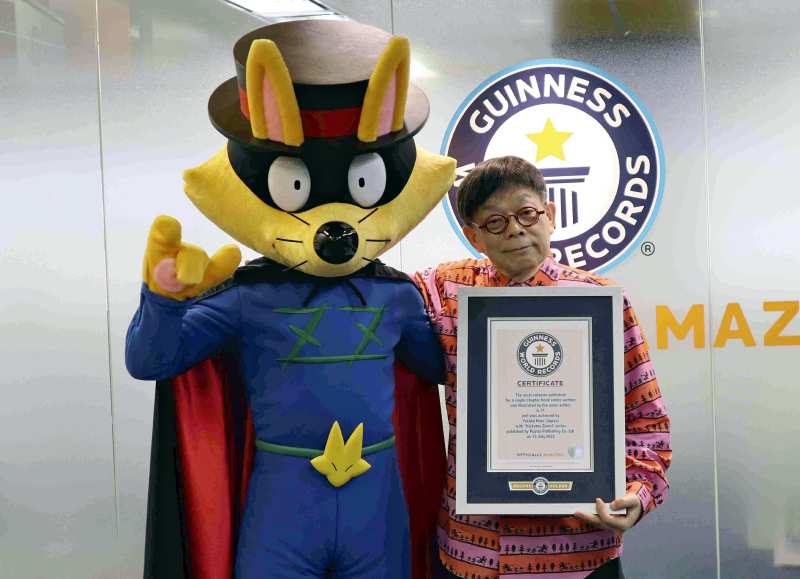
Yutaka Hara, right, shows his Guinness World Records certificate with Zorori at his side.
13:33 JST, November 30, 2022
“Kaiketsu Zorori,” a popular children’s book series by Yutaka Hara, has been certified by Guinness World Records for most volumes published for a single chapter book series written and illustrated by the same author.
An official Guinness certificate was awarded to Hara, 69, on Tuesday.
Poplar Publishing Co. in Tokyo began publishing the series in 1987. The books are about the funny adventures of Zorori, a fox aspiring to become the king of mischief, and his apprentice twin boars. The series is celebrating its 35th anniversary this year, and the total numbers of copies published has surpassed 35 million.
The 71st volume was published in July, which led to the certification by Guinness World Records on Oct. 24.
“I’m amazed that they certified the series,” Hara said. “I started this wishing to write something for my friends from the standpoint of a child, not from the standpoint of an adult.
“I don’t know how long I can continue to write, but I’ll do my best as long as children want [the series].”






Most Read
Popular articles in the past 24 hours
-

Voters Using AI to Choose Candidates in Japan's Upcoming General ...
-

Japan's Snow-Clad Beauty: Camellia Flowers Seen in Winter Bloom a...
-

Monkey Strikes Junior High School Girl from Behind in Japan's Yam...
-

Genichiro Inokuma's Mural in Ueno Station That Gave Hope in Postw...
-

Senior Japanese Citizens Return to University to Gain Knowledge, ...
-
Heavy Snow Linked to 30 Deaths across Japan since Late Jan.; JMA ...
-

Tokyo Police Arrest Head of Resignation Assistance Firm
-

Foreign and Security Policy: Political Parties Must Discuss How T...
Popular articles in the past week
-

Japan Institute to Use Domestic Commercial Optical Lattice Clock ...
-
Australian Woman Dies After Mishap on Ski Lift in Nagano Prefectu...
-
Foreign Snowboarder in Serious Condition After Hanging in Midair ...
-

Chinese Embassy in Japan Reiterates Call for Chinese People to Re...
-

Narita Airport, Startup in Japan Demonstrate Machine to Compress ...
-

Toyota Motor Group Firm to Sell Clean Energy Greenhouses for Stra...
-

Sakie Yokota, Last Surviving Parent of a North Korea Abductee, Ur...
-

Beer Yeast Helps Save Labor, Water Use in Growing Rice; Govt Hope...
Popular articles in the past month
-
Univ. in Japan, Tokyo-Based Startup to Develop Satellite for Disa...
-
JAL, ANA Cancel Flights During 3-day Holiday Weekend due to Blizz...
-

China Confirmed to Be Operating Drilling Vessel Near Japan-China ...
-

China Eyes Rare Earth Foothold in Malaysia to Maintain Dominance,...
-
M6.2 Earthquake Hits Japan's Tottori, Shimane Prefectures; No Tsu...
-
Japan Institute to Use Domestic Commercial Optical Lattice Clock ...
-

Japan, Qatar Ministers Agree on Need for Stable Energy Supplies; ...
-

Japan, Italy to Boost LNG Cooperation; Aimed at Diversifying Japa...
Top Articles in Culture
-

Junichi Okada Wears Three Hats in ‘Last Samurai Standing,’ Serving as Star, Producer, Action Choreographer in Thrilling Netflix Period Drama
-
Lifestyle at Kyoto Traditional Machiya Townhouse to Be Showcased in Documentary
-

Maison&Objet Kicks off Near Paris with Japanese Lighting Designers’ Installations on Display, Creating Rich Environment
-

‘Jujutsu Kaisen’ Voice Actor Junya Enoki Discusses Rapid Action Scenes in Season 3, Airing Now
-

Prestigious Japanese Literature Prize Names Toriyama, Hatakeyama as Winners
JN ACCESS RANKING
-
Univ. in Japan, Tokyo-Based Startup to Develop Satellite for Disaster Prevention Measures, Bears
-
JAL, ANA Cancel Flights During 3-day Holiday Weekend due to Blizzard
-
China Confirmed to Be Operating Drilling Vessel Near Japan-China Median Line
-
China Eyes Rare Earth Foothold in Malaysia to Maintain Dominance, Counter Japan, U.S.
-
Japan Institute to Use Domestic Commercial Optical Lattice Clock to Set Japan Standard Time