
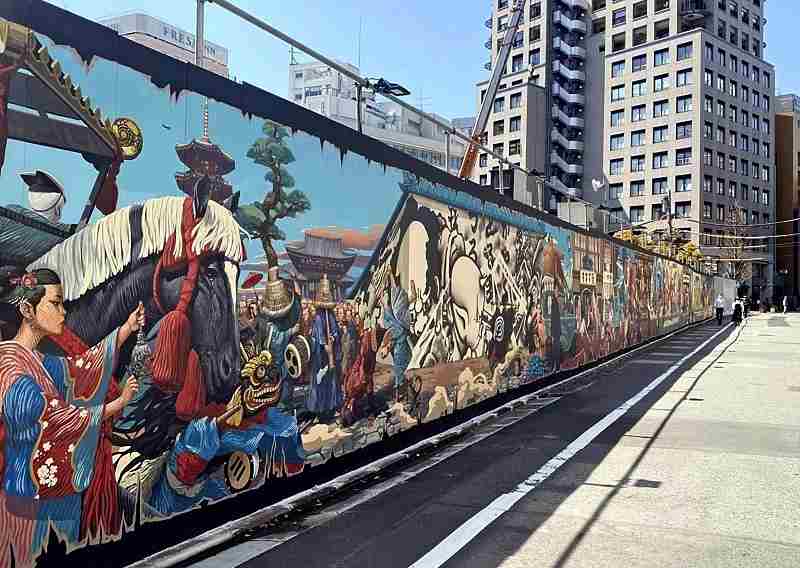
Walls covered with richly colored paintings including kimono-clad men and women, robots and skyscrapers are seen at a construction site in Kawasaki on March 24.
10:30 JST, April 23, 2021
Walking near Kawasaki Station after an interview the other day, I came across some impressive walls surrounding the construction site for the main building of Kawasaki City Hall.
The 3-meter-high walls, a combined 56 meters long, were covered with richly colored paintings ranging from kimono-clad men and women to robots, from mom-and-pop candy stores to skyscrapers.
It’s not graffiti but mural art authorized by the city. Five contemporary artists active in Japan and abroad have depicted the city, art and youth culture in the style of a picture scroll. The images in the mural stretch from the Edo period (1603-1867) to the present and into the future.
Kawasaki, which is promoting urban development utilizing street culture, commissioned the artists to create the mural. The walls have become a landmark, with people stopping to see the artwork.
There are more opportunities recently to see such artistic walls at construction sites. They appear to be spreading, thanks to the color they bring to dull construction sites and their help in preventing graffiti.
Last year, the Japan Construction Cooperative Combination held a competition for students to design construction site walls, to help improve the image of the sites and the construction industry. Seventy-six groups of students, ranging from high school students to graduate students, competed in the contest.
Construction site walls have also been used as a place for artists with disabilities to exhibit their works. Heralbony, a welfare-related service provider in Morioka, has offered the works of disabled artists to be used at more than 20 construction sites throughout the nation since 2018. Part of the proceeds it receives from the construction companies are paid to the creators and the facilities they are connected with.
According to a 2018 survey by the Japan Traffic Culture Association, 45% of respondents said that public art improves the image of spaces and facilities, and 35% said the art helps revitalize local communities.
With a little ingenuity, an inorganic, intimidating wall can be transformed into a place for interaction, conversation and understanding. Here’s hoping such public art galleries will spread further.




Most Read
Popular articles in the past 24 hours
-

Strait of Hormuz Closure Shakes Markets; Prolonged Closure Could ...
-

Iran Situation: Japan Must Exert Diplomatic Efforts without Merel...
-
2 of Japan's Opposition Parties Submit Bill to Revise Political F...
-
Chiba Police to Arrest Japanese National in Midair; Man Accused o...
-

U.S. Urges Citizens to Immediately Depart over A Dozen Middle Eas...
-

Trump Pursues Iranian Decapitation without a Plan for What Comes ...
-

Japanese Firms Ban Business Trips, Cancel Vacation Tours Amid Mid...
-

Bank of Japan and Markets: High Oil Prices Increase Difficulty of...
Popular articles in the past week
-

Milano Cortina 2026: Japanese Gold Medalist Figure Skater Miura S...
-
Tokyo Spends Big on Children, Wins Over Parents
-

Japan’s Miura, Kihara Announce Withdrawal from Figure Skating Wor...
-

Yokohama to Test Out Renewable-Powered Offshore Floating Data Cen...
-

BOJ Keeping Eye on Economy and Takaichi's ‘Proactive Fiscal Polic...
-
Tokyo Measles Patient Traveled to Fukuoka Aboard JAL Planes; Susp...
-
Japan’s Takaichi Speaks on New U.S. Tariff in Upper House, Says P...
-

Nidec Chairman Resigns Amid Accounting Scandal at Major Japanese ...
Popular articles in the past month
-

Producer Behind Pop Group XG Arrested for Cocaine Possession
-

Japan PM Takaichi’s Cabinet Resigns en Masse
-

Man Infected with Measles Reportedly Dined at Restaurant in Tokyo...
-

Israeli Ambassador to Japan Speaks about Japan’s Role in the Reco...
-

Videos Plagiarized, Reposted with False Subtitles Claiming ‘Ryuky...
-

Prudential Life Insurance Plans to Fully Compensate for Damages C...
-

Woman with Measles Visited Hospital in Tokyo Multiple Times Befor...
-

iPS Treatments Pass Key Milestone, but Broader Applications Far f...
Top Articles in Culture
-
BTS to Hold Comeback Concert in Seoul on March 21; Popular Boy Band Releases New Album to Signal Return
-

Director Naomi Kawase’s New Film Explores Heart Transplants in Japan, Production Involved Real Patients, Families
-

Tokyo Exhibition Offers Inside Look at Impressionism; 70 of 100 Works on ‘Interiors’ by Monet, Others on Loan from Paris
-
Traditional Japanese Silk Hakama Tradition Preserved by Sole Weaver in Sendai
-
Exhibition Featuring Yoshiharu Tsuge’s Manga World Underway in Chofu, Tokyo; Unique, Surreal Works Draw Steady Crowds
JN ACCESS RANKING
-
Producer Behind Pop Group XG Arrested for Cocaine Possession
-
Japan PM Takaichi’s Cabinet Resigns en Masse
-
Man Infected with Measles Reportedly Dined at Restaurant in Tokyo Station
-
Israeli Ambassador to Japan Speaks about Japan’s Role in the Reconstruction of Gaza
-
Videos Plagiarized, Reposted with False Subtitles Claiming ‘Ryukyu Belongs to China’; Anti-China False Information Also Posted in Japan